OEKO-TEX Certified Clothing Production in Turkey
The easiest certification to actually achieve at low volume, and the one most European retail buyers ask for first because it is about product safety rather than marketing.
- Standard
- OEKO-TEX STANDARD 100
- Product classes
- I baby, II skin contact, III, IV
- Minimum order
- 100 pcs / style, no uplift
- Proof
- Certificate number and issuing institute
Reviewed and updated 2026-08-09 by the Apparel Manufacturer Turkey production team in Istanbul, managing apparel production since 1995.
Quick answer
OEKO-TEX STANDARD 100 certifies that a textile has been tested for harmful substances against a defined limit list, in product classes from baby wear to home textiles. It is held by the mill or the finished article producer and identified by a certificate number. Most Turkish mills we buy from are certified, so OEKO-TEX fabric is available at our standard 100 piece minimum with no volume penalty.
What OEKO-TEX STANDARD 100 tests
STANDARD 100 tests the finished textile against a limit list covering restricted azo dyes, formaldehyde, heavy metals, phthalates, pesticides, chlorinated phenols and pH. It is stricter than REACH on several of these, so a STANDARD 100 certificate usually satisfies a REACH question at the same time.
It is a product safety standard, not an environmental or social one. It says nothing about water use, wages or organic fibre. Buyers who need those need GOTS or BSCI as well, and we say so rather than letting one certificate stand in for three.
Why this is the practical starting point
Unlike GOTS, OEKO-TEX does not force a dedicated dye lot, because the certificate belongs to the fabric quality rather than to your specific run. That means a 100 piece first order can be made in certified fabric at no volume penalty, which is why it is the certification we recommend brands start with.
For childrenswear it is effectively mandatory in most European retail. Product class I covers articles for babies and toddlers up to three years and has the tightest limits, and any serious retail buyer will ask for the class as well as the certificate.
- Class I: babies and toddlers up to 3 years, tightest limits
- Class II: articles with direct skin contact, most apparel
- Class III: articles without direct skin contact
- Class IV: furnishing materials
How the certificate is supplied on your order
You get the certificate number, the issuing institute and the validity date for the fabric used in your order, together with the fabric supplier name. That is what lets your compliance team verify it independently on the OEKO-TEX label check rather than taking a PDF on trust.
If you need the finished garment itself certified rather than the fabric, that is a separate certification held by the making-up factory. It exists, it costs more and it takes longer, and we will tell you whether your customer actually requires it or whether certified fabric is enough.
Which certification answers which question
| Is it safe to wear? | OEKO-TEX STANDARD 100 |
|---|---|
| Is the cotton organic? | GOTS or OCS |
| Is the factory ethical? | amfori BSCI or Sedex SMETA |
| Is it recycled? | GRS or RCS |
| Is it REACH compliant? | Largely covered by STANDARD 100 |
Planning a production run?
Send your tech pack or reference photos — clear quote with MOQ, sampling cost and lead time within one business day.
How production works
Send your enquiry
Share tech packs, sketches or reference garments together with target quantities and delivery dates.
Technical review
We assess fabrics, construction and printing requirements and match your project to the right production line.
Quotation
You receive a clear offer covering unit price, sampling cost, MOQ and production timeline.
Sampling
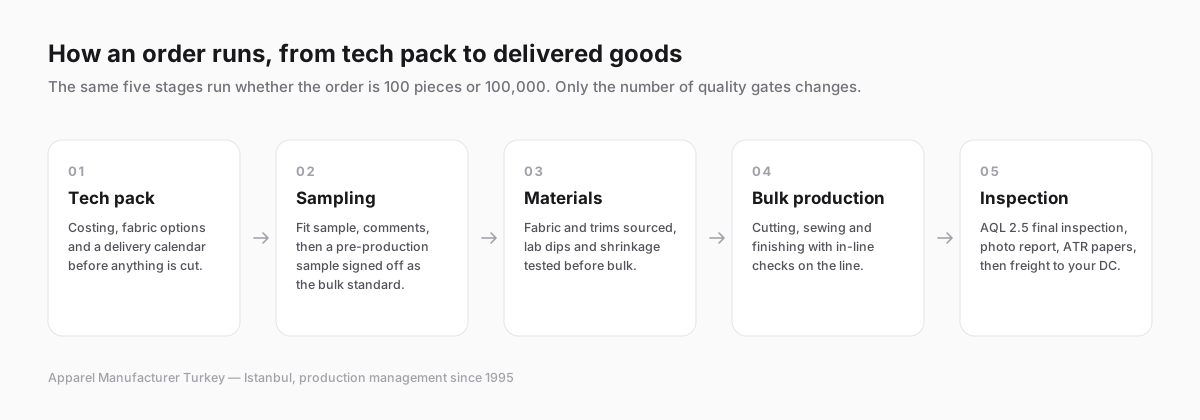
Pre-production samples are made for fit, fabric and print approval before any bulk fabric is cut.
Approval
You confirm the approved sample, quantities per size and colourway, labelling and packaging.
Bulk production
Cutting, sewing, printing, embroidery and finishing run under a production plan you can follow.
Quality control
Inline checks during production plus AQL final inspection before cartons are sealed.
Shipping
Road freight to Europe in 3-7 days, air or sea worldwide, with export documentation handled for you.
Frequently asked questions
Related pages
More in Manufacturing
Need certified fabric on your first order?
Send the styles and fabric qualities you want. We come back with certified options, the certificate numbers and a quote at your quantity.