DTF Printing Service in Turkey
Direct-to-film printing produces full-colour transfers that heat-press onto almost any fabric: cotton, polyester, blends, fleece, nylon panels. We use DTF inside production projects where its flexibility beats screens and DTG: small runs, mixed fabrics and multi-placement branding.
- Fabrics
- Cotton, poly, blends
- Colours
- Unlimited, one setup-free pass
- Small runs
- Economical from low volumes
- Application
- Heat press, controlled
Reviewed and updated 2026-08-06 by the Apparel Manufacturer Turkey production team in Istanbul, managing apparel production since 1995.
Quick answer
DTF printing produces full-colour transfers on PET film that heat-press onto almost any fabric, including polyester, blends and fleece where DTG underperforms. Priced by printed area rather than colour count, it has no meaningful minimum, so ApparelManufacturerTurkey.com uses it for small runs, neck labels and mixed-fabric productions, validating press parameters with wash tests before bulk.
How DTF printing works
DTF prints your artwork in reverse onto a PET film using pigment inks with a white backing layer, then a hot-melt adhesive powder is applied and cured onto the wet ink. The finished transfer is heat-pressed onto the garment, where the adhesive bonds the printed layer to the fabric, and the film peels away.
Because the print lives on the transfer rather than in the fibre, DTF is largely fabric-agnostic: it bonds to cotton, polyester, elastane blends, fleece and many technical fabrics that DTG cannot serve and screens struggle with. No pretreatment of the garment is needed.
Transfers can also be printed ahead of garments and stored, which is operationally useful: one print run can cover neck prints across several styles, or a drop can be decorated in stages as garments come off the sewing line.
Where DTF genuinely beats the alternatives
Small runs are the clearest case. With no screens and no per-colour setup, a 50-piece run with full-colour artwork is economical on DTF where screen printing would drown in setup cost. That makes it the default for samples, limited drops and colourway-specific artwork inside larger productions.
Polyester and blend fabrics are the second case. Sports jerseys, poly-rich fleece and nylon-panelled garments take DTF cleanly, where DTG would wash out and dye-sublimation would be limited to light polyester. Migration-blocking layers can be specified for sublimated polyester where dye bleed is a risk.
Fine detail at small sizes is the third: DTF holds thin lines and small text better than screen printing at equivalent cost, which is why inside-neck size prints and care prints are very often DTF in modern production, including as a replacement for sewn-in labels.
- No setup: full colour economical at low volumes
- Bonds to cotton, polyester, blends and fleece
- Sharp small text: ideal for neck prints
- Transfers can be pre-produced and stored
- Same artwork reusable across multiple styles
Durability and hand feel, stated honestly
A quality DTF transfer, correctly pressed at the right temperature, pressure and dwell time, withstands repeated washing well: the industry expectation for good materials is dozens of wash cycles without cracking or peeling, and failures usually trace to cheap films or rushed pressing rather than to the method itself.
Hand feel is DTF's main trade-off. The print sits on the fabric as a thin flexible layer, comparable to a light plastisol print, with a slightly plastic touch on large solid areas. Small logos and text are barely noticeable; an oversized full-coverage back piece will be felt, and we say so before you order one.
Elasticity is decent for normal garment stretch, but heavily ribbed or extremely stretchy placements can crack any film-based print over time. On those placements we recommend embroidery or repositioning the artwork.
Cost structure and minimums
DTF is priced by printed area: transfers are ganged onto film by the linear metre, so a sheet full of small logos costs little per logo, while large back prints consume film quickly. Colour count is irrelevant to price, and there are no screens or pretreatment steps to pay for.
There is no meaningful technical minimum; DTF decorates single samples as economically as it does hundreds of garments. Within our projects, the manufacturing minimum of 100 pieces per style defines the order, and DTF can decorate any portion, including different artwork per colourway at no setup penalty.
At higher volumes with simple artwork, screen printing overtakes DTF on unit price and delivers better hand feel on large areas. We quote both when a run sits near the crossover so you can choose on numbers.
Quality control for transfers in production
Press parameters are where DTF quality is won or lost. Temperature, pressure and time are set per fabric and verified on production garments, and wash tests on pressed samples validate the combination before bulk decoration. A transfer applied at the wrong settings can look perfect and fail in a month, so we do not skip this step.
Placement is jigged for consistency across the run, with the same millimetre-level tolerance discipline as screen printing. Peel quality, edge adhesion and colour against the approved sample are inspected during application, and decorated garments pass through final inspection with everything else.
You approve a pressed sample on the actual fabric before bulk. Film proofs and screen previews do not substitute, since fabric texture and colour change how the transfer reads.
Planning a production run?
Send your tech pack or reference photos — clear quote with MOQ, sampling cost and lead time within one business day.
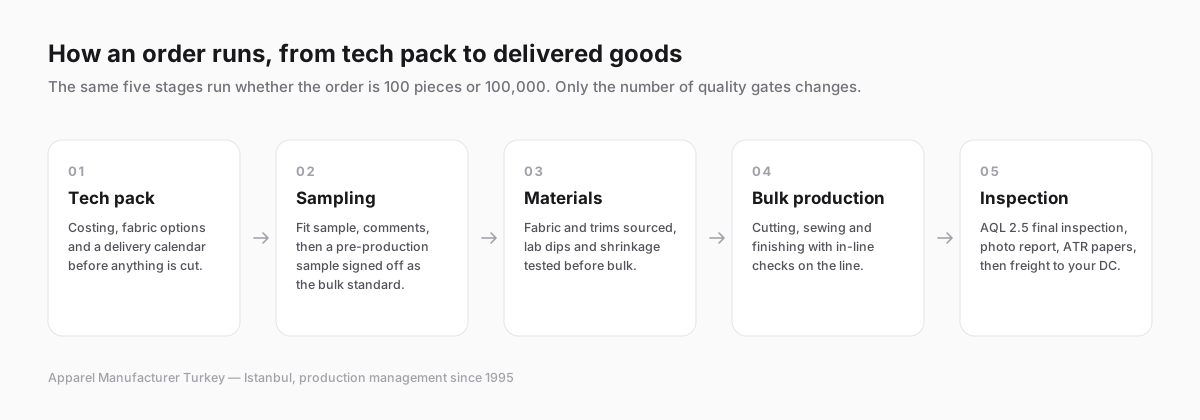
How production works
Send your enquiry
Share tech packs, sketches or reference garments together with target quantities and delivery dates.
Technical review
We assess fabrics, construction and printing requirements and match your project to the right production line.
Quotation
You receive a clear offer covering unit price, sampling cost, MOQ and production timeline.
Sampling
Pre-production samples are made for fit, fabric and print approval before any bulk fabric is cut.
Approval
You confirm the approved sample, quantities per size and colourway, labelling and packaging.
Bulk production
Cutting, sewing, printing, embroidery and finishing run under a production plan you can follow.
Quality control
Inline checks during production plus AQL final inspection before cartons are sealed.
Shipping
Road freight to Europe in 3-7 days, air or sea worldwide, with export documentation handled for you.
Frequently asked questions
Related pages
Flexible printing for real production
Send artwork and fabric details to info@apparelmanufacturerturkey.com and we will confirm if DTF fits, with area-based pricing and wash-test validation.