How to Find a Clothing Manufacturer in Turkey
Turkey is one of the world's largest apparel exporters, but the best factories rarely advertise. This guide covers the four channels that actually work, how to vet a factory before you wire money, and the warning signs that should end a conversation early.
- Main hubs
- Istanbul, Izmir, Bursa, Denizli
- Typical MOQ
- 100-1,000 pcs per style
- Sampling
- 1-2 weeks
- Bulk production
- 4-6 weeks
Reviewed and updated 2026-07-31 by the Apparel Manufacturer Turkey production team in Istanbul, managing apparel production since 1995.
Quick answer
The four channels that reliably surface Turkish clothing manufacturers are trade fairs such as IFCO and Texhibition, B2B directories like TurkishExporter and IHKIB's member list, sourcing agents charging roughly 5-15 percent, and referrals. Contact ten to fifteen candidates, vet three to five, sample with two or three, and verify legal identity, certificates and export history before paying any deposit.
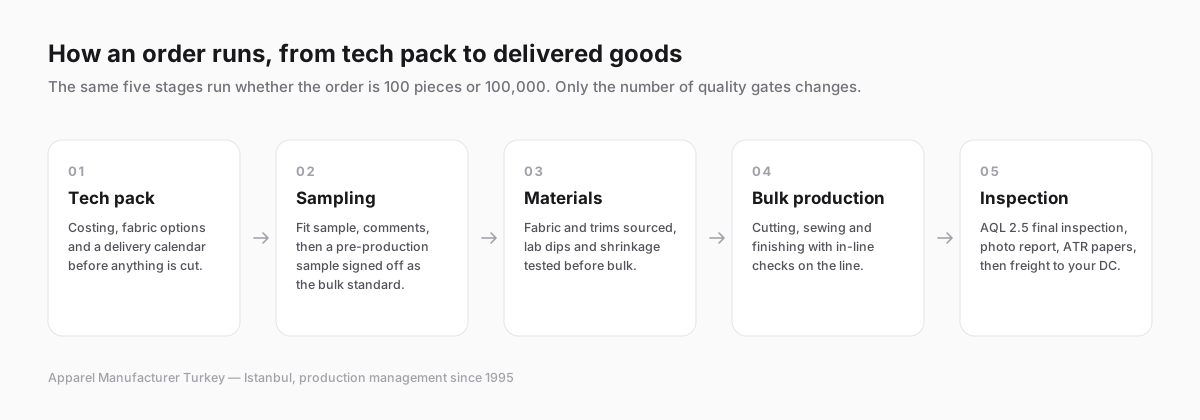
Why Turkey, and why finding a factory is harder than it looks
Turkey combines a full vertical supply chain with proximity to Europe. Fabric mills in Bursa and Denizli, printing and embroidery houses, trim suppliers and sewing factories all sit within a few hours of each other, which is why sampling can move in one to two weeks rather than the four to six weeks common with long-distance sourcing. Road freight reaches most of Europe in three to seven days, and Turkish factories are used to European sizing, labelling and compliance expectations.
The difficulty is that the strongest factories are usually busy with existing export clients and invest little in marketing. What you find on page one of a search engine is often a trading company or an agency, not the factory itself. That is not automatically bad, but you should know who you are actually dealing with before you commit, because it affects price, communication and accountability when something goes wrong.
Plan to contact ten to fifteen candidates, shortlist three to five, sample with two or three, and place your first bulk order with one. Treating the search as a funnel rather than a hunt for a single perfect partner keeps you from over-committing to the first factory that replies quickly.
Channel 1: Trade fairs
Trade fairs remain the fastest way to meet many manufacturers face to face and to handle their actual production quality. In Turkey, the main events are Istanbul Fashion Connection (IFCO) for finished apparel and denim, and Texhibition Istanbul for fabrics and yarns. Internationally, Turkish manufacturers exhibit heavily at Munich Fabric Start, Premiere Vision Paris and Texworld.
Go with a one-page brief: product category, target quantities, fabric preferences and launch timing. Collect samples and business cards, take photos of the stands you like, and note which exhibitors are actual factories versus export agencies. Ask directly where production happens and whether you could visit; genuine factories answer without hesitation.
The weakness of fairs is timing and cost. They run only a few times a year and a trip to Istanbul has real expense, so most brands combine one fair visit with the online channels below rather than relying on fairs alone.
Channel 2: B2B platforms and directories
Online directories give you volume quickly. For Turkey specifically, look at TurkishExporter, Tradeatlas and the member directories of exporter associations such as IHKIB (Istanbul Apparel Exporters' Association). Global platforms like Alibaba and Fibre2Fashion list Turkish suppliers too, though Turkish factories are far less active there than Chinese ones, so a thin platform presence does not mean a weak factory.
Treat platform profiles as leads, not verified facts. Certifications, machine counts and client lists shown on a profile page should all be re-verified directly: ask for certificate PDFs with scope and expiry dates, and check certificate numbers against the issuer's public database where one exists, such as the GOTS and OEKO-TEX online validity checks.
Expect a response rate of roughly one in three to one in five on cold platform outreach. A specific, professional first message with a tech pack or clear reference photos, quantities and a timeline will dramatically outperform a vague request for a price list.
Channel 3: Sourcing agents and production managers
A sourcing agent or production management company sits between you and a network of factories. A good one matches your product to the right factory, handles communication in Turkish, checks quality during production and consolidates shipping. Agents typically charge either a commission of around five to fifteen percent on the order value or build their margin into the unit price.
Agents earn their fee when you are new to the market, when your order spreads across several product types that no single factory makes well, or when you cannot visit Turkey for inspections. They are less compelling once you have direct, proven relationships with one or two factories and enough volume to get their attention on your own.
Vet an agent as rigorously as a factory. Ask which factories they work with and whether you may know the factory identity, how quality issues have been handled in the past, and whether they take responsibility for defects in writing. An agent who refuses to ever disclose factories or to put remedies in writing is asking you to carry all the risk.
Channel 4: Direct outreach and referrals
Some of the best factory relationships start with a referral from another brand founder, a freelance pattern maker or a fabric agent who knows who actually sews well. Ask in founder communities, at industry meetups and among any contacts who already produce in Turkey. A referral skips much of the trust-building that cold outreach requires.
You can also work backwards from products. Garment care labels show country of origin, and LinkedIn searches for production or merchandising managers at Turkish apparel companies can surface factories that never appear in directories. Export data services list which Turkish companies ship apparel to which countries, which is useful for confirming that a factory genuinely exports.
Whatever the channel, your first email should include what you make, quantities per style and colour, target dates, and a tech pack or clear references. Factories triage enquiries daily; the specific ones get answered first.
The vetting checklist
Before sampling, verify the basics. Before bulk, verify everything on this list. None of these checks is exotic; together they filter out most bad outcomes.
- Legal identity: registered company name, tax number and address, and whether you are dealing with a factory, an agent or a trader.
- Product fit: they already produce your category at your quality level; ask for photos or physical samples of comparable work.
- Capacity and MOQ: their minimums and monthly capacity fit your order size, so you are neither too small to matter nor too big to handle.
- Certifications: valid, in-scope certificates (for example OEKO-TEX, GOTS, BSCI or Sedex) verified with the issuer, not just a logo on a website.
- References: contact details for one or two current export clients, or credible evidence of export history.
- Communication: a named contact who answers questions in writing within one to two business days during the quoting stage.
- Sampling terms: sample cost, timeline and whether sample fees are credited against the bulk order.
- Payment terms: a standard structure such as 30-50 percent deposit with balance before shipment, paid to the company's bank account, never a personal one.
- Quality terms: agreed measurement tolerances, an AQL inspection standard and a written policy on defects and remakes.
- A visit or video tour: an in-person audit is best; a live video walkthrough of the sewing floor is the minimum.
Red flags that should end the conversation
Most sourcing disasters announce themselves early. The pattern is nearly always the same: pressure to pay quickly, vagueness about identity, and prices that ignore the cost of making the product properly.
Walk away, or at least slow down sharply, when you see any of the following.
- Payment requested to a personal bank account, via money transfer services, or 100 percent upfront before any samples exist.
- No verifiable address, no company registration details, or a refusal to do a live video call from the factory floor.
- Prices far below every other quote; in apparel, a price 30-40 percent under the market usually means fabric substitution or subcontracting to an unknown workshop.
- Yes to everything: any fabric, any MOQ, any deadline, any certification, without a single clarifying question about your tech pack.
- Certificates that are expired, out of scope, or whose numbers do not validate with the issuing body.
- Pressure tactics such as a price that expires in 24 hours or claims that capacity disappears unless you pay a deposit today.
- Refusal to sew a paid sample first, insisting instead that you commit to bulk to see quality.
From shortlist to first order
Once two or three factories pass vetting, order paid samples from each using the same tech pack. Comparing identical briefs is the only fair test: judge measurement accuracy against your spec, seam quality inside the garment, fabric hand feel, and how each factory communicated during the two weeks of sampling.
Start your first bulk order small even if the unit price stings. A first run of 100 to 500 pieces per style teaches you how the factory performs under real deadlines while your exposure stays manageable. Confirm everything in a written pro forma invoice: quantities per size and colour, unit prices, tolerances, packing, Incoterms, dates and payment schedule.
Plan to be present, personally or through a third-party inspector, at the final AQL inspection of your first order. After one or two clean orders you can relax to remote checks, but the first inspection sets the standard for the entire relationship.
Sourcing channels compared
| Trade fairs | Best quality signal, in-person contact; slow and costly, a few events per year |
|---|---|
| B2B platforms | Fast and free to search; profiles unverified, response rates of 20-35 percent |
| Sourcing agents | Local expertise and QC included; 5-15 percent commission, less factory transparency |
| Referrals and direct outreach | Highest trust, pre-vetted; depends on your network and takes time to build |
Planning a production run?
Send your tech pack or reference photos — clear quote with MOQ, sampling cost and lead time within one business day.
Frequently asked questions
Related pages
Skip the cold outreach
We manage production through a vetted network of Istanbul-based manufacturers, with MOQs from 100 pieces per style and sampling in 1-2 weeks. Send your project to info@apparelmanufacturerturkey.com and we will match it to the right factory.