Questions to Ask a Clothing Manufacturer
The quality of your first conversation with a manufacturer predicts the quality of your first order. This checklist organises the questions worth asking by topic, explains what a good answer sounds like, and flags the answers that should worry you.
- Checklist topics
- 6 areas, 30+ questions
- Best format
- Video call + written follow-up
- Decisive topics
- QC and capacity honesty
- Time needed
- One 45-60 minute call
Reviewed and updated 2026-08-02 by the Apparel Manufacturer Turkey production team in Istanbul, managing apparel production since 1995.
Quick answer
Before ordering, ask a clothing manufacturer about six areas: company identity and factory ownership, product specialisation, MOQs and capacity in real numbers, sampling terms and timelines, quality control (which AQL level, whether third-party inspectors are welcome) and payment structure. Strong answers are specific and quantified; vague reassurances like 'no problem' or 'we check everything' are warning signs.
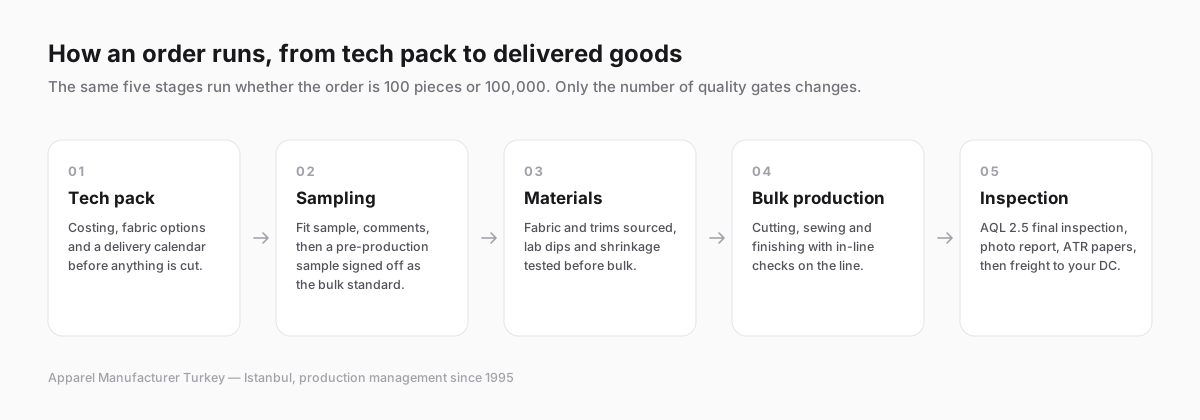
How to run the conversation
Do not send a supplier thirty questions in one email; you will get thin answers to all of them. Instead, hold a video call for the questions where tone and hesitation carry information, capacity, subcontracting, problem history, and use written follow-up for the factual items you want on record, minimums, prices, tolerances, lead times.
Listen for specificity. Good factories answer in numbers and examples: our line does about 4,000 basic tees a week, we hold plus or minus 1 centimetre on chest width, our last delayed order was in spring because a fabric lot failed shade approval and we recut. Weak or evasive counterparties answer in adjectives: high quality, very fast, no problem. The phrase no problem, delivered instantly to every question, is itself a warning sign.
Capacity and experience
You are trying to learn two things: whether your order is the right size for this factory, and whether they have made your product type before. A factory where your order is under 2 percent of monthly capacity will deprioritise you the moment a big customer sneezes; a factory where you would be 50 percent of capacity may miss dates for the opposite reason. The comfortable zone is roughly 5 to 20 percent.
Product experience matters more than general experience. A superb woven shirt factory can be mediocre at fleece. Ask what they cut most, every week, and ask to see photos of recent production in your exact category.
- How many machines and operators do you have, and what is weekly output for a product like mine?
- What products do you produce most often, and for which markets?
- What is your MOQ per style and per colourway, and is it negotiable on repeat orders?
- Do you sew everything in-house, and which processes, printing, embroidery, washing, are outsourced?
- If parts are subcontracted, who inspects the subcontractor's output?
- What is your current lead time from deposit to ex-factory, and how does it change in peak season?
Fabrics and materials
Fabric is typically 50 to 70 percent of a garment's cost and the source of most quality disputes, so probe how the factory sources and controls it. In Turkey most garment factories buy fabric from nearby mills rather than knitting in-house, which is fine, but you want to know whether they test what arrives or just sew whatever the mill sends.
Ask how fabric weight is verified on receipt; the right answer mentions cutting and weighing GSM swatches from incoming rolls. Ask what shrinkage they guarantee after the first wash; for cotton knits, answers around 5 percent or better with compacting are normal. Ask whether they can provide certified fabrics if you need them, organic cotton or recycled polyester with valid transaction certificates, and be aware that certification affects both price and minimums.
- Where do you source fabric, and can I approve lab dips and fabric swatches before bulk?
- How do you check incoming fabric for GSM, shade and defects?
- What shrinkage tolerance do you work to after wash testing?
- Can you supply GOTS or GRS certified fabric with documentation, and what does it change in price and MOQ?
- What happens if bulk fabric arrives off-shade or off-weight, who bears the cost and delay?
Quality control and problem history
Every factory says quality is important; the differentiating question is what they can describe procedurally. Ask them to walk you through what happens between sewing and packing. A real answer involves inline checks during sewing, a measurement check against the size chart, trimming and final inspection with a defect classification, and ideally a named standard such as AQL 2.5 for finished goods.
The single most revealing question in this whole guide is about failure: tell me about the last order that went wrong and what you did. Factories that produce at scale all have problems sometimes; honest ones describe a specific incident and the fix. A supplier who claims to have never had a problem is either brand new or not telling the truth, and neither is reassuring.
Also confirm they welcome third-party inspection. Any hesitation here is disqualifying, since agencies inspect factories across Turkey daily and the request is completely routine.
- Walk me through your QC steps from cutting to packed cartons
- What AQL level do you apply at final inspection, and can I see a recent report format?
- What are your measurement tolerances on key points of measure?
- Tell me about your last quality failure and how it was resolved
- Are you open to third-party inspection before balance payment?
Compliance, social and chemical
If you sell in the EU or UK, or plan to approach retailers, compliance stops being optional. Ask whether the factory has current social audits, BSCI or Sedex/SMETA are the common frameworks in Turkey, and ask for the audit date rather than just the logo, because audits expire. For chemical safety, ask whether fabrics and prints comply with REACH restrictions, and whether OEKO-TEX Standard 100 certificates are available for the fabrics they propose.
For smaller factories, a missing audit is not automatically disqualifying, many excellent workshops simply have not paid for one, but the factory should be able to discuss working hours, wages and fire safety openly and should not resist a visit. Evasiveness about who actually sews your goods is a bigger warning sign than a missing certificate.
Logistics, payment and communication
Close the call with the operational questions that determine what working together actually feels like. Confirm which Incoterms they quote in, what export documents they routinely prepare, ATR for the EU and EUR.1 for the UK should be routine words, and how goods are packed, poly bags, carton specs, barcoding if your 3PL needs it.
On payment, the standard answer is 30 to 50 percent deposit and balance after inspection; note the red flags covered in our scam-avoidance guide if you hear anything stranger. Finally, agree the communication rhythm: who is your contact, in what language, how quickly do they answer, and will you get proactive updates at cutting, sewing and packing, or only when you chase. Send a one-line question after the call and quietly time the response.
- Which Incoterms do you quote, and which documents do you prepare for my destination?
- What is your standard payment structure for new customers?
- How will goods be packed, and can you follow my 3PL's carton and labelling requirements?
- Who will be my day-to-day contact, and what is your response time across time zones?
- Will I receive photo updates at cutting, mid-production and packing?
Answer quality: what to listen for
| Capacity | Good: numbers per week. Weak: we are very big, no problem |
|---|---|
| Fabric control | Good: we weigh GSM from every incoming lot. Weak: our mills are the best |
| QC | Good: named AQL level, sample report offered. Weak: we check everything |
| Failure history | Good: specific story with a fix. Weak: we never have problems |
| Inspection | Good: third parties welcome any time. Weak: not necessary, trust us |
Planning a production run?
Send your tech pack or reference photos — clear quote with MOQ, sampling cost and lead time within one business day.
Frequently asked questions
Related pages
Skip the cold-calling stage
We have already asked these questions, on site, of every manufacturer in our network. Send your project to info@apparelmanufacturerturkey.com and start from a shortlist that has passed the checklist.