Clothing Factory in Turkey
How to get your clothing made in a Turkish factory as a brand: what going direct really involves, where a managed route earns its keep, and how minimums and pricing actually work. We are honest about our model - we manage production across vetted factories, we are not one plant.
- MOQ
- 100 pcs / style
- Colour split
- Free within the style total
- Sampling
- 1-2 weeks
- Bulk lead time
- 4-6 weeks
Reviewed and updated 2026-08-01 by the Apparel Manufacturer Turkey production team in Istanbul, managing apparel production since 1995.
Quick answer
Brands can work with a clothing factory in Turkey either directly or through a managed production partner. Direct contact can shave margin but demands technical files, on-the-ground follow-up and factory vetting. A managed route through a vetted network offers MOQs from 100 pieces, sampling in 1-2 weeks and accountable quality control under one contract.
How big we are, in numbers you can hold us to
Capacity headlines are easy to publish and impossible to check. What decides whether your order lands on time is narrower: whether the capacity was reserved in writing against your dates before fabric was bought, whether the plant was built for your product, and what the goods are inspected to before they leave Turkiye. Those are the numbers we commit to on every order.
- In Turkish apparel production
- 31 years
- Minimum order
- 100 pcs per style
- Sampling
- 1-2 weeks
- Bulk production
- 4-6 weeks
- Road freight to the EU
- 3-7 days
- Final inspection
- AQL 2.5 (1.5 on request)
Above 10,000 pieces we allocate lines and reserve them against your delivery dates before materials are ordered, then report output weekly. That is what stops a larger customer pushing your programme down the queue in week three.
Two ways into a Turkish clothing factory
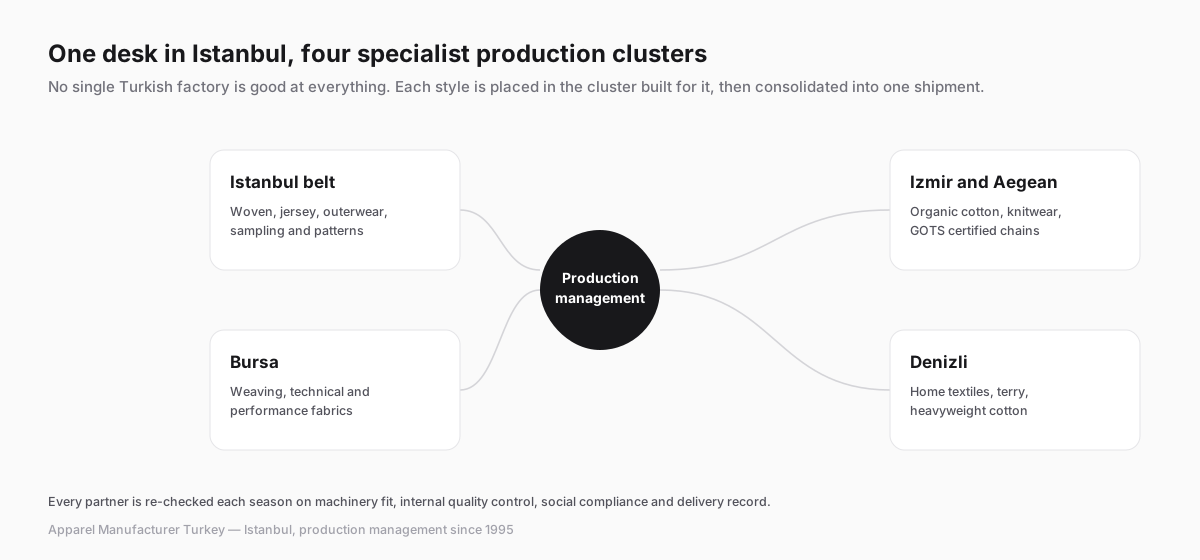
Every brand producing in Turkey ends up on one of two paths. The first is direct: you find a factory yourself, negotiate, and manage the order from your desk abroad. The second is managed: a production partner on the ground places your order inside a vetted factory network and runs it for you. Both paths lead to the same sewing lines; what differs is who carries the risk between your tech pack and your delivered cartons.
We run the second model, and we state it plainly because plenty of intermediaries do not: we are an Istanbul-based production management company, not a factory. When you work with us, your clothing is made in an audited Turkish factory matched to your product, and we are contractually responsible to you for the result.
Neither path is universally right. This page lays out the trade-offs so you can choose with open eyes rather than discovering them mid-order.
What going direct really requires
Direct-to-factory works well when three things are true: your volumes are large enough to matter to the factory, your team can produce complete tech packs and answer technical questions within hours, and someone can be physically present at critical moments - fit approvals, pilot runs, final inspection. Large brands run regional offices precisely to supply these three things.
Without them, direct relationships degrade predictably. Your emails answer slowly because bigger customers shout louder. A fabric substitution happens without sign-off because nobody was there to refuse it. The final inspection is the factory grading its own homework. None of this means Turkish factories are dishonest; it means an unmanaged order from a small foreign customer is nobody's priority.
If you have the volume and the team, going direct is legitimate and we would rather tell you that than oversell ourselves. Our guide on finding a clothing manufacturer in Turkey covers how to do it properly.
Minimums and how factory pricing is built
Turkish clothing factories price from fabric consumption, fabric cost, trims, sewing minutes at the line's minute rate, decoration, packing, overhead and margin. Two consequences follow. First, unit prices fall with volume mainly because sampling, marker making and line setup are fixed costs spread over more pieces - not because sewing gets cheaper. Second, spec changes move price more than negotiation does.
Minimums exist because setting up a line for a style costs the same whether you run 300 pieces or 3,000. Export-focused factories often decline orders under 1,000 pieces per style; through our network we produce from 100 pieces per style, because we place small programmes with factories sized for them and consolidate our clients' volume into a relationship factories take seriously.
Communication: where clothing orders go wrong
Most production failures are communication failures wearing a quality costume. A measurement chart interpreted differently, a Pantone approved on screen instead of on fabric, a delivery date that was always aspirational - each is preventable with disciplined, documented communication in a shared technical language.
Working through us, every approval is written: sample comments, fabric and colour standards, size set sign-offs, packing instructions. Our team works in English day to day and in Turkish on the factory floor, which is where nuance otherwise gets lost. When something does go wrong - it occasionally does in any factory - you have one accountable counterparty instead of a WhatsApp thread gone quiet.
The risks of going direct without vetting
The failure cases we are asked to rescue share a pattern. A brand found a factory online or at a fair, prices were attractive, early samples were fine, and then: bulk fabric differed from the approved sample, sizes drifted, delivery slipped six weeks into the season, or the counterparty turned out to be an unvetted middleman rather than the factory in the photos. Deposits paid to the wrong entity are rarely recovered.
Vetting is the difference. Before any partner factory enters our network we verify its legal identity, audit status, machine park and financial standing, and we watch its performance on live orders. If you go direct, replicate as much of that as you can: visit before paying, verify the trade registry record, insist on a pilot order, and never let the final inspection be the factory's alone. Our guide on avoiding manufacturing scams goes deeper.
What a managed route costs and returns
A managed route is not free, and anyone implying otherwise is hiding their margin inside your unit price. What you gain for that cost is concrete: factory selection matched to your product, MOQs from 100 pieces, sampling in 1-2 weeks, bulk in 4-6 weeks, independent AQL inspection, and export paperwork including ATR certificates for duty-free EU entry with road freight arriving in 3-7 days.
The honest comparison is not our price against a factory's price; it is our price against a factory's price plus your flights, your time, your defect risk and your season if it slips. For most small and mid-size brands, that comparison is why they stay after the first order.
Direct to factory vs managed production
| Factory access | Direct: your own search. Managed: vetted network matched to product |
|---|---|
| MOQ | Direct: often 1,000+ pcs/style. Managed: from 100 pcs / style |
| Vetting | Direct: your due diligence. Managed: audits plus live-order track record |
| Communication | Direct: factory English varies. Managed: one English-speaking team |
| Quality control | Direct: factory self-inspects. Managed: independent AQL inspection |
| Accountability | Direct: contract with factory abroad. Managed: one accountable partner |
| Best for | Direct: high volume with own team. Managed: 300-20,000 pcs programmes |
Planning a production run?
Send your tech pack or reference photos — clear quote with MOQ, sampling cost and lead time within one business day.
How production works
Send your enquiry
Share tech packs, sketches or reference garments together with target quantities and delivery dates.
Technical review
We assess fabrics, construction and printing requirements and match your project to the right production line.
Quotation
You receive a clear offer covering unit price, sampling cost, MOQ and production timeline.
Sampling
Pre-production samples are made for fit, fabric and print approval before any bulk fabric is cut.
Approval
You confirm the approved sample, quantities per size and colourway, labelling and packaging.
Bulk production
Cutting, sewing, printing, embroidery and finishing run under a production plan you can follow.
Quality control
Inline checks during production plus AQL final inspection before cartons are sealed.
Shipping
Road freight to Europe in 3-7 days, air or sea worldwide, with export documentation handled for you.
Frequently asked questions
Related pages
More in Manufacturing
Get your clothing made in the right factory
Send your designs or tech packs to info@apparelmanufacturerturkey.com. We will match them to a vetted Turkish factory and quote MOQ, price and timeline within days.