Clothing Quality Standards Guide
Quality is only enforceable if it is defined. This guide explains the AQL 2.5 inspection system used across the apparel industry, sensible measurement tolerances, and the small set of lab tests that verify a fabric will survive real use.
- Industry norm
- AQL 2.5 for major defects
- Typical tolerance
- Plus or minus 1 cm on majors
- Key lab tests
- Shrinkage, colourfastness, pilling
- GSM check
- Circular cutter plus scale
Reviewed and updated 2026-08-06 by the Apparel Manufacturer Turkey production team in Istanbul, managing apparel production since 1995.
Quick answer
Enforceable clothing quality means three written standards: AQL 2.5 inspection for major defects (the apparel industry norm), measurement tolerances of about plus or minus 1 cm on major points of measure, and a small set of lab tests covering shrinkage (within roughly 5 percent on knits), wash and rub colourfastness around grade 4, and pilling around grade 4.
Why Standards Beat Promises
Every factory promises good quality; the phrase costs nothing. What changes outcomes is agreeing measurable acceptance criteria before production: which defects are counted, how many are tolerable, what measurement deviations are acceptable, and which lab results the fabric must achieve. With criteria on paper, an inspection is arithmetic; without them, it is an argument.
The apparel industry has ready-made tools for this, and none of them require you to be a textile engineer. AQL sampling handles workmanship, a tolerance column in your tech pack handles dimensions, and a handful of standard lab tests handle fabric behaviour. This guide walks through each.
Put the criteria in your order documents. A line in the purchase order stating that goods are subject to final inspection at AQL 2.5 major, 4.0 minor, against tech pack version X, converts everything below from good intentions into contract terms.
AQL 2.5, Explained Without the Jargon
AQL stands for Acceptance Quality Limit, and it comes from the ISO 2859-1 sampling standard. Instead of checking every garment, an inspector checks a statistically defined random sample and counts defects. The AQL number describes the defect level the sampling plan is designed to accept; AQL 2.5 is the common apparel norm for major defects, usually paired with AQL 4.0 for minor defects.
Defects are classified before counting. A critical defect makes the product unsafe or unsellable, such as a needle fragment, and the usual tolerance is zero. A major defect would likely cause a customer return: a hole, a broken seam, a large stain, a wrong label. A minor defect is a small imperfection most customers would not return over, such as a loose untrimmed thread.
The sampling plan itself comes from tables. For a typical order under general inspection level II, the order quantity gives a code letter, the code letter gives a sample size, and the AQL column gives the accept and reject numbers. As a hypothetical example, a 1,000-piece order maps to a sample of 80 pieces, where at AQL 2.5 the lot is accepted with 5 or fewer majors and rejected at 6, and at AQL 4.0 accepted with 7 or fewer minors and rejected at 8.
Two practical notes. First, the sample must be drawn randomly across cartons, sizes and colours, not from cartons the factory offers. Second, passing AQL does not mean zero defective garments in the lot; it means the defect rate is statistically consistent with the agreed limit, which is exactly the honest promise mass production can make.
Measurement Tolerances That Work in Practice
Sewn garments are made of flexible material by humans and machines, so identical measurements piece to piece are impossible. Tolerances state how much variation you accept per point of measure. A widely used convention for casualwear is plus or minus 1 cm on major dimensions such as chest, waist, hip and body length, and plus or minus 0.5 cm on small ones such as cuff height, collar width or pocket position.
During inspection, measurement checking is done on a subset of the sampled garments across sizes, and a garment outside tolerance on any point counts as a defect, typically a major if it affects fit. This is why the tolerance column in your tech pack matters: it is not documentation, it is the pass-fail rule.
Resist the temptation to specify extremely tight tolerances everywhere. Tolerances tighter than the process can hold do not produce better garments; they produce failed inspections, renegotiations and price increases. Tighten only the points where fit genuinely depends on precision, and hold the rest at industry norms.
Shrinkage and Dimensional Stability
Shrinkage testing answers whether a garment still fits after the customer washes it. In a lab, marked fabric or garments are washed and dried under a standard method and the dimensional change is measured as a percentage in length and width. Related checks cover skewing, where the fabric twists so side seams rotate.
Indicative expectations for quality production: cotton knits are commonly engineered to hold within about 5 percent, and wovens within about 3 percent, but the number you should hold your supplier to is the one agreed in your order, because achievable shrinkage depends on the specific fabric and finishing. Compacting and preshrinking treatments exist precisely to control this.
For knitwear, insist that your measurement spec is defined after wash, and confirm whether the factory relaxes fabric before cutting. A garment cut from unrelaxed fabric can pass inspection at the factory and still shrink out of spec in the customer's first wash.
Colourfastness, Pilling and GSM Verification
Colourfastness tests measure how well colour stays put under stress, graded on scales where 5 is best. The variants that matter for most apparel are fastness to washing, to rubbing, known as crocking and tested dry and wet, to perspiration, and to light for outdoor-worn goods. As an indicative benchmark, buyers commonly ask for grades around 4 for washing and dry rubbing, accepting somewhat lower for wet rubbing on deep shades like indigo.
Pilling resistance predicts whether the fabric surface will form those small fibre balls after wear. Lab methods such as the Martindale test abrade fabric under controlled conditions and grade the result from 1, severe pilling, to 5, none. Around grade 4 is a common expectation for mid-market knits; brushed and loosely twisted yarns pill more readily and may warrant testing before you commit.
GSM, grams per square metre, verifies you received the fabric weight you paid for. The check is simple: a circular GSM cutter punches a precise 100 square centimetre disc, which is weighed on a precision scale, and the reading multiplied by 100 gives GSM. A tolerance of around plus or minus 5 percent on nominal weight is a common commercial convention. Any factory can demonstrate this test in front of you.
Putting It Together: A Quality Plan for Your Order
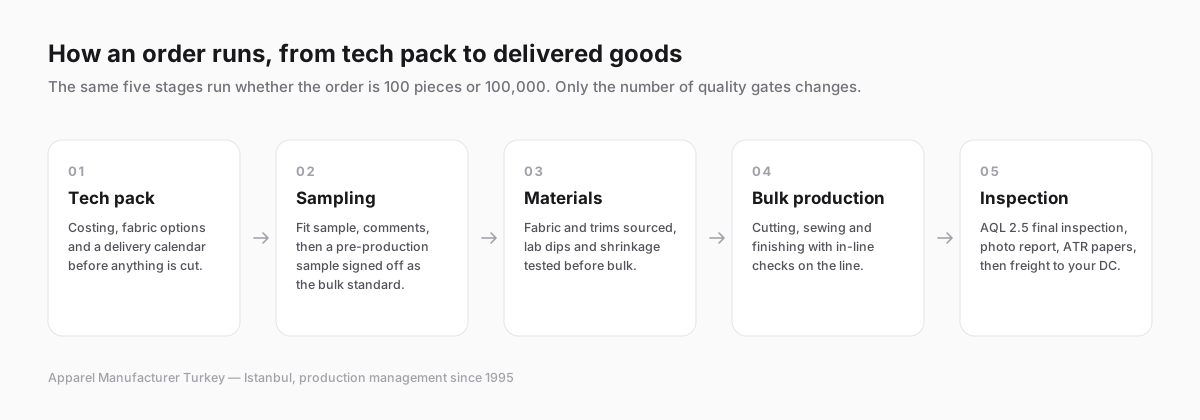
A complete quality plan for a typical order fits on one page. Fabric stage: mill test report or your own lab tests covering shrinkage, colourfastness and pilling, plus a GSM check on arrival. Pre-production: approved sample sealed by both sides. During production: an inline check when the first pieces come off the line. Final: AQL 2.5 major, 4.0 minor inspection with measurement checks before shipment release.
Decide who inspects. Factory self-inspection is standard but unaudited; a sourcing partner's QC team or a third-party inspection firm adds independent eyes for a modest fee, typically a few hundred US dollars per man-day as an indicative figure. For first orders with a new factory, independent final inspection is cheap insurance.
Agree in advance what happens on failure: rework and reinspection at the factory's cost is the normal remedy, which is also why inspection must happen before goods ship, while leverage still exists. A failed inspection with goods already on a truck is a much weaker conversation.
- Fabric test report before cutting, GSM checked on arrival
- Sealed approved sample as the production reference
- Inline check at start of sewing
- Final random inspection at AQL 2.5 major, 4.0 minor
- Measurement audit against tech pack tolerances
- Failure remedy agreed in writing before production
Common lab tests and indicative expectations
| Shrinkage, knits | Within about 5 percent length and width, per agreed method |
|---|---|
| Shrinkage, wovens | Within about 3 percent, per agreed method |
| Wash fastness | Grade around 4 on the 1 to 5 scale |
| Rub fastness | Around 4 dry; lower often accepted wet on deep shades |
| Pilling, Martindale | Around grade 4 for mid-market knits |
| GSM | Within about plus or minus 5 percent of nominal |
Planning a production run?
Send your tech pack or reference photos — clear quote with MOQ, sampling cost and lead time within one business day.
Frequently asked questions
Related pages
Want inspections handled for you?
Every order we manage in Istanbul includes final inspection at AQL 2.5 against your tech pack before shipment release. Write to info@apparelmanufacturerturkey.com to discuss your quality requirements.