What Does GSM Mean in Fabric?
GSM is the number every fabric conversation comes back to. This guide explains what it measures and what it does not, how mills and labs measure it, how to convert it, and which weights suit which garments, with a calculator you can use on your own swatches.
- Unit
- Grams per square metre
- 1 oz/yd²
- ≈ 33.9 GSM
- T-shirts
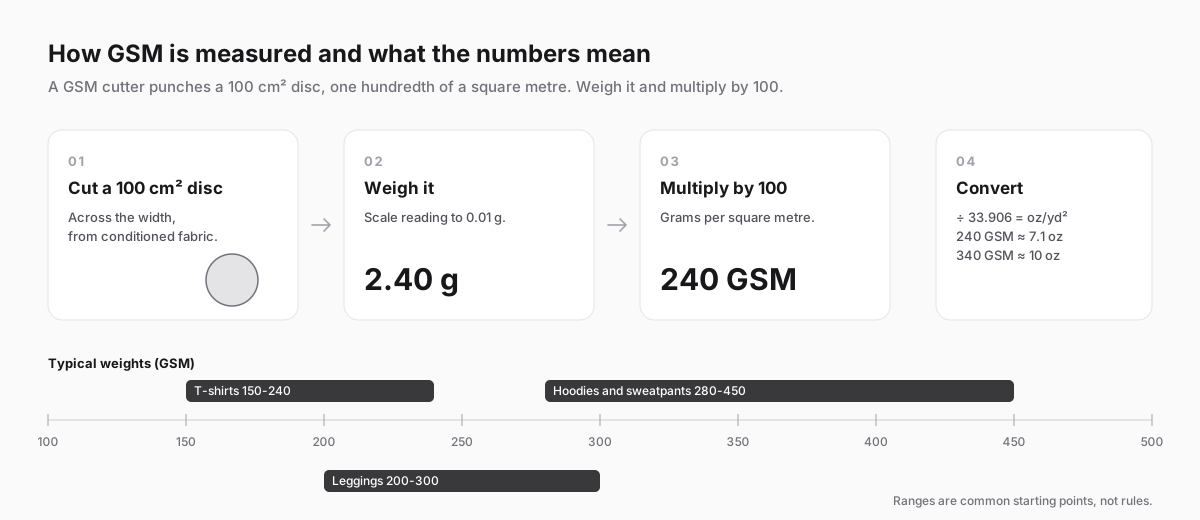
- About 150-240 GSM
- Hoodies
- About 280-450 GSM
Reviewed and updated 2026-10-25 by the Apparel Manufacturer Turkey production team in Istanbul, managing apparel production since 1995.
Quick answer
GSM means grams per square metre: the weight of one square metre of fabric. A higher GSM means more fibre in the same area, so the fabric is usually heavier and more opaque, but not necessarily thicker or warmer. T-shirts typically use 150-240 GSM, sweatshirts and hoodies 280-450 GSM.
GSM calculator
Standard formulas only. Results are estimates for comparison; the weight that counts is the one measured on your approved fabric.
Fabric weight
240 GSM
Weight per running metre at 320 GSM
576 g · 1.74 m/kg
GSM = weight (g) ÷ area (m²). For a 100 cm² disc, multiply the weight by 100. 1 oz/yd² ≈ 33.906 GSM. Weight per metre = GSM × width (m).
What GSM measures, and what it does not
GSM is mass per unit area. Cut one square metre of a fabric, weigh it, and the result in grams is its GSM. It tells you how much material sits in each square metre, which is why it is the standard way to specify knit fabrics and a common way to specify wovens.
GSM does not measure thickness, warmth or quality on its own. Brushing a fleece makes it loftier and warmer without changing its weight. A tightly knitted fabric can be thinner than a loosely knitted one of the same GSM. Two 240 GSM t-shirt fabrics can feel completely different depending on yarn and knit. Use GSM to compare like with like, and always pair it with a swatch or reference garment.
How GSM is measured
In practice nobody weighs a full square metre. Labs and mills use a circular GSM cutter that punches out a sample of exactly 100 square centimetres, one hundredth of a square metre. The sample is weighed on a precision balance and the reading is multiplied by 100. A 2.4 gram disc therefore means 240 GSM.
Moisture changes weight, so test standards condition the fabric in a standard atmosphere before weighing, usually around 20 degrees Celsius and 65 percent relative humidity. ISO 3801 covers mass per unit area for woven fabrics and ASTM D3776 is the common American method. Several samples are cut across the width and averaged, because weight varies slightly from edge to centre.
- Cut a 100 cm² disc with a GSM cutter, or measure a rectangle precisely
- Condition the fabric before weighing if you need lab-comparable results
- Weigh on a scale reading to at least 0.01 g
- GSM = sample weight in grams ÷ sample area in m² (for a 100 cm² disc: weight × 100)
- Average several samples taken across the width
Converting GSM to oz/yd² and weight per metre
American suppliers often quote ounces per square yard. One ounce per square yard equals about 33.9 GSM, so divide GSM by 33.9 to get oz/yd², or multiply ounces by 33.9 to get GSM. A 340 GSM sweatshirt fabric is about 10 oz/yd²; a 12 oz denim is about 407 GSM.
Mills also sell fabric by the running metre or by the kilo. Weight per running metre is GSM multiplied by the usable width in metres: a 320 GSM fleece at 1.80 m wide weighs about 576 g per metre, so one kilo is about 1.7 running metres. This is the number that turns a fabric quote per kilo into a cost per garment once you know the consumption; the calculator in the fabric consumption guide runs that conversion with your own figures.
Typical GSM by garment
These ranges are common starting points, not rules. Silhouette, season and price point all move the right answer, and a premium brand may deliberately go heavier than the market norm.
- Lightweight t-shirts and layering tees: about 120-160 GSM
- Standard retail t-shirts: about 160-200 GSM
- Premium and heavyweight t-shirts: about 220-300 GSM
- Polo shirts in piqué: about 180-240 GSM
- Leggings and activewear with elastane: about 200-300 GSM
- Lightweight sweatshirts and french terry: about 200-280 GSM
- Hoodies and sweatpants: about 280-400 GSM, heavyweight streetwear 400-500 GSM
- Denim: usually quoted in ounces, about 10-14 oz/yd² (340-475 GSM)
Tolerance: why the delivered fabric is never exactly your number
Knitted fabric weight varies with yarn, knitting tension and finishing, so a GSM figure always needs a tolerance. Plus or minus 5 percent is a widely used commercial tolerance; a tighter limit is possible but should be agreed with the mill before the fabric is ordered.
Finishing also moves the number. Compacting, washing and garment dyeing can raise GSM as the fabric shrinks and densifies; brushing barely changes it. When you approve a fabric, approve the finished fabric, and ask for the measured weight on the inspection report so you can compare later reorders against it.
Choosing the right GSM for your product
Start from how the garment should look and when it will be worn. A boxy streetwear tee needs enough weight to hold its shape; a fitted summer tee does not. A hoodie sold as everyday wear rarely needs to exceed 350 GSM, while a winter drop built on heaviness can justify 400 GSM and more, along with the higher fabric cost.
When two weights both seem right, sample them side by side in the same yarn and colour, so the only variable is weight. Our guide to choosing GSM for t-shirts and hoodies goes through those product decisions in detail.
Quick GSM reference
| Definition | Fabric weight in grams per square metre |
|---|---|
| GSM from a 100 cm² disc | Disc weight (g) × 100 |
| GSM → oz/yd² | GSM ÷ 33.906 |
| oz/yd² → GSM | oz/yd² × 33.906 |
| Weight per running metre | GSM × usable width (m) |
| Common tolerance | ± 5% unless agreed otherwise |
Planning a production run?
Send your tech pack or reference photos — clear quote with MOQ, sampling cost and lead time within one business day.
Frequently asked questions
Related pages
Not sure which weight to sample?
Tell us the garment, fit and season, and send a reference if you have one. We will suggest fabric weights to sample and quote the production.