Jersey Fabric Clothing Manufacturer
We produce jersey-based clothing through Turkey's circular knitting heartland, managing yarn, knitting, dyeing and sewing as one chain. T-shirts, dresses, baby wear and underlayers in single jersey, interlock, rib and pique.
- MOQ
- 100 pcs per style
- Weight range
- 120-280 GSM
- Sampling
- 1-2 weeks
- Bulk production
- 4-6 weeks
Reviewed and updated 2026-08-06 by the Apparel Manufacturer Turkey production team in Istanbul, managing apparel production since 1995.
Quick answer
Jersey clothing is the easiest entry point into Turkish manufacturing: Bursa and the Marmara region hold one of the world's densest concentrations of circular knitting machines, so standard qualities like 160-180 GSM combed single jersey run continuously. That makes 100-piece styles practical for t-shirts, polos, baby wear and loungewear, in 120-280 GSM constructions.
Jersey constructions and what each is for
Jersey is the family of weft-knitted fabrics that make up most casual tops. Single jersey is the lightest and most common, with a flat face and looped back, running roughly 120-280 GSM for apparel. Interlock is a double-knit with two smooth faces, more stable and opaque, favoured for baby wear and premium tees. Rib knits, 1x1 and 2x2, stretch and recover, serving fitted garments, collars and cuffs. Pique's textured face defines the polo shirt.
Composition options span 100 percent cotton, cotton-elastane with around 5 percent elastane for stretch, cotton-polyester for durability and price, and viscose or modal jerseys for drape. Slub and flamme yarns add surface texture for fashion tees. The construction and yarn decision drives everything downstream, so we start every jersey project there.
Turkey's circular knitting strength
Bursa and the wider Marmara region host one of the world's dense concentrations of circular knitting machines, feeding Istanbul's garment industry, while Denizli contributes strong cotton knit capacity. Many suppliers are vertical, holding knitting, dyeing and sewing under one roof or one ownership group, which compresses lead times and accountability.
For buyers this means jersey is where Turkish MOQs are most flexible. Standard qualities like 160 or 180 GSM combed single jersey are knitted continuously, so a 100-piece style can be dyed to your lab dips without custom knitting minimums. It is the easiest entry point into Turkish manufacturing for a new brand.
Garments we produce in jersey
T-shirts in every fit, longsleeves, polos, jersey dresses and skirts, baby bodysuits and kids basics, underwear and loungewear, and lightweight joggers in heavier jerseys. Elastane jerseys extend the range into fitted tops and basic leggings.
Because jersey curls at cut edges and stretches during sewing, garment quality depends on machine setup: coverstitched hems, correctly tensioned overlock seams and stabilised shoulders separate a solid tee from a twisted one. Torque, the spiral twisting of a finished tee, is controlled at knitting and finishing stage, which is why we match each programme to mills whose fabric torque results we know.
- T-shirts and longsleeves, 140-220 GSM single jersey
- Polos, 180-240 GSM pique
- Baby wear, 200-260 GSM interlock and rib
- Dresses, viscose-elastane or cotton jersey, 160-220 GSM
- Loungewear sets, 180-280 GSM
Colour, print and finish on jersey
Reactive dyeing is standard for cotton jersey, with garment dyeing available for washed looks. Yarn-dyed stripes are a Turkish speciality on feeder-stripe machines. All-over rotary and digital printing run at fabric stage, while screen printing, embroidery and transfers decorate the finished garment.
Finishing choices shape hand feel and stability: compacting controls shrinkage, silicone softeners add smoothness, and peaching gives a subtle brushed touch. OEKO-TEX certified jersey qualities are widely available across our mill network, and organic cotton jersey runs through GOTS-certified partner chains when your programme needs it.
Buying advice: reading a jersey spec sheet
Confirm three numbers before approving any jersey: GSM, shrinkage and spirality. GSM tolerance should be agreed at plus or minus 5 percent; wash shrinkage on compacted fabric should land around 5 percent or better; spirality above roughly 5 percent will show as twisted side seams on tubular or poorly finished fabric.
Also decide openly between carded and combed yarn. Combed ring-spun costs more but prints better and pills less, which matters if decoration is central to your product. For elastane jerseys, check recovery after repeated stretch, since cheap elastane grows and bags at the neckline within weeks of wear.
Planning a production run?
Send your tech pack or reference photos — clear quote with MOQ, sampling cost and lead time within one business day.
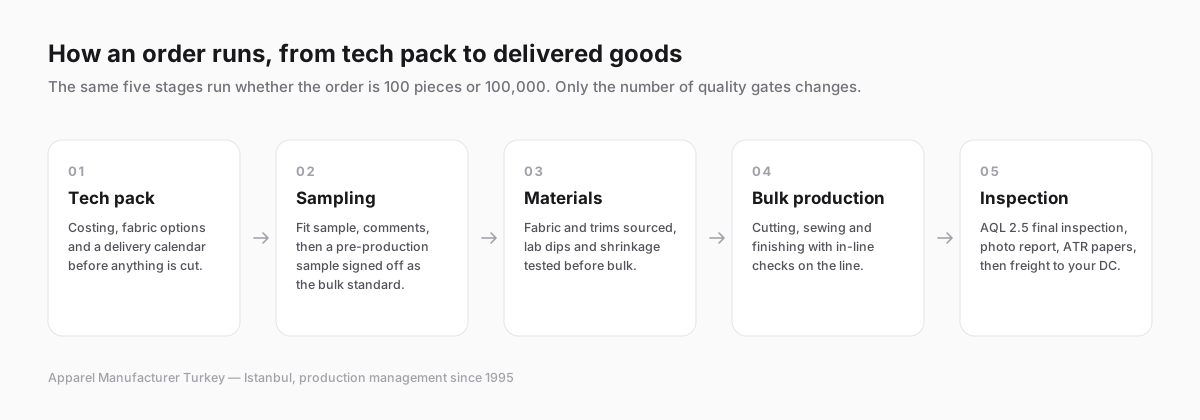
How production works
Send your enquiry
Share tech packs, sketches or reference garments together with target quantities and delivery dates.
Technical review
We assess fabrics, construction and printing requirements and match your project to the right production line.
Quotation
You receive a clear offer covering unit price, sampling cost, MOQ and production timeline.
Sampling
Pre-production samples are made for fit, fabric and print approval before any bulk fabric is cut.
Approval
You confirm the approved sample, quantities per size and colourway, labelling and packaging.
Bulk production
Cutting, sewing, printing, embroidery and finishing run under a production plan you can follow.
Quality control
Inline checks during production plus AQL final inspection before cartons are sealed.
Shipping
Road freight to Europe in 3-7 days, air or sea worldwide, with export documentation handled for you.
Frequently asked questions
Related pages
Put your jersey styles into production
Send your tech packs and target prices and we will match constructions, weights and mills within days. Contact info@apparelmanufacturerturkey.com.