How to Import Clothes from Turkey
Importing garments from Turkey is one of the most straightforward sourcing routes into Europe and the UK, but the paperwork rewards preparation. This guide walks through Incoterms, the documents your customs broker will ask for, and how to choose between road, air and sea freight.
- EU imports
- ATR certificate, 0% duty
- UK imports
- EUR.1 or origin statement
- Road freight to EU
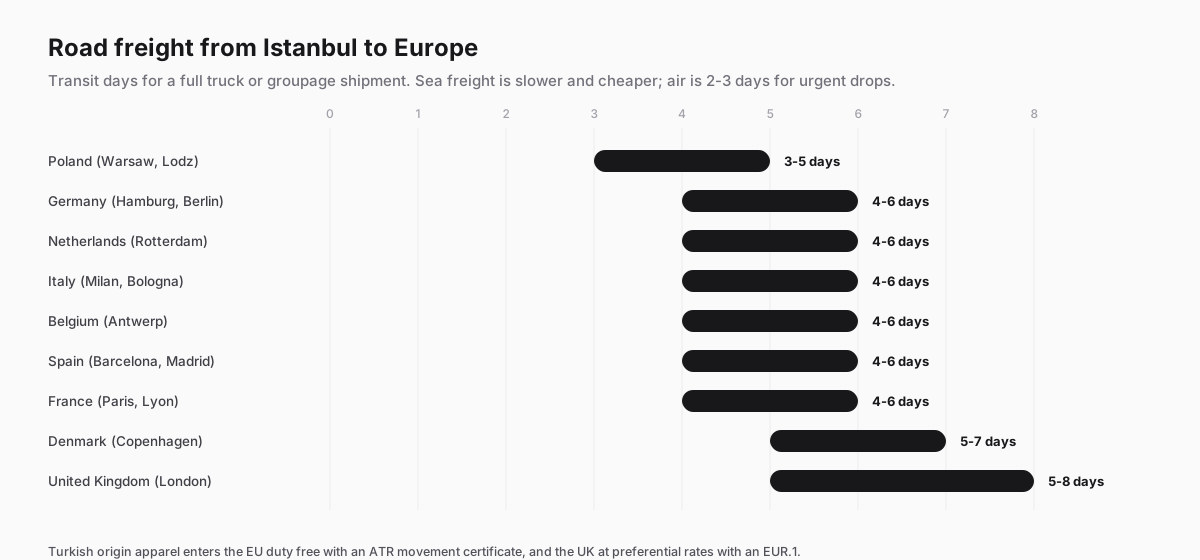
- 3-7 days
- Sea freight to US
- 25-35 days
Reviewed and updated 2026-08-09 by the Apparel Manufacturer Turkey production team in Istanbul, managing apparel production since 1995.
Quick answer
To import clothes from Turkey, agree an Incoterm (FOB and EXW are most common), collect the commercial invoice, packing list and transport document, and use an A.TR certificate for duty-free EU entry or proof of origin for the UK. Road freight reaches most of Europe in 3-7 days; sea freight to the US East Coast takes 25-35 days.
Why the import process from Turkey is simpler than from Asia
Turkey has been in a customs union with the EU for industrial goods since 1996. For apparel this means that garments shipped from Turkey to any EU member state travel with an ATR movement certificate and clear customs at a 0 percent duty rate, provided the goods are in free circulation in Turkey. There is no complex origin calculation for EU buyers: the ATR covers the goods regardless of where the fibre was grown, as long as any import duties on non-Turkish inputs were settled in Turkey.
For the UK, the picture changed after Brexit. The UK-Turkey free trade agreement still allows duty-free entry for most apparel, but it works on preferential origin rather than free circulation. Your shipment needs a EUR.1 movement certificate or an origin declaration on the invoice, and the garments must actually qualify as Turkish origin under the agreement rules, which for clothing usually means the fabric was woven or knitted in Turkey or another qualifying country and the garment was cut and sewn there.
For the US, Canada, Australia and most other markets there is no preferential agreement, so standard MFN duty rates apply. For knitted cotton garments entering the US these typically fall in the 15 to 20 percent range depending on the HS code, but rates change and you should always verify the current rate for your specific tariff line before costing an order.
Choose your Incoterm before you negotiate price
An FOB Istanbul price and an EXW factory price for the same garment can differ by a meaningful margin, so agree the Incoterm before comparing quotes. Under EXW the factory hands over cartons at its door and everything else, including Turkish export clearance, is your problem. Under FOB the supplier delivers export-cleared goods to the carrier at the named port or terminal. Under CPT or CIF the supplier also pays freight to your destination, and under DAP the goods arrive at your warehouse with only import clearance and duties left for you.
For a first order, FOB Istanbul or CPT to your city are the most practical choices. FOB keeps you in control of freight cost and carrier choice while leaving export formalities with the party best placed to handle them. Avoid EXW unless you have a forwarder who regularly collects in Turkey, because arranging Turkish export clearance remotely adds friction for no real saving.
Whatever term you choose, write it with a named place, for example FOB Istanbul Ambarli or DAP Manchester warehouse, and reference Incoterms 2020 on the order confirmation and invoice. Vague terms are the single most common cause of disputes over who pays a surprise handling charge.
The documents every shipment needs
A garment shipment from Turkey travels with a small, predictable document set. Your supplier or their customs agent prepares most of it, but you should check drafts before the truck leaves, because fixing an error at the border costs days.
The commercial invoice must show the buyer and seller, a clear goods description, HS codes, unit prices, the Incoterm, currency and total value. The packing list breaks the shipment into cartons with quantities, net and gross weights and carton dimensions, and customs officers do compare it against the physical load. Depending on destination you then add the ATR (EU), EUR.1 or invoice origin declaration (UK), or a certificate of origin (most other markets).
- Commercial invoice with HS codes, Incoterm and true transaction value
- Packing list with per-carton contents, weights and dimensions
- ATR movement certificate for EU destinations
- EUR.1 certificate or origin declaration on the invoice for the UK
- Certificate of origin for non-preferential markets such as the US
- Transport document: CMR for road, air waybill, or bill of lading for sea
- Any test reports or declarations your market requires, for example fibre content labelling compliance
How customs clearance actually works
On the Turkish side, the exporter or their broker files an export declaration, and the goods are cleared before loading. This is routine and usually invisible to you. On arrival in your country, a customs broker, often provided by your freight forwarder, files the import declaration using your EORI number in the EU or UK, or your importer number in the US.
The broker declares the HS code, customs value and origin documents, and the system calculates duty and import VAT. In the EU and UK, import VAT is normally 19 to 21 percent depending on the country, and most VAT-registered businesses either defer it via postponed VAT accounting or reclaim it on their return, so it is a cash flow item rather than a true cost. Duty, where it applies, is a real cost and is calculated on the CIF value, meaning goods plus freight and insurance.
Physical inspections happen on a small percentage of shipments. If your paperwork is consistent, with the invoice, packing list and origin certificate all telling the same story, an inspection typically adds one to three days. Inconsistent values or vague descriptions such as garments with no fibre content or gender are what trigger longer holds.
Road, air or sea: picking the right freight mode
Turkey's location makes road freight the default for European buyers. A full or part truckload from Istanbul reaches Germany, the Netherlands or France in roughly 3 to 7 days door to door, and the UK in 5 to 8 days including the channel crossing. Cost per kilogram sits far below air freight, and unlike sea freight there is no port handling on either end.
Air freight makes sense for samples, launch top-ups and genuinely urgent replenishment. Istanbul Airport has daily capacity to every major hub, with transit times of 1 to 3 days plus clearance. Expect to pay several times the road rate per kilogram, so use it for high-value or time-critical goods rather than full collections.
Sea freight is the economic choice for the US, Canada, Australia, the Gulf and Asia. From Ambarli or Izmir, transit to the US East Coast typically runs 25 to 35 days. For volumes below a full container, LCL groupage works but adds consolidation time at both ends. A useful rule of thumb: if the shipment is under roughly 2 cubic metres, get an air quote anyway, because LCL minimums and fees can close the gap.
A realistic cost walkthrough
As a purely illustrative example, imagine a UK brand importing 600 hoodies at 14 dollars FOB Istanbul, so 8,400 dollars in goods. Road freight for roughly 20 cartons might add a few hundred dollars, and customs brokerage a fixed fee of around 50 to 100 dollars. With a valid EUR.1 the duty is zero; without it, UK duty on knitted hoodies would apply at around 12 percent, which on this shipment is over 1,000 dollars. That single document is usually the difference between a good landed price and a mediocre one.
Import VAT is then charged on the duty-inclusive landed value but recovered through the VAT return for registered businesses. The lesson from the example is not the exact numbers, which you should verify for your own product and tariff line, but the structure: goods value dominates, freight is modest from Turkey, and origin paperwork determines whether duty exists at all.
Common first-timer mistakes to avoid
Most import problems are self-inflicted and cheap to prevent. The recurring ones we see are missing origin certificates discovered after arrival, EORI numbers requested the week goods land rather than the week the order is placed, and invoices that understate value to save duty, which is customs fraud and puts your whole importing history at risk.
Build the paperwork check into your order timeline: request draft documents when production finishes, verify HS codes against your own customs tariff rather than trusting the supplier's guess, and confirm your forwarder has the origin certificate in hand before the truck crosses the border.
- Register for an EORI or importer number before the goods ship, not after
- Ask for draft shipping documents at the final inspection stage
- Verify the HS code yourself; duty rates differ significantly between similar codes
- Never accept an undervalued invoice, even if offered as a favour
- Insure the goods; carrier liability for road freight is limited per kilogram and rarely covers garment value
Freight options from Istanbul at a glance
| Road to Western Europe | 3-7 days, best cost for EU, door to door |
|---|---|
| Road to UK | 5-8 days including channel crossing |
| Air worldwide | 1-3 days transit, highest cost per kg |
| Sea to US East Coast | 25-35 days, best for large volumes |
| Sea LCL | Adds 5-10 days for consolidation, fees can rival air on small loads |
Planning a production run?
Send your tech pack or reference photos — clear quote with MOQ, sampling cost and lead time within one business day.
Frequently asked questions
Related pages
Want the paperwork handled for you?
We manage production through vetted Istanbul manufacturers and prepare export documentation, ATR and EUR.1 certificates as part of every shipment. Write to info@apparelmanufacturerturkey.com with your destination and quantities for a landed-cost estimate.