Importing Clothing From Turkey
Customs is the part of sourcing that scares first-time importers most and, with the right documents, deserves it least. Here is how duties and paperwork generally work for clothing from Turkey into the EU, UK and US, in plain language.
- EU customs union
- ATR certificate
- Core documents
- Invoice + packing list
- Road to EU
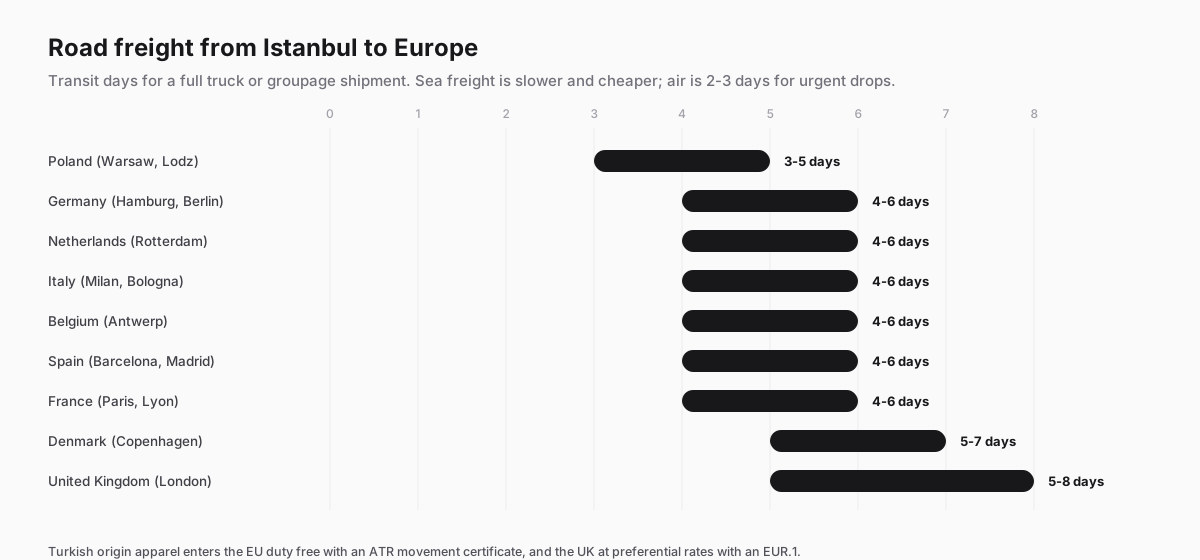
- 3-7 days
- Export docs
- Prepared by us
Reviewed and updated 2026-08-09 by the Apparel Manufacturer Turkey production team in Istanbul, managing apparel production since 1995.
Quick answer
Clothing imported from Turkey into the EU generally enters free of customs duty under the Customs Union when accompanied by an ATR certificate; import VAT still applies, and UK buyers can claim preferential treatment with origin documents. Apparel Manufacturer Turkey prepares the export paperwork, invoice, packing list and ATR or EUR.1, so shipments clear without surprises.
Turkey's customs position in one paragraph
Turkey and the EU operate a customs union covering most industrial goods, including apparel. In general terms, garments in free circulation in Turkey and shipped with an ATR movement certificate enter the EU without customs duty, which is one of the structural reasons European brands manufacture in Turkey. Import VAT still applies in the destination country, as it does for any import.
For non-EU markets such as the UK, trade is governed by separate agreements, and preferential duty treatment generally depends on the goods' origin being properly documented, typically via an EUR.1 certificate or an origin declaration. The US has no preferential agreement with Turkey for apparel, so normal US duty rates for the garment category apply. Rules and rates change, so always confirm current treatment for your specific product code with your customs broker or authority.
The documents your shipment travels with
Every commercial shipment carries a commercial invoice, stating the goods, values, currency, parties and delivery term, and a packing list detailing cartons, quantities, weights and dimensions. The transport document depends on mode: a CMR note for road freight, an air waybill for air, a bill of lading for sea. EU-bound goods add the ATR certificate; other markets may use an EUR.1 or an origin declaration where a trade agreement applies.
Depending on product and destination, you may also need details such as the HS code for each style, fibre composition for labelling rules, and care labelling that meets destination-market requirements. We prepare the export-side documentation as part of managing your production, and we align labelling with your market's rules at the PP sample stage so customs never meets a surprise.
- Commercial invoice and packing list: every shipment, every mode
- ATR certificate: EU-bound goods under the customs union
- EUR.1 or origin declaration: markets with preferential agreements, where applicable
- CMR, air waybill or bill of lading depending on transport mode
Duties and VAT in practice
Into the EU, qualifying goods with an ATR generally enter duty-free, and you pay import VAT at your country's rate, which VAT-registered businesses typically recover or account for through their normal returns. Into the UK, preferential origin treatment can reduce or remove duty where the rules are met and documented; otherwise standard apparel tariffs apply, plus UK VAT. Into the US, apparel duties vary significantly by garment type and fibre, commonly in the low-to-high teens percent range, plus any applicable fees.
The honest general advice is this: budget landed cost per unit, not ex-factory cost, before you commit to an order. We can indicate typical treatment for your product and destination, and your customs broker can confirm the exact rate for your HS code. Five minutes with a broker before ordering beats a surprise invoice at the border after.
Who handles customs clearance
It depends on your Incoterm. Under DDP, clearance and duties at destination are handled within the service you pay for, which is why first-time importers often start there. Under FOB or EXW, import clearance is your responsibility, normally executed by a customs broker or your freight forwarder's brokerage arm for a modest fee per entry.
To import commercially you will generally need to be a registered business with the identifiers your market requires, such as an EORI number in the EU or UK. Your broker or forwarder will tell you exactly what applies to you; obtaining these identifiers is typically a quick administrative step, not a barrier.
Common first-timer mistakes and how to avoid them
The classic errors are budgeting on ex-factory price and forgetting VAT and clearance fees, shipping without the ATR or origin paperwork and paying duty that was avoidable, mismatched values between invoice and payment records, and care labels that do not meet destination-market rules. Every one of these is preventable with ten minutes of planning at order stage.
Our role is to make the export side clean: correct documents, correct labelling agreed at sampling, values that match reality, and forwarders who know the Turkey-to-EU, UK and US lanes cold. Pair that with a decent customs broker on your side of the border and importing from Turkey becomes routine logistics, not adventure.
Planning a production run?
Send your tech pack or reference photos — clear quote with MOQ, sampling cost and lead time within one business day.
How production works
Send your enquiry
Share tech packs, sketches or reference garments together with target quantities and delivery dates.
Technical review
We assess fabrics, construction and printing requirements and match your project to the right production line.
Quotation
You receive a clear offer covering unit price, sampling cost, MOQ and production timeline.
Sampling
Pre-production samples are made for fit, fabric and print approval before any bulk fabric is cut.
Approval
You confirm the approved sample, quantities per size and colourway, labelling and packaging.
Bulk production
Cutting, sewing, printing, embroidery and finishing run under a production plan you can follow.
Quality control
Inline checks during production plus AQL final inspection before cartons are sealed.
Shipping
Road freight to Europe in 3-7 days, air or sea worldwide, with export documentation handled for you.
Frequently asked questions
Related pages
More in Manufacturing
Import with clean paperwork from day one
We prepare export documents, align labelling with your market and work with forwarders who know your lane. Ask us anything about your route at info@apparelmanufacturerturkey.com.