What Is MOQ in Clothing Manufacturing?
MOQ, the minimum order quantity, is the smallest order a factory will accept per style or colour. It is not arbitrary gatekeeping: it comes from fabric minimums and line economics. Understanding where MOQs come from is what makes them negotiable.
Reviewed and updated 2026-08-03 by the Apparel Manufacturer Turkey production team in Istanbul, managing apparel production since 1995.
Quick answer
MOQ (minimum order quantity) is the smallest order a clothing factory will accept per style or colourway. It exists because fabric mills impose dyeing minimums and sewing lines carry fixed setup costs. Typical MOQs run around 100 pieces per style in Turkey, while Chinese and Bangladeshi factories commonly require 500-1,000 pieces or more.
The definition, precisely
MOQ is the minimum quantity a manufacturer will produce in one order, and the unit it applies to matters as much as the number. A factory saying MOQ 300 might mean 300 pieces per style across all colours and sizes, 300 per colourway, or 300 per fabric across several styles. Always ask which, because the same number can differ by a factor of three in real commitment.
MOQs also cascade through the supply chain. The sewing factory has a minimum, but so does the fabric mill (often 300 to 1,000 metres per colour for custom dyeing), the label weaver (often around 1,000 labels), and the print house (setup charges that only amortise over volume). The factory's stated MOQ is usually the point where all of those minimums stop making the unit price absurd.
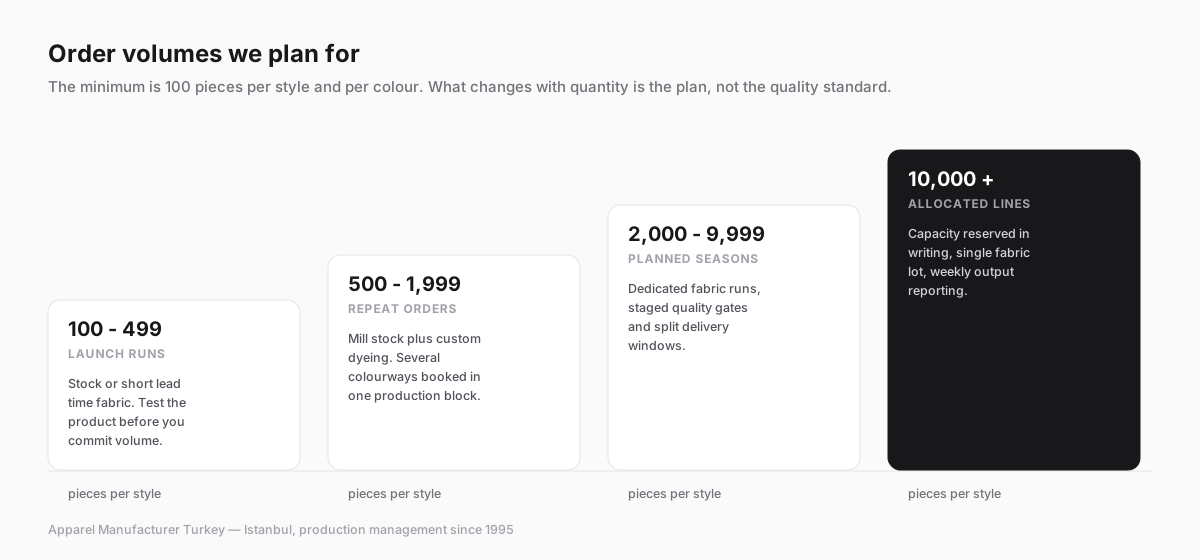
A typical structure from Turkish manufacturers, ours included, is around 100 pieces per style, spread across a size curve and across whichever colours you choose. That is genuinely low by export-factory standards and reflects a market that has organised itself around small European brands.
Why MOQs exist: fabric minimums
The largest driver is fabric. Custom dyeing runs in batches: a dye house loads a machine with hundreds of kilograms of fabric per colour, and running it one-third full costs nearly as much as running it full. Mills therefore set minimums, commonly in the range of 300 to 1,000 metres or the equivalent in kilograms per colour, below which they either refuse or charge a steep surcharge.
Translate that into garments and factory MOQs stop looking arbitrary. If a hoodie consumes about one kilogram of fleece and the knitting and dyeing minimum for a custom colour is 150 to 300 kilograms, the fabric alone dictates a floor of roughly 150 to 300 hoodies per colour. Stocked fabrics in standard colours escape this, which is exactly why low-MOQ programmes are built on stock fabric.
Trims repeat the pattern in miniature. Woven main labels, custom zip pullers, printed ribbons and hangtags all carry their own minimums, usually around 500 to 1,000 units. On a 50-piece order, custom trims either dominate the unit cost or get replaced with generic stock, which is a real branding compromise.
Why MOQs exist: line setup and factory economics
The second driver is the sewing line. Before the first garment of a style comes off the line, the factory has spent hours on marker making, cutting plans, machine threading and adjustment, sewing-operator briefing and first-piece approval. That setup cost is roughly the same for 50 pieces as for 5,000, so small runs carry it on far fewer units.
There is also opportunity cost. A line that switches styles daily loses efficiency every changeover, so a factory with steady demand will price small orders to compensate or decline them. This is why MOQ is really a price curve, not a wall: many factories will sew 150 pieces if you accept a 20 to 40 percent higher unit price that covers the setup economics.
Understanding this reframes negotiation. You are not asking a factory for a favour; you are looking for the arrangement where your order is genuinely worth their line time, whether through price, stock fabric, consolidated styles or a credible growth story.
Typical MOQs by country
Ranges below are indicative for custom cut-and-sew production; individual factories vary widely, and blanks-with-printing programmes everywhere go far lower. The pattern is consistent: the larger and more export-industrialised the country's apparel sector, the higher the comfortable minimum.
Turkey occupies a useful middle position: minimums low enough for emerging brands, in a full-package industry with its own fabric mills, which is precisely what keeps those minimums workable. Portugal competes at similar or lower MOQs at higher unit prices; South and Southeast Asia offer the lowest prices but expect volumes an emerging brand cannot sell.
How to negotiate a lower MOQ
MOQs bend most easily when you reduce the factory's real costs rather than just asking for a smaller number. The tactics below are ordered roughly by effectiveness.
- Use stocked fabrics and standard colours, eliminating the dye-lot minimum that drives most MOQs
- Consolidate: one fabric across three styles lets the factory hit fabric minimums while you hit variety
- Cut colourways before cutting styles; each colour carries its own fabric and setup minimums
- Accept a higher unit price for the first order, explicitly framed as a trial run before larger repeats
- Show a credible reorder plan; factories flex for brands that look like future volume
- Ask about joining production of similar garments already running, sharing setup across clients
- Use generic trims and printed neck labels instead of custom woven labels below label minimums
- Time requests for the factory's low season, when line time is cheap; in Turkey often mid-winter and late summer
The MOQ maths you should run before negotiating
Before pushing for the lowest possible MOQ, check whether you actually want it. Unit prices fall meaningfully with volume: the same t-shirt might be 9 at 100 pieces, 7 at 300 and 5.5 at 1,000. A lower MOQ reduces your cash at risk but raises your cost per unit and shrinks your margin, and tiny runs sell out precisely when marketing finally works.
Run the arithmetic both directions. Downside: if the product fails, what does the whole run cost to write off? Upside: at your realistic monthly sales, how many months of stock is each order size, and what does the reorder gap of six to eight weeks do to you if you sell out in month one? The right order size is the one where both answers are survivable.
As a rough rule, ordering less than two months of expected stock guarantees a stockout during your launch momentum, and ordering more than eight to ten months of stock ties up cash you will want for marketing. For most small brands that lands somewhere between 200 and 600 pieces per style, which is exactly the range Turkish MOQs serve well.
MOQ red flags in both directions
Suspiciously low MOQs deserve scrutiny. A factory offering full custom production at 30 pieces with custom-dyed fabric either has a sampling room posing as a production line, will substitute stock fabric without telling you, or is quoting a price you have not seen yet. Ask how the fabric minimum is being handled; a good low-MOQ operator has a clear answer, usually stock fabric programmes.
Equally, do not read a high MOQ as rejection. MOQ 1,000 from a large factory simply means you are talking to the wrong size of factory for your stage, not that your brand is unserious. Matching factory size to order size is a core sourcing skill: a factory where your order is 5 to 20 percent of monthly capacity will care about you; one where it is 0.5 percent will not.
Finally, get the agreed MOQ and its price in writing on the pro forma invoice, including how quantities split across sizes and colours. Verbal flexibility has a way of evaporating between quoting and contract.
Indicative custom production MOQs by country
| Turkey | From 100 pcs per style, colours free within the total |
|---|---|
| Portugal | 100-500 pcs per style, higher unit prices |
| China | 100-1,000 pcs per style; some small workshops lower |
| India | 100-1,000 pcs per style; strong in wovens |
| Bangladesh | 1,000-5,000 pcs per style; volume-oriented |
| Vietnam | 500-2,000 pcs per style |
| USA / Western Europe | 50-100 pcs per style, at the highest unit costs |
Planning a production run?
Send your tech pack or reference photos — clear quote with MOQ, sampling cost and lead time within one business day.
Frequently asked questions
Related pages
Looking for workable minimums?
We produce from 100 pieces per style through vetted Istanbul factories. Email your styles and quantities to info@apparelmanufacturerturkey.com and we will confirm the exact MOQ and price for your project.