How to Create a Clothing Sample
Sampling is where a design becomes a manufacturable product, and where disciplined brands separate themselves from expensive learners. This guide covers each sample stage, what it costs, how many rounds to expect, and the approval habits that protect your bulk order.
- Rounds to expect
- 2-3 per style
- Time per round
- 1-2 weeks plus courier
- Indicative cost
- 50-150 per sample
- Golden rule
- No bulk before PP approval
Reviewed and updated 2026-08-07 by the Apparel Manufacturer Turkey production team in Istanbul, managing apparel production since 1995.
Quick answer
Creating a clothing sample runs through three stages: a proto sample to prove design and pattern, one or two fit samples to correct measurements, and a pre-production sample in final fabric that becomes the binding quality standard for bulk. Expect two to three rounds per style, one to two weeks each in Turkey, at roughly 50-150 per sample.
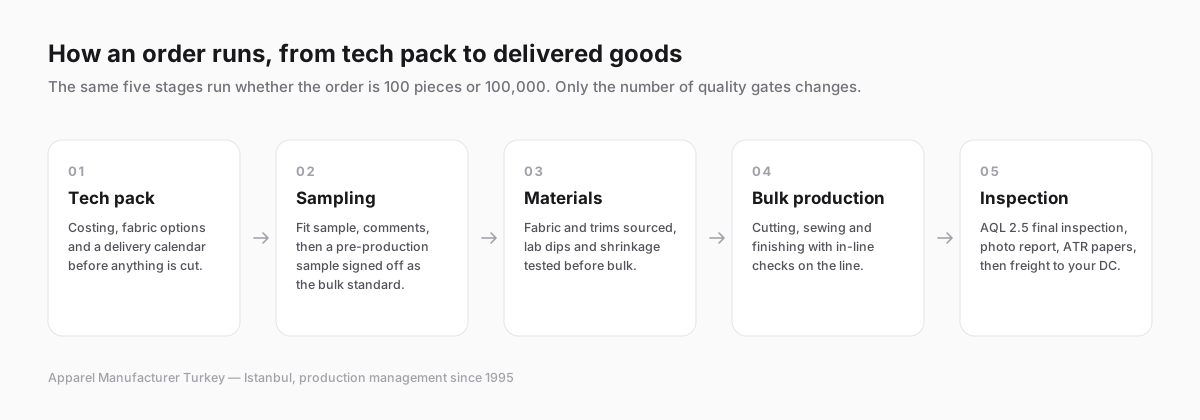
Why sampling exists at all
A sample is a one-off garment made before bulk production to test and lock down design, fit, fabric and construction. It exists because paper and pixels lie: a measurement chart cannot tell you how a 240 GSM jersey drapes on a shoulder, and a rendering cannot tell you that a neckline gapes. Sampling converts those unknowns into decisions while the cost of change is one garment, not three hundred.
It also creates the legal and practical quality standard for your order. The approved pre-production sample, together with the tech pack, defines what the factory owes you. When a bulk delivery is disputed anywhere in the world, the first question is always what the approved sample looked like and measured.
Plan sampling as a project with a calendar, not as a formality. For a new style in Turkey, two to three rounds at one to two weeks each, plus courier time between rounds, means four to eight weeks from tech pack to approved sample. Brands that treat this as dead time before the real work usually end up repeating it.
Stage 1: The proto sample
The proto (prototype) is the first physical version of your design, sewn from your tech pack or reference garment to prove the concept and the pattern. Factories often make protos in available fabric of similar weight and any colour in stock, because the point is silhouette and construction, not shade.
Judge a proto on the right things. Is the overall shape and proportion what you intended? Do the construction choices work, and does the garment assemble cleanly? Is the fabric weight and behaviour in the right family? Do not burn a round arguing about a colour that was never meant to be final.
Give feedback in writing, against the tech pack, with numbers. Lengthen body by 3 centimetres, raise pocket 2 centimetres, change neckline binding to 2-centimetre rib is actionable; make it feel more premium is not. Photograph the sample with your comments marked, update the tech pack to a new version, and send both back together.
Stage 2: Fit samples
Fit samples are revision rounds focused on measurements and how the garment sits on a body. Fit them on a live person or a form matching your base size, not on a hanger, and measure every point of measure against the spec before anyone tries it on. A garment can measure correctly and still fit badly, but a garment that measures wrongly tells you the pattern needs work before opinions even start.
Check fit in motion: arms raised, sitting, walking. Check both ends of your size range if fit is central to your product; grading errors hide at XS and XXL. And wash the sample according to its care label, because shrinkage of a few percent on a cotton knit can move a garment a full size, and you want the spec to reflect post-wash reality.
One to two fit rounds is normal for a new style with a decent tech pack. If you are on round four, stop and diagnose: either the tech pack is ambiguous, the feedback has been vague, or the factory's pattern room is not up to the style. Each of those has a different fix, and none of them is another identical round.
Stage 3: SMS and PP samples
Two more sample types matter, and they answer different questions. A salesman sample (SMS) is made to look right: correct fabric, colour and branding, produced in small sets for lookbooks, wholesale appointments, ecommerce photography and pre-orders. Brands selling wholesale often need SMS sets months before bulk, so schedule them deliberately.
The pre-production (PP) sample is the one that matters contractually. It is made in the final fabric, final colour, with final trims, labels and prints, ideally by the same factory and methods that will run bulk. Approving the PP sample is your last checkpoint before fabric is cut in volume; after this, changes stop being revisions and start being remakes.
Approve the PP sample formally and in writing: an email stating that PP sample for style X, version Y, received on date Z is approved for bulk production, listing any final tolerated deviations. Keep one approved PP sample yourself and have the factory keep a sealed counterpart; these twin garments are the reference for the final inspection.
What samples cost and how long they take
Indicatively, factories charge around 50 to 150 per sample for standard knitwear and more for complex or heavily decorated styles, commonly two to three times the expected bulk unit price. Many reputable manufacturers credit some or all sampling fees back against a confirmed bulk order; ask about this upfront rather than assuming it.
Sampling is charged because it consumes the scarcest resource in a factory: pattern room time. Free samples usually mean either a factory desperate for any client, or costs quietly recovered in the bulk price. Paying a fair sampling fee also keeps you honest about how many factories you sample with in parallel; two or three is diligence, eight is indecision.
On timing, each round in Turkey typically takes one to two weeks of work plus two to four days of courier each way. The compressible part is your side: brands that return structured feedback within 48 hours run sampling in half the calendar time of brands that let samples sit in a studio for two weeks.
Approval discipline: the habits that protect you
Most bulk-order disputes trace back to sloppy sampling habits, not bad factories. The fixes are procedural and cheap.
- Keep one tech pack version per round, dated and numbered, and reference the version in every email
- Give all feedback in writing with measurements; calls are fine, but confirm decisions by email the same day
- Measure every sample against the POM chart before giving any subjective feedback
- Wash-test at least one sample per style before PP approval
- Never approve verbally, partially or conditionally without writing the conditions down
- Keep a sealed approved PP sample on each side as the bulk quality reference
- Refuse to authorise bulk fabric purchase before PP approval, whatever the deadline pressure
When sampling goes wrong
Some failure modes deserve naming. If the proto arrives wildly off-spec, the factory may have redrawn your pattern from habit rather than your chart; ask directly whether they sewed from your measurements. If every round fixes one thing and breaks another, the pattern is being patched rather than corrected, and it may be worth paying for a fresh pattern from a dedicated pattern maker.
If the PP sample is beautiful but the price quietly rises afterwards, the factory underquoted and is renegotiating through the back door; settle the bulk price in writing at PP approval, not after. And if a factory resists sampling altogether and pushes you straight to bulk, walk away, because you are being asked to fund their risk with your inventory.
Treat sampling problems as information about the partnership. A factory that samples carefully, communicates deviations proactively and documents changes will almost always produce well; the reverse is equally reliable.
Sample types at a glance
| Proto sample | Proves design and pattern; available fabric, any colour; judge silhouette and construction |
|---|---|
| Fit sample | Corrects measurements and fit on body; 1-2 rounds typical |
| SMS (salesman sample) | Final look for photos, wholesale and pre-orders; made in small sets |
| PP (pre-production) sample | Final fabric, trims and branding; the binding quality standard for bulk |
| TOP (top of production) | Pulled from the bulk line early in the run to confirm production matches PP |
Planning a production run?
Send your tech pack or reference photos — clear quote with MOQ, sampling cost and lead time within one business day.
Frequently asked questions
Related pages
More in Resources
Start with a sample, not a leap
Our Istanbul network produces protos and pre-production samples in 1-2 weeks, with sampling fees credited against bulk orders from 100 pieces. Send your tech pack or reference garment to info@apparelmanufacturerturkey.com to begin.