How to Check Clothing Quality
Quality control is not a mystical skill; it is a checklist applied consistently at the right moments. This guide covers what to check on fabric, measurements, seams and finishing, how AQL sampling works in plain language, and when a third-party inspection earns its fee.
Reviewed and updated 2026-07-29 by the Apparel Manufacturer Turkey production team in Istanbul, managing apparel production since 1995.
Quick answer
Check clothing quality by measuring garments against the spec with agreed tolerances, inspecting fabric, seams and finishing inside and out, and wash-testing samples. For bulk orders, apply AQL 2.5 sampling: on a 500-piece order an inspector checks 50 garments and rejects the lot at four major defects. Third-party inspections cost roughly 200-350 per man-day.
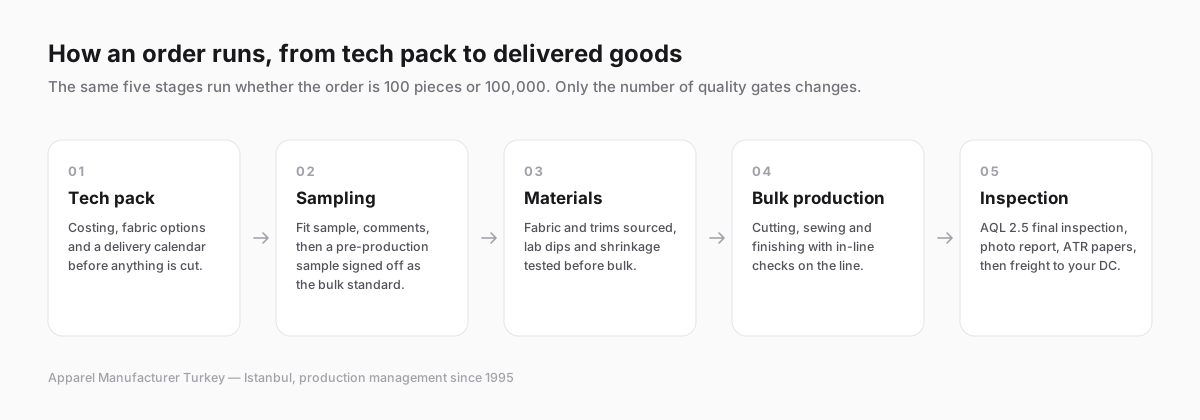
Quality is defined before it is checked
You cannot inspect quality into a garment that was never specified. Every check in this guide compares production against a standard, and that standard is your tech pack plus your approved pre-production sample. If those do not exist, an inspection can only find the defects everyone agrees on, stains, holes, broken stitches, and none of the ones that actually sink brands, wrong fit, wrong fabric weight, wrong colour.
So the first quality action happens at approval time: a measurement chart with tolerances for every point, a fabric spec with GSM and composition, Pantone TCX colour references, and a sealed PP sample held by both sides. With those in place, quality checking becomes comparison rather than debate.
The second principle is timing. Checking quality only at delivery means discovering problems when they are least fixable and you are least leveraged, since the goods are made and often paid for. Good QC is layered: fabric before cutting, inline during sewing, and a final AQL inspection before cartons seal and the balance payment is released.
Checking fabric
Fabric determines more of perceived quality than sewing does, and it is checkable with modest equipment. Verify weight with a GSM cutter and scale, or by weighing a known area; a fabric quoted at 300 GSM arriving at 260 is a different, cheaper product, and a tolerance of around 5 percent is a normal expectation to agree in advance. Verify composition against the spec, with lab testing available for certainty on blends.
Check colour against the approved lab dip under consistent lighting, ideally a D65 daylight source, and always compare dye lots when an order spans several, since panels cut from different lots can mismatch visibly in a finished garment. Check hand feel and surface against your retained fabric swatch from approval.
Then test behaviour, because fabric that looks right can still perform wrong: wash a sample per the care label and measure shrinkage (up to around 5 percent is common for cotton knits and should be built into the pattern), rub a white cloth against dark fabrics wet and dry for colourfastness, and stretch and recover ribs and elastane blends. On the factory side, mills grade fabric rolls with the four-point system; asking whether incoming fabric is four-point inspected is a legitimate and revealing question.
Checking measurements
Garments are measured flat at defined points of measure, laid on a table without stretching, using the same method the spec was written with. The half-chest of a tee measured 2 centimetres below the armhole must be measured exactly there every time, or the numbers are noise. Your tech pack should define each point and its method precisely for this reason.
Tolerances make measurements enforceable. Typical knitwear tolerances run around plus or minus 1 centimetre on widths and 1 to 1.5 centimetres on lengths, tighter on sensitive points like neck width, sometimes wider on long measures. A garment inside tolerance is conforming even if not perfect; a garment outside tolerance on a key point is a defect. Without agreed tolerances, every millimetre becomes an argument.
In practice, measure a sample of garments per size and colour rather than one lucky pull: at final inspection a common approach is a spec check on a handful of pieces per size. Watch for systematic drift, every piece 1.5 centimetres short in the body points to a pattern or shrinkage issue affecting the whole run, while scattered deviations point to loose sewing discipline.
Checking seams, stitching and construction
Turn the garment inside out first; the inside tells the truth. Look for clean, even overlocking with no raw edges escaping, consistent seam allowances, secured seam ends and no untrimmed thread nests. Then check stitch density, counted as stitches per inch or centimetre: denser stitching generally means a stronger seam and slower, costlier sewing, so it is a spec point worth writing down, commonly in the range of 10 to 12 stitches per inch for many seams on knitwear.
Stress the seams gently: tug shoulder seams, neckline and armholes; a seam that gapes to show thread ladders under light stress will fail in wear. Check that stress points, pocket corners, plackets, belt loops, are reinforced with bartacks. On knits, confirm seams stretch with the fabric rather than cracking; on garments with stripes or checks, confirm pattern matching at side seams and centre front if your spec requires it.
Finish with function and symmetry: every zip run up and down, buttons aligned with buttonholes and secured with shanks or tight stitching, drawcords intact and evenly ended, left and right sides mirror-symmetrical, collars sitting flat. Then the surface: stains, oil marks from machines, needle holes, snags, printing cracks or misregistration, embroidery puckering. Each of these has a place on a defect checklist, which is exactly how professional inspectors work through a garment in two to four minutes.
AQL inspection, explained in plain language
AQL, acceptable quality limit, is the standard statistical method (ISO 2859-1) for inspecting a random sample of an order instead of every piece, while still making a statistically defensible accept-or-reject decision. You choose an inspection level, general level II is the common default, and the standard's tables convert your order size into a sample size and maximum allowed defect counts.
Apparel convention is AQL 2.5 for major defects, ones a customer would notice or return, and AQL 4.0 for minor defects, small imperfections unlikely to cause returns; critical defects such as needles left in garments or safety failures are allowed at zero. A worked example: for a 1,000-piece order at level II, the sample is 80 pieces, and at AQL 2.5 the order passes with up to 5 majors and fails at 6 or more, with minors counted separately against their own limit.
Two practical notes. First, classify defects in advance with your manufacturer, agreeing what counts as major versus minor for your product, so the inspection is arithmetic rather than negotiation. Second, a passed AQL is not a promise of zero defects; at AQL 2.5 a small percentage of imperfect garments is statistically expected, which is why brands also screen returns and feed findings into the next order's checklist.
Third-party inspection: when it is worth it
Independent inspection companies, among the best known are SGS, Intertek, Bureau Veritas, TUV and QIMA, send an inspector to the factory to perform the final random inspection against your spec and an agreed AQL, typically for roughly 200 to 350 per man-day in Turkey, with one man-day covering most small-brand orders. The inspector's report, with photos, measurements and defect counts, arrives before you release the balance payment, which is exactly the moment you still have leverage.
Book third-party inspection for your first order with any new factory, for any order too large to comfortably write off, and whenever you cannot attend inspection yourself. Skip it, reasonably, once a factory has passed several consecutive inspections and your order sizes are small, or when you work through a production partner who inspects as part of the service and shares reports.
Alternatives and complements exist along the timeline: a during-production (DUPRO) check at 20-40 percent completion catches systematic problems while they are still correctable, and a simple arrival check of a carton sample at your warehouse closes the loop. Whatever the setup, put the consequence in writing before production: a failed inspection triggers rework and re-inspection at the factory's cost, and payment follows a passed inspection, not a calendar date.
A practical QC routine for a small brand
Pulled together, here is a proportionate routine for orders in the low hundreds to low thousands of pieces. It costs little beyond attention and one inspection fee, and it prevents the large majority of quality disasters that reach small brands.
- Approve a PP sample in final fabric and keep sealed counterparts on both sides
- Agree measurement tolerances, defect classifications and AQL 2.5/4.0 in the order confirmation
- Ask for fabric confirmation before cutting: GSM check and a dye-lot swatch against the approved lab dip
- Request inline photos or a short video at roughly 30 percent of sewing, plus a TOP sample from the first production pieces
- Run or commission a final random inspection against AQL before cartons seal, with balance payment conditional on passing
- On arrival, check a random carton: count, sizes, labels, packing and a quick spec measure of a few pieces
- Log every defect found in returns and inspections, and hand the list to the factory before the next order
AQL level II sample sizes and limits at AQL 2.5 (majors)
| Order of 281-500 pcs | Inspect 50; accept up to 3 major defects, reject at 4 |
|---|---|
| Order of 501-1,200 pcs | Inspect 80; accept up to 5 major defects, reject at 6 |
| Order of 1,201-3,200 pcs | Inspect 125; accept up to 7 major defects, reject at 8 |
| Order of 3,201-10,000 pcs | Inspect 200; accept up to 10 major defects, reject at 11 |
| Critical defects | Zero tolerance at any order size (needles, safety failures) |
| Minor defects | Counted separately, conventionally against AQL 4.0 |
Planning a production run?
Send your tech pack or reference photos — clear quote with MOQ, sampling cost and lead time within one business day.
Frequently asked questions
Related pages
Quality control built into every order
Orders through our Istanbul network include inline checks and AQL final inspection before shipment, with photo reports you can review before balance payment. Ask us how it works at info@apparelmanufacturerturkey.com.