How to Start a Clothing Brand
Most clothing brands fail on maths, not on design. This guide walks through the whole path from concept to first sale, with realistic budget ranges, the MOQ arithmetic that decides your product line, and the production steps that new founders most often get wrong.
Reviewed and updated 2026-08-09 by the Apparel Manufacturer Turkey production team in Istanbul, managing apparel production since 1995.
Quick answer
Starting a clothing brand with custom production realistically costs 10,000-20,000 dollars or euros for one to two styles and takes six to nine months from concept to first sale. The path: define a narrow concept, build tech packs (100-400 per style), sample in two to three rounds, order around 100 pieces per style, then launch to a pre-built audience.
Step 1: Define a concept narrow enough to execute
A brand is a repeatable answer to the question of who buys this and why they choose it over the hundred alternatives one tap away. Before touching production, write one page covering your customer, your price point, your positioning (quality, values, design, community) and your first product. If you cannot name the three brands you will be compared against, you have not finished this step.
New brands succeed by going narrow. One to three styles, done exceptionally well, beat a ten-piece debut collection almost every time, because each additional style multiplies your sampling cost, your minimum order commitment and your unsold inventory risk. A single hero product, for example one heavyweight hoodie in three colours, is a legitimate and often smart launch.
Validate before you produce. Post design mockups, build a waitlist, talk to twenty people in your target audience, or run a small pre-order. None of this is perfect evidence, but silence at this stage is a cheap warning that would cost tens of thousands to learn later.
Step 2: Face the budget reality
The money question deserves straight numbers. A realistic minimum for launching with actual custom production of one to two styles is roughly 10,000 to 20,000 US dollars or euros, and a three-to-five style launch commonly runs 25,000 to 60,000. These are indicative ranges; your fabric choices, order quantities and marketing appetite move them substantially in both directions.
The biggest line item is inventory. At an example cost of 12 per hoodie with a 100-piece minimum, one style in one colour ties up 3,600 before shipping, duties, packaging and a single sale. Multiply by styles and colours and you see why the concept stage insisted on a narrow line.
If those numbers are out of reach, there are honest smaller paths: printing on ready-made blanks can start under 2,000, and some low-MOQ workshops produce 50-100 custom pieces at a higher unit cost. Both trade margin or product uniqueness for lower risk, which is a reasonable trade for a first test.
- Design and tech packs: roughly 100-400 per style if outsourced to a freelancer
- Sampling: roughly 100-300 per style across two to three rounds
- First inventory: usually 3,000-15,000 per style depending on garment and quantity
- Branding, labels, packaging: roughly 500-2,000 for a first run
- Website, photography, content: roughly 1,000-5,000
- Launch marketing: commonly 2,000-10,000, and easily more
- Buffer: keep 15-20 percent of the total unallocated, because something will go wrong
Step 3: Turn designs into tech packs
A tech pack is the document a factory manufactures from: technical flat drawings, a measurement chart by size, fabric and GSM specification, trims, stitching details, artwork placements and label positions. It is the difference between ordering a product and describing a wish.
You do not need fashion design software skills to get this done. Freelance technical designers on platforms like Upwork typically charge 100 to 400 per style for a proper tech pack, and many manufacturers, including managed production networks, can develop one from your sketches and reference garments. What you should not do is send a factory two Instagram screenshots and hope.
Reference garments are a powerful shortcut. Buying a garment whose fit you love and specifying your changes against it removes enormous ambiguity from sampling. Combine a reference garment with a written spec and your first proto sample will land far closer to your intent.
Step 4: Sample until it is right
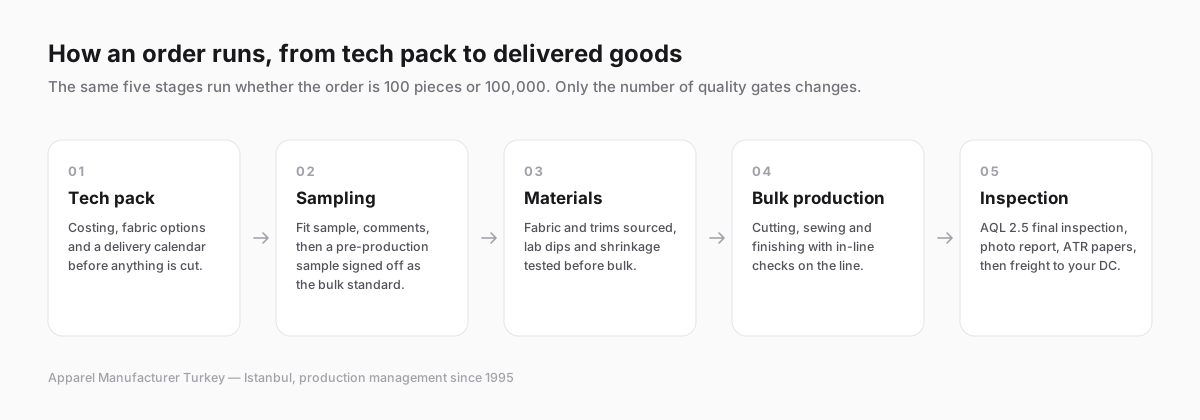
Sampling is where your product actually gets designed. The normal sequence is a proto sample to prove the concept, one or two fit rounds to correct measurements, and a pre-production sample in the correct fabric and colour that becomes the binding quality standard for bulk. Expect two to three rounds and 100 to 300 per style in sample fees, which reputable factories often credit back against the bulk order.
Each round in Turkey typically takes one to two weeks plus courier time, so sampling a style properly takes four to eight weeks end to end. Build this into your launch date honestly; compressing sampling is how brands end up selling garments that fit badly.
Test samples brutally. Wash them five times, wear them for a week, check shrinkage against the size chart, and put them on real bodies at each end of your size range. Every flaw you find now costs a revision; every flaw you find after bulk costs an inventory write-off.
Step 5: Do the MOQ maths before you fall in love
Minimum order quantities decide what your launch can look like, so run the arithmetic early. A typical Turkish MOQ structure is around 100 pieces per style, split across sizes and colours as you choose. That means one style in three colours is one 100-piece commitment, while three styles in three colours each is a 300-piece commitment.
Now attach money. At an example 8 per t-shirt and 13 per hoodie, a launch of one tee and one hoodie at 300 pieces each is roughly 6,300 in production cost before freight, duty and packaging. Check that against your budget from step two, then check sell-through: at 30 units sold per month, 300 pieces is ten months of stock. If the maths does not close, cut styles or colours, not quality.
Size curves matter too. Your order will be spread across sizes, typically weighted toward M and L. Order flat across sizes and you will sell out of mediums while sitting on double-XL stock, so ask your manufacturer for a standard size curve for your market and adjust from your own data after launch.
Step 6: Production, quality control and shipping
Bulk production on approved styles typically takes four to six weeks in Turkey: fabric knitting or procurement and dyeing, then cutting, printing or embroidery, sewing, finishing and packing. During production, ask for weekly photo or video updates at defined milestones rather than a silent month.
Insist on a final inspection against an AQL standard, commonly AQL 2.5 for major defects, before goods ship. You can do this through the factory's own QC, a third-party inspection company for roughly 200 to 350 per man-day, or your production partner. Also agree measurement tolerances in writing, typically plus or minus 1 to 2 centimetres depending on the point of measure.
From Istanbul, road freight reaches most of Europe in three to seven days, air freight reaches most of the world in two to five days at a premium, and sea freight to North America takes roughly three to five weeks. Factor customs duties and import VAT for your market into your landed cost from the start, not as a surprise at delivery.
Step 7: Launch like a retailer, not an artist
Start building an audience months before inventory arrives. A brand that launches to 2,000 engaged followers and a 500-person email list sells in days; a brand that launches to silence sells nothing regardless of product quality. Content documenting your process, sampling included, is the cheapest audience builder available.
Price from your costs upward, not from your ego downward. Direct-to-consumer apparel brands commonly price at 3 to 5 times landed cost to fund marketing, returns, storage and future production runs. A hoodie that lands at 15 all-in and sells at 65 to 75 is a business; the same hoodie at 35 is a hobby that pays for itself on a good month.
Finally, plan run two before run one sells out. Reordering takes four to six weeks of production plus shipping, so track sell-through weekly and reorder your winners when roughly half the stock is gone. The first order proves the product; the second order is where the brand starts making money, because sampling and setup are already paid for.
Indicative launch budgets
| Blanks and printing test | 1,000-3,000; ready-made garments with your prints, lowest risk, lowest margin |
|---|---|
| Single-style custom launch | 8,000-15,000; one cut-and-sew style, 300 pieces, small marketing budget |
| Two to three style launch | 15,000-35,000; small capsule, proper photography and marketing |
| Full capsule launch | 35,000-60,000 and up; four to six styles, multiple colourways, paid acquisition |
Planning a production run?
Send your tech pack or reference photos — clear quote with MOQ, sampling cost and lead time within one business day.
Frequently asked questions
Related pages
More in Resources
Ready to make your first production run?
We help new brands go from tech pack to delivered inventory through vetted Istanbul factories, with MOQs from 100 pieces per style. Email info@apparelmanufacturerturkey.com with your idea and we will tell you honestly what it will cost and how long it will take.