Free Tech Pack Template for Clothing Brands
A complete tech pack template you can download and use straight away: style information, flats and artwork, bill of materials, graded measurements, colourways, size breakdown, labels and a revision log. No sign-up. Below the download, a sheet-by-sheet guide to filling it in.
- Format
- Excel (.xlsx)
- Sheets
- 8 working + 2 examples
- Grading
- Automatic from base size
- Price
- Free, no sign-up
Reviewed and updated 2026-10-24 by the Apparel Manufacturer Turkey production team in Istanbul, managing apparel production since 1995.
Quick answer
This free Excel tech pack template covers everything a factory needs to quote and sample a garment: style details, flat sketches and artwork placement, a bill of materials, points of measure that grade automatically from your base size, colourways, size breakdown, labelling and a revision log, with filled hoodie and t-shirt examples.
Download the tech pack template
Excel file (.xlsx), works in Excel, Google Sheets, Numbers and LibreOffice. Free, no sign-up.
- Style information
- Flats and artwork placement
- Bill of materials (BOM)
- Points of measure with auto grading
- Colourways
- Size breakdown with totals
- Labels and packaging
- Revision log
- Filled hoodie example
- Filled t-shirt example
Example sheets use illustrative values, not a size standard.
What a factory needs from your tech pack
A tech pack is the written instruction set for one garment. A factory uses it three times: to quote, to make the first sample, and as the standard the bulk order is checked against. Anything missing is guessed, and guesses are where cost surprises and wrong samples come from.
The template is organised in the order a factory reads it: who and what the style is, what it looks like, what it is made of, how big it is in every size, which colours, how many, and how it is labelled and packed. Fill it top to bottom and you have answered the questions a technical team would otherwise send back by email.
Style and flats: the first two sheets
The Style sheet holds the header information: style name and number, season, category, fit, base size, size range, main fabric, number of colourways, target quantity, delivery date and destination, and your target price with its Incoterm. Quantity, destination and date matter as much as the design, because they decide which production route makes sense.
On Flats and Artwork, paste front and back flat sketches, then list construction callouts such as seam types, stitch details and finishes. Every print or embroidery gets its own row with placement, technique, size in centimetres and position measured from a fixed point, usually the high point shoulder or centre front.
Bill of materials: list every component
The BOM lists every physical item in one finished, packed garment: main fabric, rib, drawcords, eyelets, zips, thread, labels, hangtags, polybags. For each one, give a description, composition, weight or size, colour, placement and quantity per garment.
Be specific about fabric. Instead of cotton fleece, write the structure, composition and weight with tolerance, for example three-thread fleece, brushed back, 80 percent cotton 20 percent polyester, 320 GSM plus or minus 5 percent. Our fabric GSM guide explains how weight is specified and measured.
Points of measure and grading
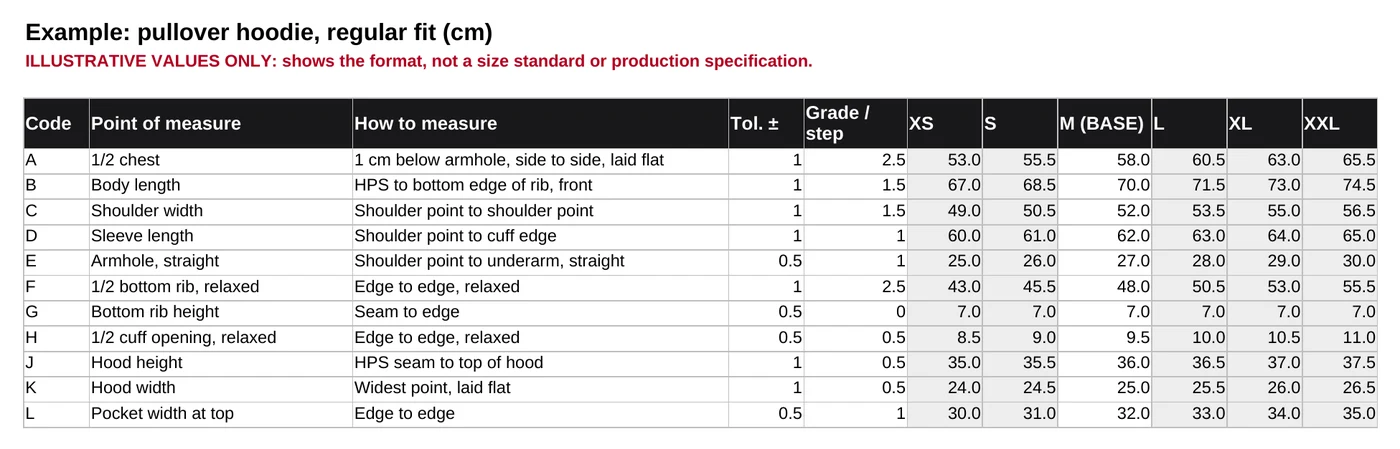
The POM sheet is the measurement chart. Each row is one point of measure with a code, a plain description of how to measure it, a tolerance and the base-size value. Enter a grade per size step and the template calculates the other sizes, so a change to the base size updates the whole chart.
Real grade rules are not always uniform. Rib heights usually stay the same across sizes, and some points grade differently between small and large sizes. Where that happens, overwrite the calculated cell and record why in the revision log. Measure garments laid flat and relaxed unless the row says otherwise, and keep the method identical between sample and bulk checks.
Colourways, size breakdown, labels
Colourways lists the colour reference for each component: body, rib, drawcord, thread and print colours. Use a physical standard such as a Pantone TCX reference or an approved lab dip, not a screen colour. The Size breakdown sheet totals your quantities per colour and size automatically, which is what the factory uses to plan fabric.
Labels and Packaging covers main and size labels, care label content, hangtags, barcodes, folding, polybags and carton marks. Care label wording has legal requirements in each market, so check the rules where you sell before approving it.
Keep a revision log
After the first sample, every change goes into the revision log with version, date, what changed, why and who approved it. Reference the version number in every email. When a bulk order is checked, it is checked against a specific version, and the log is how both sides agree which one that is.
- Issue a new version for every set of sample comments
- Change the file name with the version, for example HD-001 v3
- Approve the pre-production sample against the latest version, in writing
What is in the template
| Style | Header details, quantities, destination, target price and Incoterm |
|---|---|
| Flats & Artwork | Front and back flats, construction callouts, artwork placement |
| BOM | Every fabric, trim, label and packaging item per garment |
| POM | Measurements, tolerances and automatic grading XS-XXL |
| Colourways | Colour references per component and colourway |
| Size breakdown | Quantities per colour and size with totals |
| Labels & Packaging | Label content, care instructions, packing |
| Revision log | Version history and approvals |
Planning a production run?
Send your tech pack or reference photos — clear quote with MOQ, sampling cost and lead time within one business day.
Frequently asked questions
Related pages
Finished your tech pack?
Send the completed file and we will check it for gaps and quote fabric options, sampling and production.