Cut and Sew vs Ready-Made Clothing
Every apparel brand faces the same fork: manufacture garments from scratch, or buy ready-made blanks and decorate them. Both are legitimate businesses with different economics. This guide compares them honestly and gives you a decision framework that does not depend on hype.
Reviewed and updated 2026-08-08 by the Apparel Manufacturer Turkey production team in Istanbul, managing apparel production since 1995.
Quick answer
Cut and sew means manufacturing garments from scratch to your own pattern and fabric; ready-made means decorating existing blanks. Blanks let you launch in one to three weeks from about 20-50 pieces, while cut and sew takes two to four months and roughly 100-piece minimums but delivers unique fit, custom fabric and stronger margins beyond a few hundred units.
Two different businesses wearing the same t-shirt
Cut and sew means full custom production: fabric is knitted or bought to your specification, cut against your pattern and sewn into a garment that did not exist before you designed it. You control silhouette, measurements, fabric weight, seams, every trim and every label. In Turkey this typically means MOQs from around 100 pieces per style, sampling in one to two weeks per round, and bulk production in four to six weeks.
Ready-made, often called blanks plus decoration, means buying finished garments from a blank supplier and adding your prints, embroidery and relabelling. The garment itself is designed and produced by someone else at enormous scale, which is why a quality blank can cost less than the fabric alone would in a small custom run.
The comparison matters because founders regularly pick by default rather than by decision: designers default to cut and sew because it feels like real fashion, marketers default to blanks because it feels fast. Both defaults ignore the actual trade-offs, which are cost structure, branding depth and speed.
Cost: where the money goes in each model
Blanks look cheaper per experiment and often are. A good mid-weight blank tee might cost 4 to 10 depending on brand and market, plus roughly 2 to 6 for printing and relabelling. There is no development cost, no sampling beyond print approval, and no minimum beyond the printer's, often 20 to 50 pieces. Total exposure for a first drop can sit comfortably under 1,500.
Cut and sew front-loads cost and then wins on units. Development and sampling might run 300 to 700 per style, and a 100-piece MOQ at an example 6 to 8 per custom tee commits roughly 2,000 to 2,500. But at comparable quality the custom unit cost is frequently at or below the decorated-blank cost, because you are not paying the blank brand's margin and distribution chain. On reorders, with development already paid, the gap widens further.
The crossover point varies by product, but as a rough orientation: below a few hundred units per style, blanks usually cost less in total; beyond that, cut and sew usually costs less per unit and earns more margin. Run your own numbers with real quotes before believing either camp.
Branding: what each model lets you own
With blanks, your brand lives on the surface: graphics, embroidery, neck print, hangtags, packaging and story. That is not nothing; entire successful merch and streetwear operations are built on exceptional graphics on well-chosen blanks. But the garment underneath is available to every competitor with the same catalogue login, and informed customers increasingly recognise popular blanks on sight.
With cut and sew, the product itself is the brand: a fit nobody else has, a 350 GSM fabric with a specific wash, a seam detail that photographs distinctively. These are compounding assets, because fit loyalty drives reorders and cannot be copied by relabelling. Custom production also unlocks details blanks forbid: custom ribbing, specific dye colours, garment washes, unique silhouettes and inclusive size curves.
A useful test: describe your product without mentioning the graphic or the logo. If there is nothing left to say, you are in the blanks business regardless of ambition, and your moat must come from community and content. If the description survives, cut and sew is how you deliver it.
Speed and operations
Blanks win on calendar speed, decisively. Stock garments plus local printing can go from idea to sellable product in one to three weeks, which suits drops, event merchandise, trend reactions and audience tests. There is no sampling loop, no fabric lead time and no size-curve gamble beyond choosing how many of each blank size to buy.
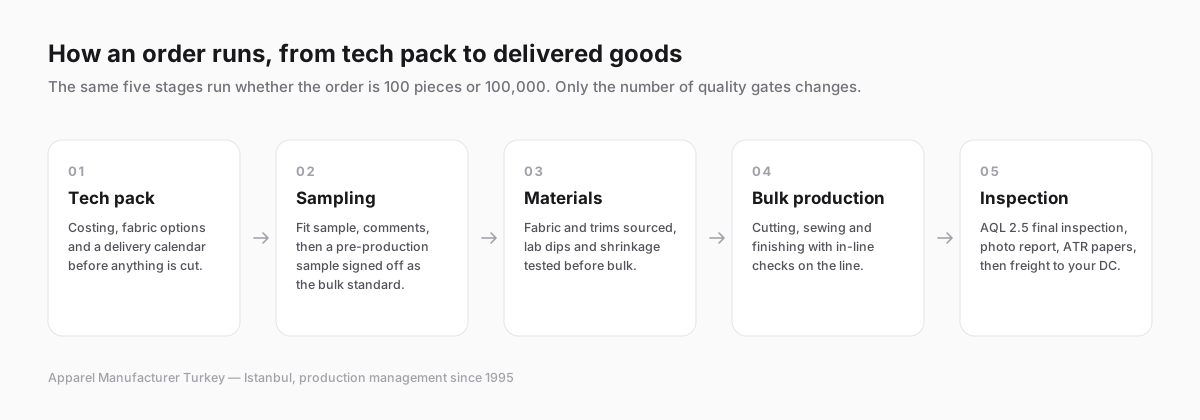
Cut and sew runs on a production calendar: tech pack, two to three sampling rounds over four to eight weeks, then four to six weeks of bulk, plus freight. From standing start, two to four months to first delivery is realistic in Turkey, faster on repeats since development is done and fabric may be reserved.
Operationally, blanks also outsource inventory risk on the garment side; sold-out colourways can often be repurchased within days. Cut and sew makes you the inventory owner with six-to-eight week reorder cycles, which demands forecasting discipline but also means supply of your bestseller is never hostage to a blank supplier discontinuing a style, changing a fit, or raising prices mid-season.
Quality and the myth of the premium blank
It is worth killing a myth in both directions. Blanks are not inherently low quality: the best blank programmes offer heavyweight combed cotton, tight tolerances and consistent dyeing that many small custom runs struggle to match. Equally, cut and sew is not inherently premium: a badly specified custom garment from an unvetted workshop will be worse than any reputable blank.
What cut and sew genuinely offers is quality you define rather than quality you select. If the blank market already makes exactly the garment your customer wants, custom production adds cost without adding value. If your intended product does not exist in any catalogue, the correct fit, fabric or construction being the point, then no amount of blank shopping will get you there.
Whichever route you take, quality control is yours to own: measure and wash-test blanks before committing a drop, and inspect custom production against your approved pre-production sample. The failure mode of skipping checks is identical in both models.
A decision framework
Answer these questions honestly and the choice usually makes itself.
- Is the garment itself part of your pitch, fit, fabric or construction? Yes points to cut and sew; no points to blanks
- Can you commit roughly 2,500-5,000 per style including development? No points to blanks for now
- Do you need to launch within a month? Yes points to blanks
- Is your realistic first-year volume per style above roughly 500 units? Yes strengthens the cut and sew case on margin
- Does your price point exceed roughly 40-50 for a tee or 70-80 for a hoodie? Customers at those prices expect a garment that justifies them, which points to cut and sew
- Are you selling identity and community first, product second? Blanks are a perfectly good vehicle, and a hybrid, blanks for graphic pieces plus one or two custom hero products, is often the strongest configuration
Cut and sew vs ready-made blanks
| Design control | Cut and sew: full. Blanks: decoration and labels only |
|---|---|
| Typical minimums | Cut and sew: about 100 pcs per style. Blanks: often 20-50 pcs |
| Upfront cost per style | Cut and sew: development plus MOQ. Blanks: little beyond the drop itself |
| Unit margin at scale | Cut and sew: stronger beyond a few hundred units. Blanks: capped |
| Speed to first sale | Cut and sew: 2-4 months. Blanks: 1-3 weeks |
| Supply risk | Cut and sew: you own it. Blanks: catalogue changes can kill a bestseller |
Planning a production run?
Send your tech pack or reference photos — clear quote with MOQ, sampling cost and lead time within one business day.
Frequently asked questions
Related pages
Ready to move beyond blanks?
Our Istanbul factory network produces full cut-and-sew programmes from 100 pieces per style, with sampling in 1-2 weeks and bulk in 4-6 weeks. Send your product idea to info@apparelmanufacturerturkey.com for a straight answer on cost and timeline.