Turkey vs Pakistan for Clothing Manufacturing
Pakistan is an underrated sourcing base, particularly for denim and knitwear, where its value is genuinely strong. This comparison looks honestly at where Pakistani pricing beats Turkey, and where Turkey's proximity to Europe changes the equation.
- Pakistan edge
- Denim and knit value
- Turkey MOQ
- From 100 pcs / style
- Turkey to EU
- 3-7 days by road
- Shared strength
- Cotton-based supply chains
Reviewed and updated 2026-08-02 by the Apparel Manufacturer Turkey production team in Istanbul, managing apparel production since 1995.
Quick answer
Pakistan generally undercuts Turkey on cotton products, and its denim mills offer world-class value at volume, though sea freight to Europe takes three to five weeks. Turkey answers with premium denim washes, MOQs from around 100 pieces, faster sampling and duty-free EU delivery in 3-7 days by road. Pick by scale versus speed.
Two cotton countries, one big geographic difference
Turkey and Pakistan have more in common than most pairings in this series: both are cotton-growing countries with vertically integrated textile industries, and both are internationally respected for denim in particular. Karachi, Lahore and Faisalabad host serious denim mills and garment factories that supply well-known Western brands, and Pakistani knitwear, towels and basics offer strong value.
The decisive difference is geography. Pakistan ships to Europe by sea over several weeks; Turkey ships by road in 3-7 days and sits inside the EU Customs Union. Almost every trade-off between the two countries flows from that single fact.
Pricing: Pakistan usually undercuts Turkey
On comparable cotton-based products, Pakistani factory prices are generally lower than Turkish ones; labour costs are lower and the industry competes aggressively for export orders. For denim and knit basics at volume, the FOB gap in Pakistan's favour is real, and buyers with scale use it.
The honest counterweight is landed cost and cash cycle. Sea freight to Europe typically takes three to five weeks, and the longer pipeline means more capital locked in inventory and less ability to react to demand. For large planned programmes that overhead is absorbed easily; for a brand ordering 500 pieces per style with monthly drops, the cheaper unit often costs more by the time it is sold.
Denim: a genuine head-to-head
Denim deserves its own section because both countries are world-class. Pakistani denim mills are respected globally and offer excellent fabric value; the country's denim garment sector handles washes and finishes at serious volume. For value-driven denim programmes at scale, Pakistan is a legitimate first choice, not a compromise.
Turkish denim competes at the premium end of the same market: mills around Istanbul and the wider region supply high-fashion and contemporary brands, and the garment side offers advanced laundries and short development loops. The practical split many buyers land on: Pakistan for value denim at volume, Turkey for premium washes, faster development and mid-size fashion denim runs from around 100 pieces.
Logistics, access and compliance perception
Operationally, Turkey is simply easier for a European buyer. Istanbul is a short direct flight from anywhere in Europe with straightforward access, factories work on European time, and goods arrive duty-free by road in under a week. Visiting Pakistani factories involves longer travel, more planning, and for some companies internal travel-policy restrictions, which in practice means less first-hand oversight.
On compliance, Pakistan's top exporters are well audited and certified, and the country benefits from preferential EU market access under trade schemes. Perception nevertheless varies among Western buyers and some retailers apply extra scrutiny to the origin, fairly or not. That perception gap is a commercial reality worth naming: it affects some brands' sourcing decisions independent of what individual factories actually deliver.
- Pakistan: lower prices on cotton products, world-class denim mills, strong knit and towel base
- Turkey: 3-7 day EU delivery, duty-free Customs Union access, easier factory visits, faster sampling loops
- Both: vertically integrated cotton supply chains and genuine denim credibility
Verdict: scale and price versus speed and proximity
Choose Pakistan when you are buying cotton-based product, especially denim or knit basics, in large planned volumes where its price advantage compounds, and when your team can manage a longer, more distant supply chain. In that profile Pakistan offers some of the best value in the industry.
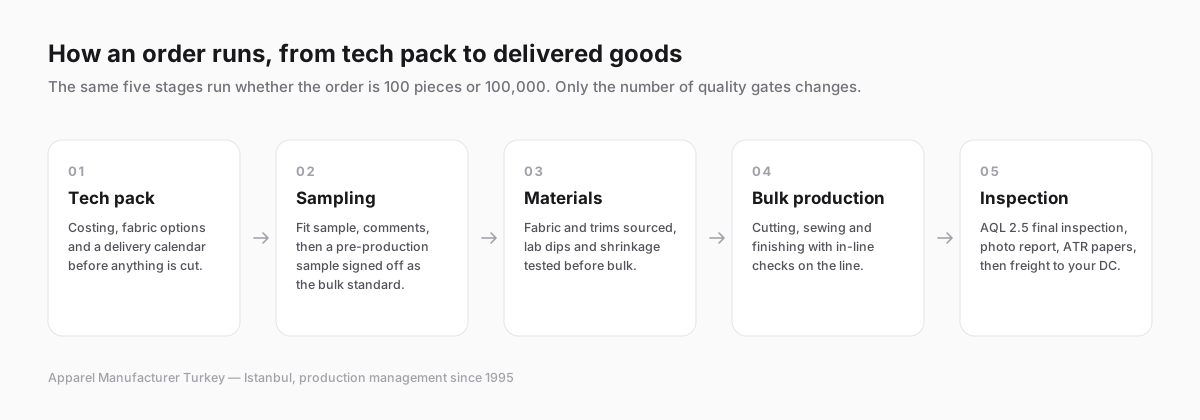
Choose Turkey when your orders sit in the hundreds to low thousands of units, when your market is Europe or the UK and speed protects your margin, or when development iterations matter as much as unit price. We run that model daily through a vetted Turkish network managed from Istanbul, with sampling in 1-2 weeks and bulk in 4-6 weeks. Email info@apparelmanufacturerturkey.com and we will benchmark your product honestly, including where Pakistan would win.
Turkey vs Pakistan at a glance
| Unit price on cotton products | Pakistan generally lower |
|---|---|
| Denim credentials | Both world-class; Pakistan value-led, Turkey premium-led |
| Typical MOQ | Turkey: from 100 pcs / style. Pakistan: often 1,000+ pcs at export factories |
| Transit to EU | Turkey: 3-7 days by road. Pakistan: typically 3-5 weeks by sea |
| EU market access | Turkey: Customs Union duty-free. Pakistan: preferential EU scheme access |
| Factory access from Europe | Turkey: short direct flights. Pakistan: longer, more planning |
| Best fit | Pakistan: value denim and knits at volume. Turkey: fast mid-size EU programmes |
Planning a production run?
Send your tech pack or reference photos — clear quote with MOQ, sampling cost and lead time within one business day.
Frequently asked questions
Related pages
More in Resources
Benchmark your denim or knit programme
Send your tech pack to info@apparelmanufacturerturkey.com for a full quote from our vetted Turkish network, with an honest note on whether Pakistan's pricing would serve your volumes better.