Clothing Production Planning Guide
Most production disasters are really planning disasters. This guide shows how to build a production calendar backwards from your launch date, where to place buffers, and how to time reorders so a bestseller never sits out of stock for months.
- Sampling
- 1 to 2 weeks per round
- Bulk production
- 4 to 6 weeks typical
- Freight from Turkey
- Days by road to EU
- Safe concept-to-launch
- 4 to 6 months
Reviewed and updated 2026-07-31 by the Apparel Manufacturer Turkey production team in Istanbul, managing apparel production since 1995.
Quick answer
Plan clothing production backwards from your launch date: allow one to two weeks of sampling per round, four to six weeks of bulk production, freight time, and a buffer at every handover. A safe concept-to-launch runway is four to six months, and reorders on winning styles should trigger when roughly half the stock has sold.
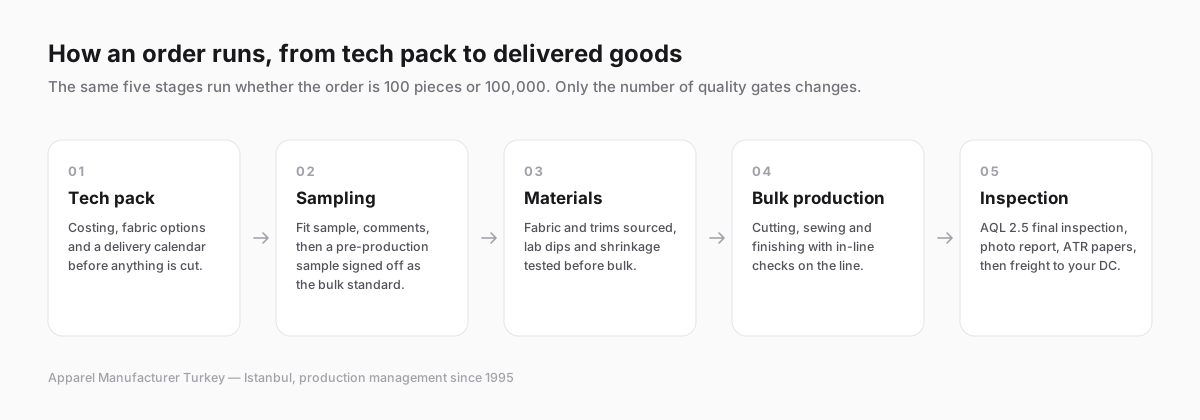
Think in Calendars, Not Deadlines
A launch date on its own is not a plan. A plan is the chain of dated milestones that must each happen for the launch to be possible: design freeze, tech pack complete, sampling rounds, fabric booking, bulk production, quality inspection, freight, warehouse receipt, and content production for the launch itself.
The fashion industry formalises this as a seasonal calendar. Traditional wholesale brands work two seasons ahead, designing autumn-winter in the previous winter. Direct-to-consumer brands can compress this, but the logic is identical: every downstream date is dictated by an upstream one, and the chain only moves as fast as its slowest link.
The discipline that makes this work is planning backwards. Fix the launch date, then subtract each stage's duration plus a buffer to find your latest safe start date. If that start date is in the past, change the launch date now rather than discovering the problem in week four of production.
Know Your Real Lead Times
Working with Turkish manufacturers, typical durations are one to two weeks per sampling round, four to six weeks for bulk production after approval, and road freight to most of Europe in roughly three to seven days, with air freight to the US in under a week and sea freight taking several weeks. These are indicative; your quote is the number that counts.
Two stages are routinely underestimated. First, sampling is usually plural: a first proto, a revision, and often a pre-production sample means three rounds, not one, so budget four to eight weeks for the sampling phase of a new style. Second, fabric procurement can gate everything; stock fabrics are available in days, but custom-dyed or custom-knitted fabric can add two to four weeks before sewing even starts.
Ask your manufacturer to break their quote into stages with dates: fabric in-house, cutting start, sewing complete, inspection, ex-factory. A single all-in lead time hides where the risk sits and makes progress impossible to track.
Build the Backwards Plan: A Worked Example
Here is a hypothetical example for a brand launching a hoodie collection on 1 October. Working backwards: stock must be in the warehouse by 15 September to allow content photography and fulfilment setup. Road freight from Istanbul takes about a week, so goods must leave the factory by 5 September. Final inspection takes a few days, so production must finish by 1 September.
Bulk production at five weeks means production starts by 28 July, which requires approved pre-production samples and fabric in-house by then. Allowing two sampling rounds at two weeks each plus shipping and evaluation time, sampling must start by mid-May, which means tech packs are finalised by early May and designs frozen in April.
Notice that a 1 October launch consumed the whole summer. That is normal. The worked example also shows where compression is possible if you are late: use stock fabrics instead of custom dyeing, sample two styles in parallel rather than sequence, or launch with a pre-order model that tolerates a later delivery date.
Where to Put Buffers, and How Big
Buffers belong at handoff points, because that is where delays actually occur: sample evaluation waiting on your feedback, fabric waiting on a lab dip approval, finished goods waiting on a customs document. A useful starting rule is one week of buffer after sampling, one week after bulk production, and one week around freight and customs.
Do not spread buffer evenly as padding on every task, and do not let the team treat buffer as available time. The buffer exists to absorb the one stage that overruns, and on a first production run with a new manufacturer, something usually does.
Your own response time is part of the timeline. A factory that turns a sample in ten days gains you nothing if the sample then sits in your inbox for two weeks. Put your own evaluation and approval tasks on the calendar with dates, exactly like factory tasks.
Plan Reorders Before You Launch
The most expensive stockout is on your bestseller, and it is also the most predictable. A reorder placed the day you sell out still takes the full bulk lead time plus freight to arrive, which can mean six or more weeks of dead sales at exactly the moment demand is proven.
Set a reorder trigger before launch: when remaining stock of a style drops below the units you expect to sell during one replenishment cycle, reorder. If you sell 100 pieces a week and replenishment takes six weeks, the trigger is around 600 pieces plus a safety margin. The arithmetic is simple; the discipline is deciding it in advance.
Reorders are also where relationships pay off. Repeat styles skip sampling, patterns and consumption are known, and manufacturers often prioritise a proven customer's repeat order. Keeping label and trim stock from your first order, as covered in our branding guide, removes another gate. Many brands find reorder lead times meaningfully shorter than first-order lead times for these reasons.
Tools and Habits That Keep the Plan Honest
You do not need planning software to start; a shared spreadsheet with one row per milestone, an owner and a date is enough for a small brand. What matters is that it is shared with your manufacturer, updated weekly, and treated as the single version of the truth.
Hold a short weekly check-in with your manufacturer or sourcing partner during active production: what finished last week, what starts this week, what is blocked. Ask for photos at milestones, such as fabric arrival and the first pieces off the line. Surprises shrink in proportion to communication frequency.
Finally, review the plan after each season: which stages ran long, which buffers were consumed, where your own approvals lagged. Two or three seasons of honest retrospectives will give you brand-specific lead times far more accurate than any generic guide, including this one.
- One shared milestone sheet, updated weekly
- Every milestone has an owner and a date, including your approvals
- Photo checkpoints at fabric arrival, first off line, and packing
- Reorder triggers set before launch, not after sellout
- Post-season review to calibrate your real lead times
Backwards plan for a 1 October launch (hypothetical)
| April | Designs frozen, fabric direction chosen |
|---|---|
| Early May | Tech packs finalised and sent for quoting |
| Mid May to early July | Sampling rounds, fit approval, lab dips |
| Mid July | Bulk fabric and trims ordered and in-house |
| 28 July | Bulk production starts (5 weeks) |
| 1 to 5 September | Final inspection and ex-factory |
| 15 September | Goods in warehouse, content and fulfilment prep |
| 1 October | Launch |
Planning a production run?
Send your tech pack or reference photos — clear quote with MOQ, sampling cost and lead time within one business day.
Frequently asked questions
Related pages
Want a production calendar built for your launch date?
Tell us your styles and target launch, and we will map a realistic backwards plan with our Istanbul network, including sampling in 1 to 2 weeks and bulk in 4 to 6. Contact info@apparelmanufacturerturkey.com.