Clothing Brand Launch Checklist
Launching a clothing brand is a sequence, and skipping steps early creates expensive rework later. This checklist walks the whole path from concept to first sale, with a timeline table you can adapt to your own launch date.
- Realistic runway
- 6 to 9 months concept to sale
- Production block
- 3 to 4 months of that
- First collection
- 3 to 6 styles is plenty
- MOQ to plan for
- From 100 pcs per style
Reviewed and updated 2026-07-31 by the Apparel Manufacturer Turkey production team in Istanbul, managing apparel production since 1995.
Quick answer
A realistic clothing brand launch takes six to nine months: concept, budget and legal setup in month one, designs and tech packs in month two, manufacturer selection and sampling in months three to four, bulk production in months five to six, then inspection, freight and photoshoot before launch in month seven. Keep the first collection to three to six styles.
Phase 1: Concept and Positioning
Before any garment exists, decide what the brand is: who it serves, what it stands for, what it costs, and why anyone would choose it over the thousands of alternatives a click away. Write this down in a page. Every later decision, fabric, fit, packaging, photography, gets easier when it can be tested against that page.
Define the first collection narrowly. Three to six styles executed well beat twelve styles executed adequately, and every additional style multiplies sampling cost, MOQ commitment and inventory risk. Most strong launches are built around one or two hero products with a couple of supporting pieces.
Set the commercial frame early: target retail prices, an assumed landed cost per style, and the margin between them. If a hoodie must retail at 60 and land at 20 to make the model work, that constraint should shape fabric and decoration choices now, not after sampling.
Phase 2: Legal and Financial Setup
Register a business entity appropriate to your country, open a business bank account, and understand your VAT or sales tax obligations, including what applies when importing goods from Turkey into your market. None of this is glamorous; all of it takes longer than expected, so start it in parallel with design rather than after.
Check that your brand name is usable: a trademark search in your key markets, domain availability, and social handles. A trademark application is worth filing before you print the name on thousands of labels; discovering a conflict after production is a genuinely painful and avoidable scenario.
Build a simple launch budget covering sampling, production, freight and duties, packaging, content creation, website costs and a marketing reserve. Production is usually the largest line but rarely the only large one; brands that budget only for garments routinely run out of money before customers can find them.
Phase 3: Design and Tech Packs
Turn concepts into buildable designs: flat sketches, fabric direction, colour palette and print artwork. Then convert each style into a tech pack, the specification document a factory manufactures from, covering flats, bill of materials, measurement spec with grading and tolerances, construction notes and print placements. Our step-by-step tech pack guide covers the build in detail.
Decide your fabric strategy at this stage because it drives both cost and minimums: stock fabrics in stock colours keep MOQs low and timelines short, while custom dyeing and custom knits raise both. For a first collection, stock qualities from Turkish mills are usually the pragmatic choice.
If you lack design or technical skills, this is the phase to buy help: freelance designers and technical developers can produce professional tech packs from your references. It is far cheaper to pay for a good tech pack than to pay for the extra sampling rounds a bad one causes.
Phase 4: Manufacturer, Sampling and Production
Select your manufacturer using quotes at your real quantities, references, and ideally samples or a visit; our guide to finding a manufacturer in Turkey covers the process. Confirm MOQ per style and colourway, sampling terms, payment terms, typically a deposit with balance before shipment, and quality criteria in writing.
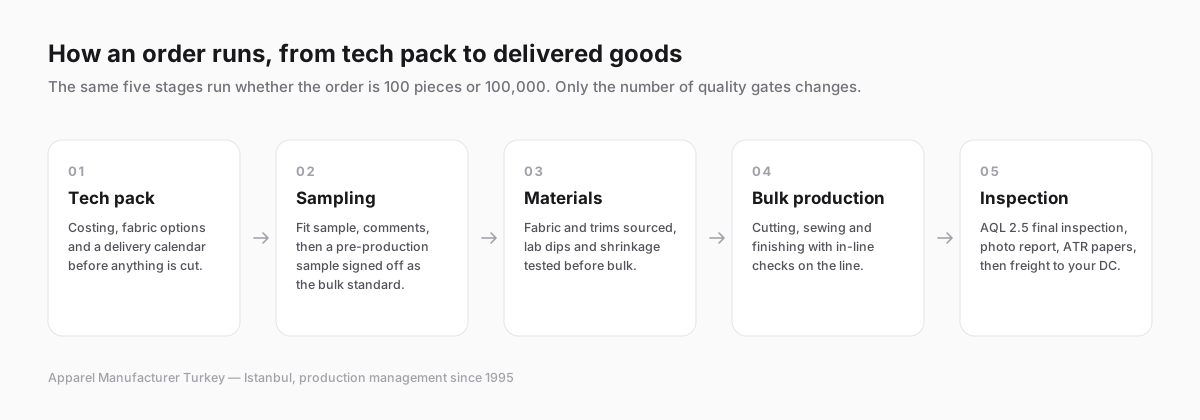
Run sampling seriously: evaluate each round against the tech pack using a structured checklist, wash test the samples, and expect one or two revision rounds. With Turkish partners, each round typically takes one to two weeks plus shipping and your evaluation time. Approve a pre-production sample in bulk fabric before releasing production.
Bulk production typically runs four to six weeks, with labels, tags and packaging produced in parallel if you ordered them on time. Book a final inspection before shipment release, then arrange freight: road to most of Europe in under a week, air or sea elsewhere. Clarify duties and import paperwork for your market in advance so goods clear without surprise costs.
Phase 5: Store, Content and Launch Preparation
While production runs, build the sales channel: an e-commerce store with product pages, payment, shipping rates and a returns policy, plus the legal pages your market requires. Decide fulfilment: from your own space, or a third-party logistics provider that receives your production cartons directly.
Content is the launch's fuel and it needs the actual product, which is why the production timeline includes stock arriving two or more weeks before launch. Shoot product images on model and flat, gather short video for social channels, and write product descriptions that include fit guidance and honest measurement charts drawn from your spec.
Warm the audience before the date: a waitlist or pre-launch email list, teaser content, seeding product with a few relevant micro-creators. A launch to an empty room is the most common first-brand disappointment, and it is prevented in the weeks before, not the days after.
Phase 6: Launch, Learn, Reorder
Launch is a beginning, not a finale. In the first weeks, watch sell-through by style, size and colour, returns and their stated reasons, and which content actually drove sales. This data is the entire brief for your second production decision.
Set reorder triggers on day one: when a style's remaining stock falls below what you expect to sell during one replenishment cycle, reorder it. Repeat production of an approved style is faster than the first run, and Turkish proximity keeps the replenishment loop short, which is precisely the advantage of producing near your market.
Finally, close the loop with your manufacturer: share what sold, what customers said about fit and fabric, and what the next drop looks like. Factories plan capacity around brands that communicate, and your second season will run smoother for it.
- Track sell-through by style, size and colour from day one
- Read return reasons; fit feedback is free product development
- Reorder triggers defined before launch
- Post-launch debrief with your manufacturer
Launch timeline, working backwards from month 7 (hypothetical)
| Month 1 | Concept, positioning, budget; legal setup begins |
|---|---|
| Month 2 | Designs finalised, tech packs built, trademark filed |
| Month 3 | Manufacturer selected, sampling round one |
| Month 4 | Sample revisions, pre-production approval, trims ordered |
| Months 5 to 6 | Bulk production, store build, content planning |
| Late month 6 | Inspection, freight, stock received, photoshoot |
| Month 7 | Launch, first sales, data collection |
| Months 8 plus | Reorders on winners, second drop planning |
Planning a production run?
Send your tech pack or reference photos — clear quote with MOQ, sampling cost and lead time within one business day.
Frequently asked questions
Related pages
Ready to move from checklist to production?
We handle the manufacturing block of this checklist end to end: factory matching, sampling in 1 to 2 weeks, bulk in 4 to 6, from 100 pieces per style. Email info@apparelmanufacturerturkey.com with your plans.