MOQ Negotiation Guide
Minimum order quantities are not arbitrary, but they are often more flexible than the first quote suggests. This guide explains where MOQs come from, which levers actually move them, and how to run the negotiation without burning the relationship.
- Our network MOQ
- From 100 pcs per style
- Colourway minimum
- From 100 pcs on knits
- Biggest lever
- Stock fabric choice
- Best tactic
- Trade volume across styles
Reviewed and updated 2026-08-06 by the Apparel Manufacturer Turkey production team in Istanbul, managing apparel production since 1995.
Quick answer
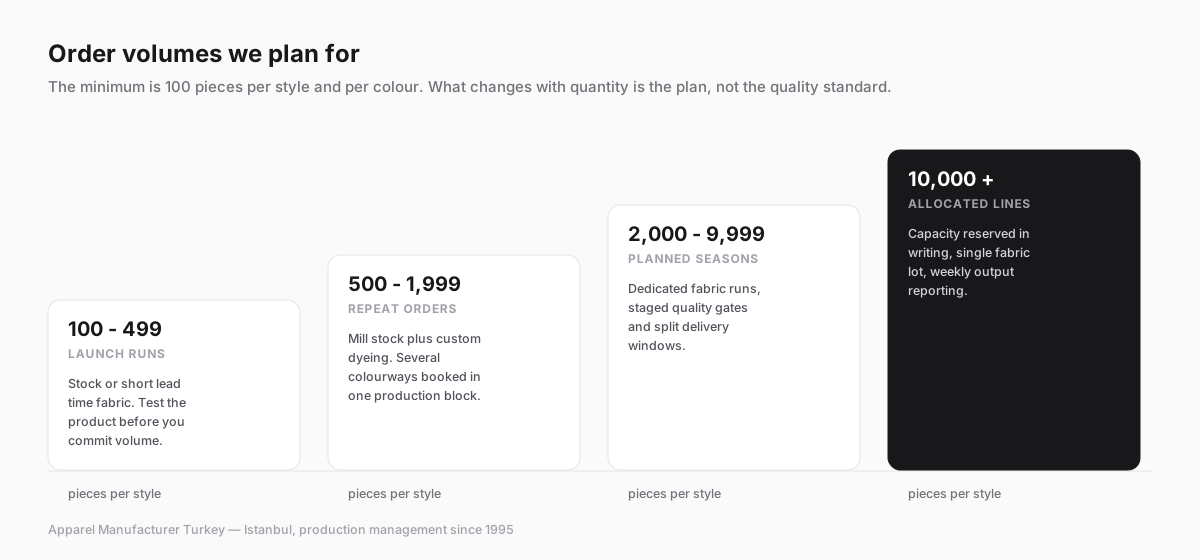
MOQs move when you lower the factory's real costs, not when you simply ask. The strongest levers: choose stock fabrics the mill already runs, consolidate colourways, trade volume across several styles, accept a higher unit price for a smaller first run, and commit to reorders. In Turkey, knitwear minimums start around 100 pieces per style.
Why MOQs Exist at All
A factory's MOQ is mostly a pass-through of constraints further up the chain. Fabric mills dye in batches with their own minimums, often in the range of hundreds of kilograms for a custom colour; trim suppliers have minimums per label or zip; and a sewing line has setup costs, pattern work, machine threading and line balancing, that are the same whether the run is 50 pieces or 5,000.
Understanding this changes how you negotiate. When a factory quotes an MOQ, they are usually protecting themselves from fabric minimums they cannot subdivide and setup costs they cannot recover on tiny runs. Attack the constraint, not the number: if the fabric minimum is the binding constraint, switching to a stock fabric dissolves it.
It also explains why MOQs differ so much between products and regions. A basic tee in a stock jersey has almost no upstream minimums, while a custom-dyed, yarn-dyed stripe program inherits large ones. Turkish manufacturers, working close to domestic mills with strong stock service, can typically run smaller quantities than large-scale Asian export factories, which is why minimums from around 100 pieces per style are achievable here.
Know What the Numbers Mean Before You Negotiate
Clarify three different quantities before responding to any quote. MOQ per style is the total pieces of one design across all sizes and colours. MOQ per colourway is the minimum per colour, driven by fabric dye lots. And the size curve is how pieces distribute across sizes, which factories usually set in standard ratios rather than letting you order five pieces of each size.
A hypothetical example: a factory quotes 300 pieces per style, 100 per colourway. You could run one style in three colours at 100 each, or one colour at 300. You could not run six colours at 50 each, because each colour drops below the dye-lot minimum even though the style total is fine.
Also ask what the MOQ is for, exactly: does it assume their stock fabric or your custom fabric, one print placement or several, and does the sampling cost get credited against bulk? Quotes are only comparable when these assumptions are visible.
What Is Genuinely Negotiable
The most reliable lever is fabric. Choosing a quality the mill holds in stock service, in a stock colour, removes the dye-lot minimum entirely, and factories can often halve an MOQ on that basis alone. You give up a custom shade; you gain small-batch freedom. Many successful brands launch on stock colours and introduce custom dyeing once volumes support it.
The second lever is consolidation. Factories care about total order value and line utilisation more than per-style counts, so offering 900 pieces across three styles in the same fabric is a stronger proposition than three separate 100-piece conversations. Same-fabric styles share cutting lays and fabric purchasing, which genuinely lowers the factory's cost, not just their patience.
Other real options include paying a small-batch surcharge, accepting a longer lead time so the factory can slot your run into gaps, reducing colour count per style, simplifying decoration, and committing, in writing, to a follow-up order. What is rarely negotiable: dropping below a mill's dye minimum for a custom colour, and cutting the price and the quantity simultaneously. Pick one.
- Stock fabric and stock colours: the biggest MOQ reducer
- Consolidate styles in one fabric to raise total order value
- Accept a per-unit surcharge for small runs
- Offer schedule flexibility for gap production
- Fewer colourways per style
- A credible reorder commitment, in writing
The Trade-Offs, Priced Honestly
Every MOQ concession has a cost somewhere, and it is better to see it before you ask. Smaller runs raise the per-unit price because setup costs amortise over fewer pieces; as an indicative pattern, halving quantity can raise unit cost noticeably, with the effect strongest on decorated and complex styles. If your margin cannot absorb that, a lower MOQ is not actually helping you.
Stock fabric limits your palette to what mills carry, which for Turkish mills is usually a workable range of staple colours in common jerseys, fleeces and rib. Fewer colourways concentrate inventory risk in fewer bets, which is often a feature for a first collection rather than a bug: three colours selling through beats six colours half-sold.
Weigh all of this against the cost the MOQ protects you from: dead stock. Ordering 1,000 pieces at a great unit price and selling 400 is worse than ordering 300 at a higher unit price and selling out. For a first run, the cheapest unit is rarely the cheapest outcome.
Scripts for the Conversation
Opening the topic, after you have a quote: We are planning our first production run and your standard MOQ is above our launch volume. Before we ask you to move the number, can you tell us what drives it, is it the fabric minimum, the line setup, or both? This question signals you understand their side, and the answer tells you which lever to pull.
Pulling the fabric lever: If we switch this style to a jersey you hold in stock, in stock colours, what would the minimum and the unit price become? Or the consolidation lever: We can commit to three styles in the same fleece, 900 pieces total this season. On that basis, could you run 100 per style?
Closing with a growth frame: Our plan is a 100-piece first run, and if sell-through meets target we reorder within eight weeks at double the quantity. We are happy to put that intention in the purchase order. Can you support the first run at this level? Note what these scripts never do: plead, bluff about fake volumes, or demand a lower price and lower quantity in the same breath. Factories remember both good and bad first negotiations.
When the Answer Is Still No
If a factory will not move, it usually means your request sits below their operating model rather than below their goodwill, and no script fixes that. The efficient response is to change counterparties, not to keep pushing: seek out smaller workshops, or work through a sourcing partner whose aggregated volume gives factories a reason to accept smaller individual runs.
Alternatives worth considering while volumes grow include starting with blanks plus decoration, which has very low minimums but limited differentiation, running a pre-order launch so demand accumulates before production, and beginning with one hero style done properly instead of a six-style collection spread thin.
Whatever route you choose, revisit the economics honestly each season. MOQ pressure eases quickly as a brand grows; the negotiation that failed at 150 pieces is uneventful at 500. The goal of a first run is to reach a second run, not to win the best terms in the building.
Planning a production run?
Send your tech pack or reference photos — clear quote with MOQ, sampling cost and lead time within one business day.
Frequently asked questions
Related pages
Need small-batch production without the negotiation?
Our vetted Istanbul network runs from 100 pieces per style, terms already agreed. Send your styles to info@apparelmanufacturerturkey.com for a quote at your real quantities.