Private Label vs White Label Clothing
The two terms are used interchangeably so often that most articles about them are wrong. This guide draws the line precisely, weighs cost against control for each model, and gives you a straightforward way to choose between them.
Reviewed and updated 2026-08-08 by the Apparel Manufacturer Turkey production team in Istanbul, managing apparel production since 1995.
Quick answer
Private label means a manufacturer produces your own design under your brand; white label means you put your branding on the manufacturer's existing catalogue product. Private label offers full control over fit and fabric but needs roughly 100-piece MOQs, 200-700 in development per style and two to four months; white label launches in one to three weeks from 50-200 pieces.
The definitions, untangled
White label clothing is a pre-designed, pre-developed product that a manufacturer offers to many buyers, each of whom sells it under their own brand. The manufacturer owns the design; you add your label, prints and packaging. The classic example is a blank hoodie from a catalogue that fifty different brands relabel and decorate.
Private label clothing is product developed for you and sold only by you. You control the design, the fit, the fabric and the specification, usually via a tech pack, and the manufacturer produces to it. The design belongs to your brand, and no competitor can order the same garment from the same catalogue.
The confusion arises because both models put your label in someone else's factory output, and because many manufacturers offer both. The test is simple: if another brand could order substantially the same garment from the same supplier, it is white label; if the product exists because you specified it, it is private label.
The white label model in practice
White label works from a catalogue. You choose from existing styles, fits, fabrics and colours, then customise the surface: your woven or printed label, your prints or embroidery, your hangtags and packaging. Because development is already done, minimums are low, often 50 to 200 pieces or even less, and delivery can be as fast as one to three weeks since garments may already exist in stock.
The economics are friendly to starters. There are no tech pack or pattern costs, no sampling rounds beyond a strike-off of your print, and no fabric minimums to fund. Your risk per style can be a few hundred rather than a few thousand euros, which makes white label the cheapest legitimate way to test whether anyone wants to buy from your brand at all.
The ceiling is equally real. Your fit and fabric are identical to every other brand using that catalogue, so your differentiation lives entirely in graphics and marketing. Margins are thinner because the blank already carries the supplier's margin, and you have no answer when a customer asks what makes the garment itself special.
The private label model in practice
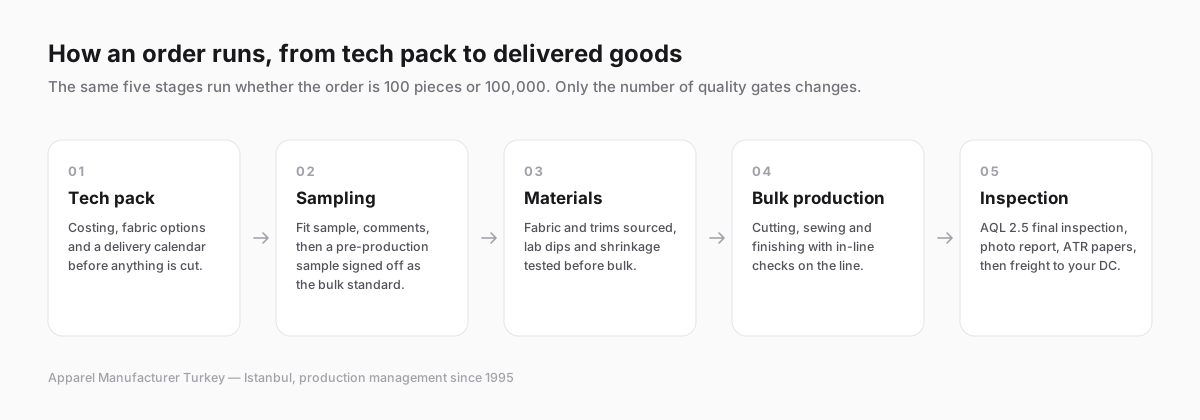
Private label starts from your specification. You, or a technical designer you hire, define the silhouette, the measurements, the fabric down to GSM and yarn, the trims and the construction. The manufacturer patterns, samples and produces it, and the result is a garment nobody else sells.
The costs follow from the development work. Expect tech pack and sampling investment of roughly 200 to 700 per style, MOQs of around 100 pieces per style in Turkey because custom fabric and line setup have minimums, and a development-to-delivery timeline of roughly two to four months for a first style. In exchange, unit costs at volume are usually lower than buying decorated blanks of comparable quality, and margins improve accordingly.
Control is the deeper advantage. Fit is the strongest retention lever in apparel; a customer who loves how your hoodie fits cannot buy that fit anywhere else, which is a moat no graphic can provide. Private label also lets you choose certified fabrics, adjust for your market's body shapes, and evolve products from sales feedback, none of which a catalogue permits.
Cost and control, side by side
The trade-off between the models is not quality, since excellent garments exist in both; it is where your money goes and what you own afterwards. White label spends nothing on development and more per unit; private label spends up front and less per unit at scale, while accumulating assets, namely patterns, fit data and product reputation, that belong to you.
A worked hypothetical makes it concrete. A brand testing a concept buys 100 quality blanks at 8 each and prints them for 3 each: 1,100 committed, live in two weeks, unit cost 11. The private label version of a comparable garment might cost 400 in development, then 300 pieces at 9: about 3,100 committed and eight weeks to delivery, unit cost just over 10 and falling on reorders, with a fit and fabric that are yours alone. Neither is wrong; they answer different questions.
The first question is does anyone buy from me; the second is can I build something defensible. White label answers the first cheaply. Private label answers the second properly.
Which to choose, when
The decision usually reduces to stage, budget and product ambition. Use these rules of thumb rather than ideology.
- Choose white label when testing demand, when your budget per style is under roughly 2,000, or when speed to market matters more than product uniqueness
- Choose white label for merchandise, event and community drops, where the graphic is the product
- Choose private label when fit, fabric or construction is part of your pitch, or when your customer pays a premium you must justify in the garment
- Choose private label when reorders are proven and margin per unit starts to dominate your economics
- Choose private label when you need certified or specific fabrics, inclusive sizing, or any spec a catalogue cannot offer
- A hybrid is legitimate: many brands run white label graphic tees alongside two or three private label hero pieces, and migrate winners to private label as volumes justify development
Questions to ask a supplier under each model
For white label, ask what blank styles and fabrics are stocked and in which colours, what the decoration and relabelling minimums are, whether garments meet your market's labelling and safety rules once relabelled, and who is legally the manufacturer of record for compliance purposes. Also confirm continuity: catalogues change, and a discontinued blank kills a bestseller overnight.
For private label, ask who owns the pattern and whether you may take it to another factory, what development and sampling cost and how much is credited against bulk, what the MOQ is per style and colourway, and how the factory documents your approved specification. Pattern ownership deserves particular attention: paying for development should mean the pattern is yours, and good manufacturers will confirm that in writing.
Under both models, the compliance floor is the same: correct fibre content and care labelling for your market, and safety compliance where relevant. Your label on the garment generally makes your company responsible to the consumer, whichever model produced it.
Private label vs white label at a glance
| Design ownership | Private: yours. White: the manufacturer's catalogue |
|---|---|
| Differentiation | Private: fit, fabric, construction. White: graphics and branding only |
| Typical MOQ | Private: around 100 pcs per style. White: often 50-200 pcs or less |
| Upfront development | Private: roughly 200-700 per style. White: near zero |
| Speed to market | Private: 2-4 months first run. White: 1-3 weeks |
| Unit margin at scale | Private: stronger. White: capped by the blank's built-in margin |
| Best for | Private: building a defensible brand. White: testing demand and merch drops |
Planning a production run?
Send your tech pack or reference photos — clear quote with MOQ, sampling cost and lead time within one business day.
Frequently asked questions
Related pages
Weighing the two models for your brand?
We run private label development through vetted Istanbul factories from 100 pieces per style, and can advise honestly when blanks are the smarter first step. Write to info@apparelmanufacturerturkey.com with your product and quantities.