How to Scale Clothing Production from 300 to 30,000 Pieces
Scaling apparel production is not ordering bigger numbers; it is changing how you forecast, book fabric, reserve capacity and control quality so growth compounds instead of collapsing into stockouts and defect waves. This guide maps the path from a first 100-piece run to repeatable multi-thousand-piece programs.
- First run
- From 100 pcs per style
- Bulk lead time
- 4-6 weeks after approval
- Scaling lever 1
- Fabric booked ahead of orders
- Scaling lever 2
- Repeat styles on fixed blocks
Reviewed and updated 2026-08-07 by the Apparel Manufacturer Turkey production team in Istanbul, managing apparel production since 1995.
Quick answer
Scaling clothing production from 300 to 30,000 pieces means changing systems, not just quantities: book greige fabric ahead of orders (which can cut bulk lead times by two weeks or more), reserve factory capacity, keep repeat styles on fixed blocks, and move from final-inspection QC to inline and process control. Unit prices typically step down at each volume milestone.
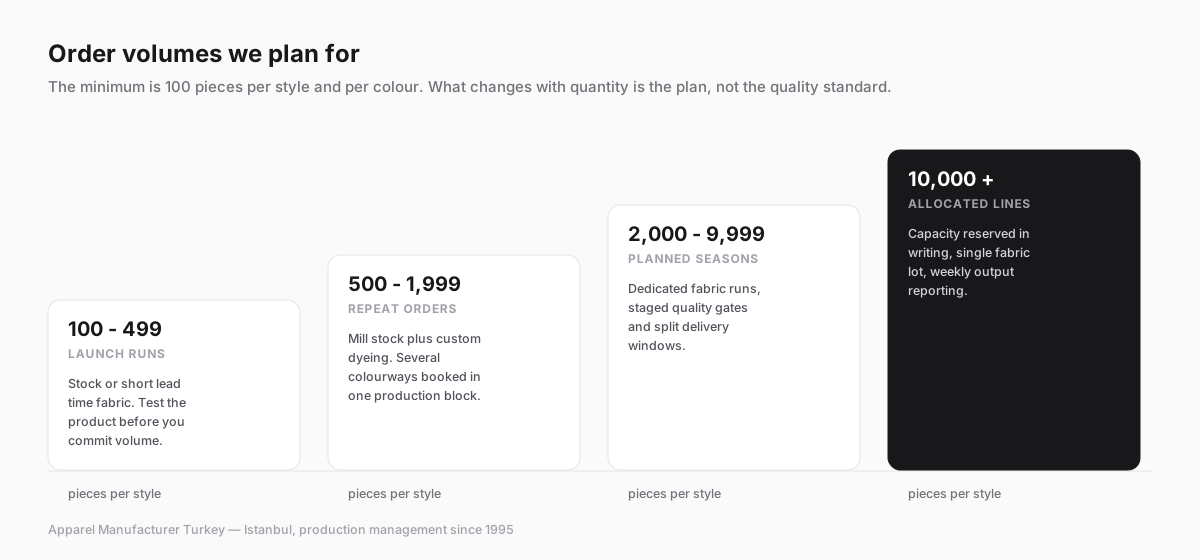
What actually changes as volumes grow
At 100 pieces per style, you are a project the factory fits between larger customers: fabric is bought spot, capacity is found week to week, and your risk is concentrated in whether the product sells at all. At several thousand pieces per style across repeating drops, you become a program: fabric is booked ahead, a production line plans around you, prices drop with volume, and your risk shifts from product to planning, because a forecasting error now strands real money in inventory or leaves weeks of stockout.
The transitions are predictable. Somewhere around 1,000-2,000 pieces per style, spot fabric buying becomes the bottleneck, since mill minimums and dyeing lead times dominate your timeline. Beyond that, capacity becomes the constraint: factories plan lines weeks or months out, and a customer who cannot forecast cannot be planned for. And throughout, quality control must move from inspecting shipments to running a system, because a defect rate that was annoying across 300 pieces is a crisis across 10,000.
The encouraging part: none of this requires becoming a corporation. It requires three artifacts, a rolling forecast, a fabric position, and a written QC standard, and the discipline to maintain them. The rest of this guide is those three artifacts plus the commercial architecture around them.
Forecasting: the rolling 12-week view
Scaling brands run a simple rolling forecast: for each core style-colour, expected sales per week for the next 12 or more weeks, refreshed weekly or fortnightly from actual sell-through. It does not need statistical sophistication; recent run-rate adjusted for seasonality, marketing plans and stock cover is enough. What matters is that it exists, is written down, and is shared with your factory as a forward signal, clearly marked as forecast, not commitment.
From the forecast, derive reorder points per style-colour: when stock cover falls below lead time plus a safety buffer, a replenishment order triggers at a pre-agreed quantity. With a 4-6 week bulk lead time from Istanbul plus a week of freight to Europe, a practical trigger is somewhere around 8-10 weeks of cover for steady sellers, tuned by how volatile the style is. Brands that operate this mechanically avoid the classic scaling failure: reordering only after a stockout, then over-ordering in panic.
Forecast honesty also changes the factory relationship. A manufacturer shown a credible 12-week view will reserve capacity, pre-position fabric and often improve prices, because predictable customers are cheaper to serve. The forecast is the entry ticket to every other scaling mechanism in this guide.
Fabric booking: buying time before you buy goods
Fabric is the longest lead-time item in most garments and the first thing to book ahead. The mechanisms, in increasing commitment: nominating fabrics that your mill holds as running stock; booking greige, undyed fabric, ahead of orders so only dyeing, one to three weeks, remains when you order; and committing seasonal fabric contracts at agreed prices and quantities, drawn down against orders. Each step trades commitment for speed and price.
A concrete, illustrative pattern for a scaling basics brand: agree a core jersey quality with the mill; hold a rolling greige booking equal to roughly one replenishment cycle of demand; dye to order per colour as replenishment triggers fire. The effect is cutting bulk lead time by weeks and protecting you from spot-market price and availability swings, at the cost of owning greige if demand dies, which the rolling forecast exists to prevent.
Two disciplines keep fabric positions safe. Concentrate: the fewer fabric qualities your range uses, the more volume each books, the better your minimums, prices and risk pooling; scaling brands ruthlessly rationalise onto a handful of core qualities. And test consistently: every incoming lot gets shade and shrinkage checks against the approved standard, because at scale a bad fabric lot no longer ruins an order, it ruins a month.
Capacity, calendars and the multi-factory question
Factories plan sewing lines against a calendar, and scaling means getting onto it in advance. The practical instrument is a capacity reservation: you commit indicative monthly volumes a quarter ahead, the factory holds line time, and actual orders confirm against it with agreed flexibility, commonly plus or minus 20-30 percent. Alongside it, agree a time-and-action calendar per order, the dated checklist from fabric in-house through cutting, sewing, finishing and inspection, so slippage is visible in week one rather than week five.
The single-versus-multi-factory question arrives with scale. Concentrating volume in one factory maximises your importance and price leverage but concentrates risk; the standard evolution is a primary factory carrying core programs plus a qualified second source carrying overflow and providing resilience, onboarded with the same tech packs, blocks and QC standards so styles can move between them. Managed production networks provide this architecture ready-made, which is their core argument for scaling brands.
Also decide what scales where. High-volume stable basics can run on booked programs; fashion styles with demand risk stay on smaller flexible runs; and new styles should still launch at modest quantities, 300-500 pieces, with scaling reserved for proven repeaters. Blending these modes deliberately, rather than scaling everything or nothing, is what keeps working capital efficient while the brand grows.
- Quarterly capacity reservations with agreed volume flexibility
- Time-and-action calendar per order, reviewed weekly
- Primary factory plus qualified second source for core programs
- New styles launch small; only proven repeaters scale
- Same tech packs, blocks and QC standard across all factories
QC systems: from inspecting shipments to controlling process
At small volumes, a final AQL inspection per shipment is adequate QC. At scale it is too late: by the time a final inspection fails, thousands of pieces embody the defect. Scaling QC means moving control upstream into a written system: an agreed quality manual, your defect classification, tolerance tables, approved samples and packing standard, plus inline inspection during sewing, an in-process check early in each bulk run, first pieces off the line checked against seal samples, and final AQL as the backstop rather than the whole defence.
Instrument the system with data. Track defects found per order by type and by stage, and review the top three defect types with the factory after each run; recurring faults get root-cause fixes, a machine setting, a training gap, a fabric issue, instead of repeated rework. Factories respond to buyers who measure: the ones worth scaling with will run this loop with you, and the resulting defect trend is the honest KPI of your production quality.
Keep physical standards current as you scale: sealed approval samples per style at both sides, shade bands per colour, and a light-box for shade decisions stop quality drifting across repeats, which is the characteristic failure of repeat programs; the tenth run must match the first, not the ninth. And keep third-party or own-staff inspection independent of delivery pressure, because the weeks when everyone is desperate to ship are exactly the weeks inspections earn their cost.
A staged roadmap from 300 to 30,000
Stage one, roughly 100-1,000 pieces per style: prove demand. Buy fabric spot, keep the range narrow, run size sets and final inspections, and collect sell-through data weekly. Your goals are a fit block per category, a tech pack library, and evidence of which styles repeat.
Stage two, roughly 1,000-5,000 pieces per style: build the machinery. Start the rolling forecast and reorder points, rationalise onto core fabric qualities and open a greige booking, agree capacity reservations and a T&A calendar with your primary factory, and formalise the QC manual with inline checks. Prices should improve with volume; measure landed cost per unit and defect rates as your scaling KPIs.
Stage three, 5,000 pieces and up per style or per program: industrialise. Seasonal fabric contracts, a second source qualified and carrying share, defect and delivery data reviewed quarterly with factories, and finance arranged for the longer cash cycle, since scaling production stretches the gap between paying deposits and selling goods, and many otherwise healthy brands strain here. At every stage the constraint moves, product, then fabric, then capacity, then cash, and the job of scaling is noticing which constraint is current and building the artifact that manages it.
- Stage one: prove demand, build blocks and tech packs
- Stage two: rolling forecast, fabric booking, capacity reservation, QC manual
- Stage three: fabric contracts, second source, quarterly data reviews, financing
- Track landed cost per unit, defect rate and on-time delivery as core KPIs
- Scale only proven repeat styles; keep launches small
What changes at each volume stage
| 100-1,000 pcs per style | Spot fabric, order-by-order capacity, final inspection QC |
|---|---|
| 1,000-5,000 pcs | Greige booking, reserved capacity, inline plus final QC, reorder points |
| 5,000-30,000 pcs | Fabric contracts, dual sourcing, process QC with data, structured financing |
| Lead-time effect | Booked fabric can cut bulk lead time by two weeks or more |
| Price effect | Unit prices typically step down at volume and consistency milestones |
| Risk shift | From product risk to planning, quality-drift and cash-cycle risk |
Planning a production run?
Send your tech pack or reference photos — clear quote with MOQ, sampling cost and lead time within one business day.
Frequently asked questions
Related pages
Scale on one production network
We run 100-piece launches and multi-thousand-piece repeat programs through the same vetted Istanbul network, with fabric booking, capacity planning and AQL systems managed for you. Email info@apparelmanufacturerturkey.com with your growth plan and current volumes.