The Clothing Manufacturing Process, Step by Step
Between an approved design and a delivered carton sit a dozen distinct stages, each with its own timeline and failure modes. Understanding the sequence helps you plan launch dates realistically and know which checkpoints deserve your attention.
- Sampling
- 1-2 weeks per round
- Bulk production
- 4-6 weeks typical
- Critical checkpoint
- Pre-production sample
- Final gate
- AQL inspection before shipping
Reviewed and updated 2026-08-02 by the Apparel Manufacturer Turkey production team in Istanbul, managing apparel production since 1995.
Quick answer
The clothing manufacturing process runs: quotation from tech pack (2-4 days), lab dips and sampling (1-2 weeks per round), bulk fabric knitting, dyeing and finishing (2-3 weeks), cutting, decoration and sewing (2-3 weeks for 300-1,000 pieces), final AQL inspection and packing (2-4 days), then freight, which takes 3-8 days by road from Turkey to Europe.
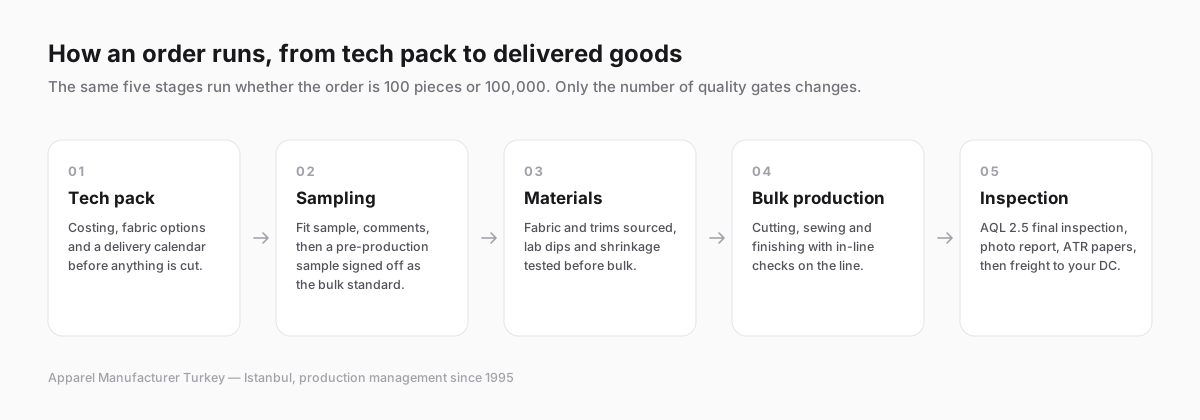
Stage 1: tech pack and quotation
Everything starts with the tech pack: flat sketches, measurement chart by size, fabric specification with composition and GSM, trims, stitching details, print or embroidery artwork with placements and sizes, and labelling. A factory quoting from a complete tech pack can commit to a real price; a factory quoting from an Instagram screenshot is estimating, and the estimate will drift once details firm up.
The quotation that comes back should itemise unit price at your quantity, sampling cost, MOQ, lead time and payment terms, and name the Incoterm. Expect quotes within a few working days for standard products. This stage is also where quantity tiers get discussed, since a price at 300 pieces and at 1,000 pieces can differ noticeably because fabric buying and line setup amortise differently.
Stage 2: fabric selection and lab dips
Before or alongside sampling, fabric is confirmed. The factory proposes qualities from its mills, you receive physical swatches, and for custom colours the mill produces lab dips, small dyed samples of your exact shade for approval against a Pantone reference. Approve lab dips in daylight and under shop lighting, since some shade pairs that match under one light source split under another.
For knits, this is also the moment to agree finishing: compacting to control shrinkage, enzyme or silicone washes for hand feel, peach finishing for a soft surface. Each finish adds cost and a few days but is far cheaper specified now than regretted after bulk dyeing. Custom-dyed fabric typically carries its own minimum per colour, which is one reason a custom colour usually wants volume concentrated behind it.
Stage 3: sampling and fit approval
The first physical garment is the proto or development sample, made to test the pattern and construction, often in available fabric rather than your final quality. You review fit on a body or dress form, mark corrections, and the pattern is revised. One to two rounds is normal for a well-specified garment; three or more usually means the tech pack was thin.
Once fit and details are settled, the pre-production sample, the PPS, is made in the actual bulk fabric with the real trims, prints and labels. This sample is the contract in physical form: bulk production will be judged against it. Approve it formally in writing, keep one sealed reference of it, and never let bulk cutting start before PPS approval. Each sampling round in Turkey typically takes one to two weeks including courier time.
Stage 4: fabric production and inspection
On bulk order confirmation and deposit, the factory books fabric. For custom-dyed knits, knitting, dyeing and finishing typically take two to three weeks and often run in parallel with final pattern grading. When rolls arrive, a serious factory inspects them: GSM checked by weighing cut swatches, shade checked against the approved lab dip roll by roll, and fabric relaxed, laid flat for 24 hours or more, so that knits recover before cutting rather than shrinking in the lay.
This is a checkpoint worth asking about explicitly, because fabric faults discovered after cutting become your problem in practice, whatever the paperwork says. A photo of your rolls with batch labels is cheap reassurance.
Stage 5: cutting, printing and sewing
Cutting starts with marker making: arranging pattern pieces of all sizes across the fabric width to minimise waste, then spreading fabric in layers and cutting the whole lay with straight-knife or automated cutters. Cut panels are bundled by size and shade lot, which prevents the classic defect of mixed-shade panels in one garment.
Panel-level decoration happens next where applicable: screen printing and embroidery are usually applied to cut panels before sewing, because flat panels give better registration than finished garments. Then sewing: garments move through a line where each operator performs one operation, join shoulders, set sleeves, attach neck rib, hem. A basic tee has around 8 to 12 operations; a hoodie with pocket, hood and drawcord runs 25 or more, which is why hoodie sewing prices are multiples of tee prices. Inline QC checks work between operations so defects are caught before they are buried under the next seam.
Stage 6: finishing, final QC and packing
After sewing, garments are trimmed of loose threads, pressed or steamed, and checked. Final inspection samples finished goods against the approved PPS and the measurement chart, classifying defects as critical, major or minor, most commonly under an AQL 2.5 standard for majors on a statistically drawn sample. Needle detection is run where the destination market or retailer requires it.
Approved garments are folded, poly-bagged with size stickers, and packed into export cartons per your assortment plan, solid sizes per carton or prepacked size ratios, whichever your warehouse prefers. Carton marks, quantities and weights go onto the packing list that will accompany the shipment.
- Thread trimming, pressing, and needle detection where required
- Final AQL inspection against the sealed PPS and size chart
- Folding, poly-bagging, size and barcode stickering
- Cartonisation per your ratio plan, with numbered carton marks
- Packing list finalised against the physical count
Stage 7: documents and shipping
While cartons are sealed, the paperwork is prepared: commercial invoice, packing list, and the origin document your destination needs, ATR for the EU, EUR.1 or an invoice declaration for the UK, certificate of origin elsewhere. Export clearance in Turkey is filed by the factory or its broker, and goods hand over to your chosen freight mode: road trailers reach most of Europe in 3 to 7 days, air freight covers urgent shipments in 1 to 3 days, sea serves distant markets in weeks.
Put the whole sequence together and a realistic first-order calendar from tech pack to European warehouse runs roughly 8 to 12 weeks: quoting and fabric confirmation in week 1 to 2, sampling in weeks 2 to 5, bulk fabric and production in weeks 5 to 10, inspection and delivery thereafter. Repeat orders skip most of sampling and compress meaningfully.
Typical timeline by stage (first order, knitwear)
| Quotation from tech pack | 2-4 working days |
|---|---|
| Lab dips and swatches | 1-2 weeks, parallel with sampling |
| Proto and PPS sampling | 1-2 weeks per round, 1-2 rounds |
| Bulk fabric knit, dye, finish | 2-3 weeks |
| Cutting, decoration, sewing | 2-3 weeks for 300-1,000 pcs |
| Final QC and packing | 2-4 days |
| Road freight to EU/UK | 3-8 days |
Planning a production run?
Send your tech pack or reference photos — clear quote with MOQ, sampling cost and lead time within one business day.
Frequently asked questions
Related pages
Want a managed version of this process?
We run every stage above through vetted Istanbul factories, with photo checkpoints at fabric, cutting and packing. Send your tech pack to info@apparelmanufacturerturkey.com for a quote and a dated production plan.