DTG Printing Service in Turkey
Direct-to-garment printing puts full-colour, photographic artwork straight onto the garment with inkjet precision and no screens to set up. We run DTG inside managed production for designs that screens cannot serve economically: gradients, photos, and artwork with unlimited colours.
- Best fabric
- Cotton-heavy, 95%+ ideal
- Colours
- Unlimited, photographic
- Setup cost
- None per colour
- Best for
- Complex art, smaller runs
Reviewed and updated 2026-08-09 by the Apparel Manufacturer Turkey production team in Istanbul, managing apparel production since 1995.
Quick answer
DTG printing jets full-colour, photographic artwork directly into cotton-heavy fabric with no screens and no per-colour setup, which makes it ideal for gradients and complex designs in smaller runs. In Turkey, ApparelManufacturerTurkey.com runs DTG inside managed production: dark garments are pretreated with a white underbase, heat curing is verified, and a printed sample is approved before bulk.
What DTG printing is and where it fits
DTG works like a high-end inkjet printer for garments: water-based pigment inks are jetted directly into the fabric face, building the full artwork in one pass. There are no screens, no separations and no per-colour setup, so a design with two colours costs the same to print as a design with two hundred.
That economics profile makes DTG the natural choice for photographic artwork, fine gradients, and multi-colour designs in runs too small to amortise screens. Within a production project it also covers colourway-specific artwork variations that would each need their own screen set.
The limits are equally real: DTG inks bond with cellulose fibres, so results are best on cotton-heavy fabrics, print speed per garment is slower than a screen carousel, and very large solid areas of a single bold colour are cheaper and more opaque as screen prints once quantities grow.
Pretreatment, curing and why fabric choice decides quality
Dark and mid-tone garments must be pretreated before DTG printing: a liquid applied and dried onto the print area that lets a white ink underbase sit on the fabric surface instead of sinking in. Good pretreatment is invisible after washing; poor pretreatment shows as rectangles, staining or dull colour, which is a process failure, not a technology flaw.
After printing, garments cure through heat, bonding the pigments into the fibre. Cure control matters for wash durability just as it does in screen printing, and it is part of what we inspect at the print house.
Fabric is the other half of print quality. Combed, ringspun cotton jerseys with a smooth face print sharply; carded, hairy surfaces soften detail; polyester content beyond a modest percentage dulls colour and weakens ink bonding. This is why we plan decoration and fabric together rather than sequentially.
- Pretreatment plus white underbase on darks
- Heat curing controlled for wash durability
- Best results on smooth, cotton-heavy jersey
- Detail sharpness depends on fabric surface
- Poly-rich fabrics are better served by DTF
Costs, minimums and realistic run sizes
DTG pricing is per print, driven by print size, ink coverage and whether a white underbase is needed. A small chest logo on white fabric is cheap; an A3 full-coverage photographic back print on black, with pretreatment and heavy white ink, costs several times more. There is no per-colour charge, which is the whole point.
Because there is no setup, DTG has no hard technical minimum, and inside our projects it works from sample quantities up. Our garment production minimum still applies to manufacturing itself: 100 pieces per style, with DTG decorating any share of that run.
The crossover point against screen printing depends on colour count. One-colour artwork crosses to screens quickly; artwork with many colours or gradients can stay cheaper on DTG for hundreds of pieces because screens for every colour never need to be made.
Durability and hand feel, without the marketing gloss
A properly pretreated, properly cured DTG print on good cotton survives normal washing for the life of the garment, softening slightly and fading marginally over many cycles in the way water-based prints do. It will not crack or peel the way a failed transfer does, because the ink is in the fibre, not on it.
Hand feel is one of DTG's genuine advantages: light coverage prints are nearly imperceptible, and even heavy prints feel softer than an equivalent plastisol deposit. On dark garments the underbase adds some presence, though still less than layered screen ink.
The honest caveats: colours on dark garments are slightly less punchy than plastisol, true fluorescent and metallic effects are not achievable with process inks, and exact Pantone matching is approximate because colours are built from CMYK plus white rather than mixed as spot inks. Where a brand colour is critical, we print a sample for approval first.
How DTG runs inside our production projects
Artwork arrives as high-resolution files, ideally 300 dpi at print size with transparent backgrounds. Our prepress check catches the usual traps: low-resolution logos, semi-transparent edges that interact badly with white underbase, and colours outside the printable gamut, which we flag with realistic proofs rather than letting the printer surprise you.
You approve a printed sample on the actual production fabric, since fabric colour and surface change how artwork reads. Bulk printing then runs against that approved sample, with cure and placement checks in our inspection scope, and prints go through final garment inspection like every other component.
Combined decoration is common and sensible: DTG for the complex front artwork, embroidery for a sleeve hit, a one-colour screen print inside the neck. We coordinate the sequence so processes do not compromise each other.
Planning a production run?
Send your tech pack or reference photos — clear quote with MOQ, sampling cost and lead time within one business day.
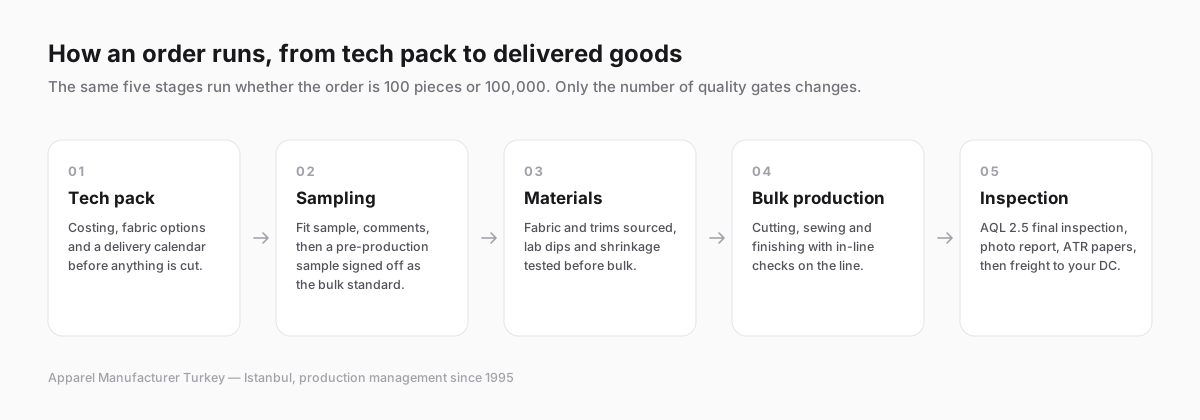
How production works
Send your enquiry
Share tech packs, sketches or reference garments together with target quantities and delivery dates.
Technical review
We assess fabrics, construction and printing requirements and match your project to the right production line.
Quotation
You receive a clear offer covering unit price, sampling cost, MOQ and production timeline.
Sampling
Pre-production samples are made for fit, fabric and print approval before any bulk fabric is cut.
Approval
You confirm the approved sample, quantities per size and colourway, labelling and packaging.
Bulk production
Cutting, sewing, printing, embroidery and finishing run under a production plan you can follow.
Quality control
Inline checks during production plus AQL final inspection before cartons are sealed.
Shipping
Road freight to Europe in 3-7 days, air or sea worldwide, with export documentation handled for you.
Frequently asked questions
Related pages
Print complex artwork right
Send your artwork and fabric plan to info@apparelmanufacturerturkey.com and we will confirm whether DTG is the right tool, with sample pricing.