Clothing Manufacturers in Zeytinburnu, Istanbul
Zeytinburnu is Istanbul's historic leather quarter and a working garment production district. Leather jackets and coats are its signature, alongside cut-and-sew ateliers serving the wider city. This guide covers what the district makes and how to source from it sensibly.
- District role
- Leather trade plus garment workshops
- Signature product
- Leather jackets and coats
- Heritage
- Istanbul's historic leather district
- MOQ via our network
- From 100 pcs per style; lower for leather
Reviewed and updated 2026-08-06 by the Apparel Manufacturer Turkey production team in Istanbul, managing apparel production since 1995.
Quick answer
Zeytinburnu is Istanbul's historic leather district, where ateliers cut and sew leather jackets, coats, shearling and suede in lambskin, sheepskin and goatskin for wholesale and export buyers. Heavy tanning has moved outside the city, but the garment craft remains, with leather minimums often just a few dozen pieces per style alongside general cut-and-sew workshops.
Istanbul's leather quarter
Zeytinburnu, on the European side between the old city walls and the Marmara shore, has been associated with leather for generations. The heavy tanning industry that once defined it has largely relocated to organised industrial zones outside the city, but the district kept the commercially valuable end of the trade: leather garment ateliers, wholesale showrooms, hide and skin merchants and the craftsmen who work them.
Leather jackets, coats, blazers, skirts and shearling pieces are designed, cut and sewn here in lambskin, sheepskin, goatskin and suede. The district sells to visiting wholesale buyers, exports across Europe, Russia and the Middle East, and supplies many of the leather retailers found across Istanbul's tourist and shopping areas.
Leather garment making is a distinct craft: skins are natural materials with individual variation, panels must be matched by hand, and seams behave nothing like fabric. Zeytinburnu's concentration of that craft is why it remains the address for the category.
Beyond leather: a working production district
Zeytinburnu is not only about leather. The district and its industrial pockets host cut-and-sew garment ateliers producing textiles for Istanbul's wholesale and export trade, along with outerwear workshops for which leather skills translate naturally into coats and jackets in fabric.
Its position in the city's garment geography is closest to Gungoren's: a place where things are made rather than merely sold, with the same pattern of small specialised units, and the same reality that quality and reliability vary sharply from door to door.
How leather buying works, and what to watch
Leather runs on different economics from textiles. Skins are graded and priced individually, a single jacket can consume several skins, and material often represents the majority of the garment cost. Consequently minimums are lower than in textile production, sometimes a few dozen pieces per style, while unit prices are far higher and sampling matters even more.
The classic risks are material risks: being quoted one leather grade and shipped another, colour variation between skins within an order, split leather or bonded materials presented as full grain, and skimped linings and hardware that undermine an otherwise good shell. None of these are visible in a showroom photograph, and some are hard to catch even in person without experience.
Written specifications should therefore cover skin type, grade, thickness, finish, lining, hardware and stitching standards, and goods should be inspected piece by piece before shipment, which is standard practice in our leather projects.
- Agree skin type, grade and thickness in writing, with a sealed sample
- Expect per-skin colour variation and set acceptable tolerance upfront
- Verify linings, zips and hardware, not just the leather shell
- Inspect leather goods individually before final payment
Who should source from Zeytinburnu
The district makes sense for brands and retailers building leather outerwear lines, from classic biker and bomber jackets to fashion-led coats and shearling, and for outerwear programmes generally. It also serves buyers adding a small premium leather capsule to a textile collection, since leather minimums per style are comparatively low.
It is not the district for knit basics, jersey fashion or high-volume textile programmes; those belong in Merter's orbit, Gungoren, or the Anatolian production cities. As always in Istanbul, the district defines the product, and matching product to district is half the sourcing decision.
Leather and outerwear production through our network
Our vetted network includes leather garment ateliers in Zeytinburnu alongside textile workshops across Istanbul, so leather capsules and full collections can run under one managed programme. We handle skin selection and approval, pattern development, sampling in one to two weeks, and bulk production in four to six weeks with piece-level inspection before dispatch.
Textile production starts from 100 pieces per style; leather styles can often run in smaller quantities because of the category's economics, confirmed per project. Send your designs or reference pieces to info@apparelmanufacturerturkey.com and we will quote with the leather specification stated explicitly, in writing.
Zeytinburnu at a glance
| Role | Historic leather district and production workshops |
|---|---|
| Signature products | Leather jackets, coats, shearling, suede |
| Materials | Lambskin, sheepskin, goatskin, suede |
| Leather MOQs | Lower than textiles, often a few dozen pieces per style |
| Textile MOQ via our network | From 100 pcs per style |
| Key risks | Skin grade substitution, colour variation, hardware quality |
Planning a production run?
Send your tech pack or reference photos — clear quote with MOQ, sampling cost and lead time within one business day.
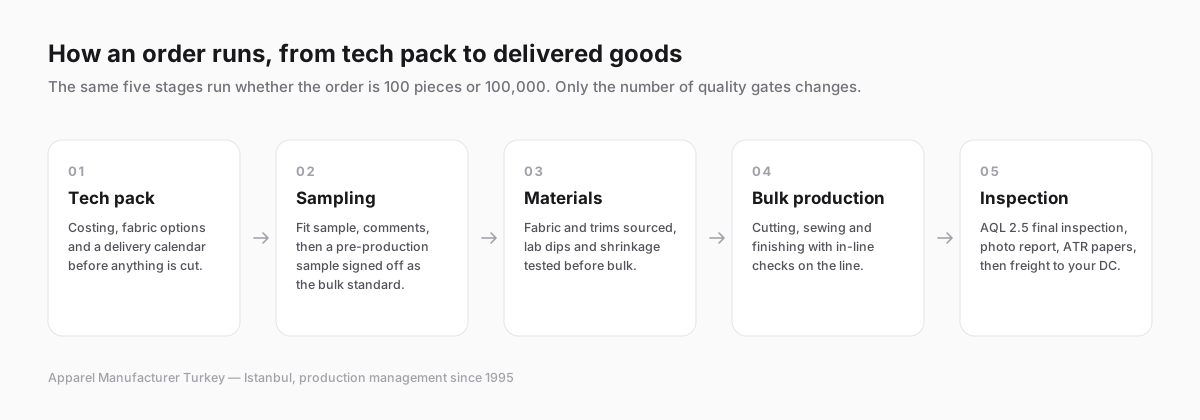
How production works
Send your enquiry
Share tech packs, sketches or reference garments together with target quantities and delivery dates.
Technical review
We assess fabrics, construction and printing requirements and match your project to the right production line.
Quotation
You receive a clear offer covering unit price, sampling cost, MOQ and production timeline.
Sampling
Pre-production samples are made for fit, fabric and print approval before any bulk fabric is cut.
Approval
You confirm the approved sample, quantities per size and colourway, labelling and packaging.
Bulk production
Cutting, sewing, printing, embroidery and finishing run under a production plan you can follow.
Quality control
Inline checks during production plus AQL final inspection before cartons are sealed.
Shipping
Road freight to Europe in 3-7 days, air or sea worldwide, with export documentation handled for you.
Frequently asked questions
Related pages
More in Locations
Source leather outerwear from the district that owns it
We manage leather jacket and outerwear production through vetted Zeytinburnu ateliers, with written leather specifications and piece-level inspection. Email info@apparelmanufacturerturkey.com to start your leather project.