Sustainable Fabric Sourcing in Turkey
We help brands source lower-impact fabrics through Turkish mills whose claims we can actually verify: organic cotton through GOTS-certified partners, recycled fibres with documentation, OEKO-TEX tested qualities and BSCI or Sedex audited factories.
- Organic cotton
- GOTS via certified partners
- Tested fabrics
- OEKO-TEX available
- Factory audits
- Partners BSCI/Sedex audited
- MOQ
- 100 pcs per style
Reviewed and updated 2026-07-28 by the Apparel Manufacturer Turkey production team in Istanbul, managing apparel production since 1995.
Quick answer
Sustainable fabric sourcing in Turkey rests on verifiable layers rather than vague eco labels: organic cotton through GOTS-certified partner chains, recycled polyester and 20-50 percent recycled cotton blends with mill documentation, OEKO-TEX tested qualities, and BSCI or Sedex audited factories. Cotton grows in Cukurova, mills concentrate in Bursa and Denizli, and EU road freight takes 3-7 days.
What sustainable actually means in fabric sourcing
Sustainability in textiles is not one property but several: fibre origin, processing chemistry, water and energy use, working conditions and end-of-life. A fabric can score well on one axis and poorly on another, which is why we break every request into specific, checkable claims instead of shopping for a vague eco label.
In practice, most brand requirements map to four verifiable layers: certified fibre such as organic cotton or documented recycled content, tested chemical safety through schemes like OEKO-TEX, audited working conditions via BSCI or Sedex, and lower-impact processing choices such as garment-level laser finishing or digital printing. We build your programme from whichever layers your market and budget require.
Why Turkey is a strong base for lower-impact sourcing
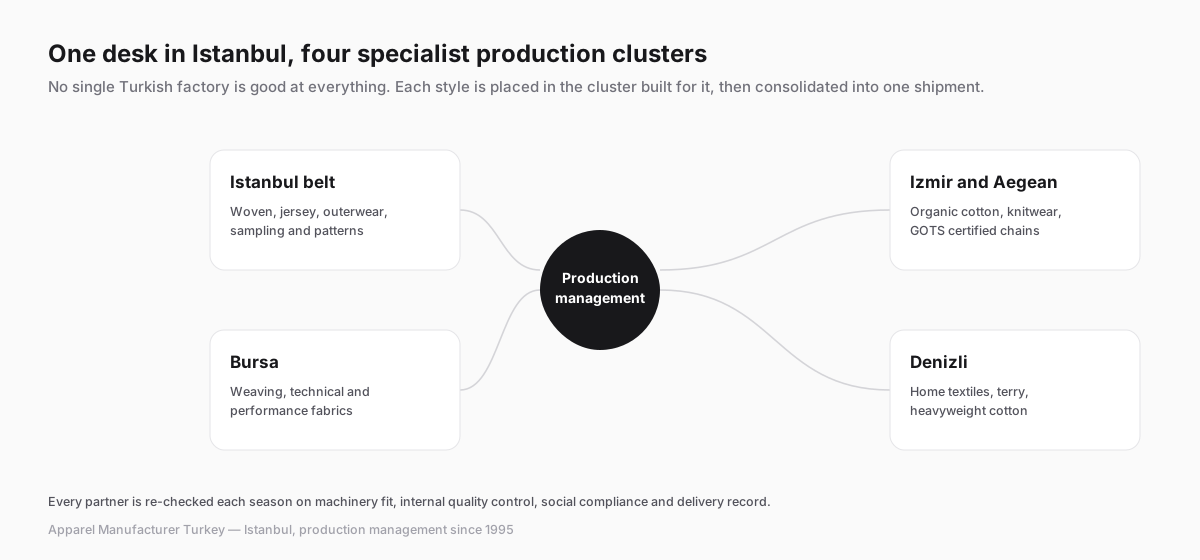
Turkey compresses the supply chain geographically. Cotton grows in Cukurova and the southeast, spinning and knitting concentrate in Bursa and Denizli, and garment production clusters around Istanbul, so a garment's inputs often travel hundreds of kilometres rather than crossing oceans between stages. Road freight of 3-7 days to the EU then replaces long shipping legs on the outbound side.
Turkey is also one of the world's meaningful organic cotton producers, hosts a significant mechanical textile recycling industry, and its export-oriented mills have invested in certification because European customers demand it. None of that makes every Turkish fabric sustainable, but it means credible options exist in nearly every category, and our job is knowing which mills hold which certificates today.
The lower-impact fabric menu we source from
For natural fibres: organic cotton jerseys, fleeces and wovens through GOTS-certified partner chains, and linen, which is inherently low-input as a crop, in pure and blended qualities. For recycled content: recycled polyester knits and wovens, and cotton blends with 20-50 percent mechanically recycled fibre, with certificates confirmed per mill and per order.
For regenerated cellulosics, lyocell qualities and certified-origin viscose offer a middle path between drape and impact. Across all of these, OEKO-TEX certified options cover chemical-safety requirements for skin-contact garments. Where a request cannot be met credibly, for instance a fully biodegradable performance legging at a mass-market price, we say so and propose the nearest honest alternative.
- Organic cotton via GOTS-certified partner mills
- Recycled polyester and recycled cotton blends with documentation
- Linen and linen blends as low-input naturals
- Lyocell and certified-origin cellulosics
- OEKO-TEX tested qualities across categories
Claims, certificates and how we keep you safe
Every certificate belongs to a specific holder and scope: a mill, a fabric, a process. Our discipline is to collect the certificate, check its validity and scope against your order, and obtain transaction documents where the scheme requires them, before any claim reaches your labels or website. GOTS garments run only through certified partner facilities; OEKO-TEX claims attach to the tested fabric, not to the brand or the country.
This matters commercially, not just ethically. EU green-claims enforcement is tightening, and an unsupported eco claim is a legal and reputational liability. Buying through a partner who documents claims properly is itself a risk-management decision.
Building a realistic sustainable programme
Start from your product and market, not from the longest list of certifications. A baby wear brand usually needs organic fibre and chemical safety first; a streetwear brand may get more real-world impact from recycled fleece and garment-level water-saving washes; an activewear brand from certified recycled polyester. Layering every scheme onto every style multiplies cost without multiplying trust.
Timelines and volumes stay familiar: MOQs from 100 pieces per style, sampling in 1-2 weeks and bulk in 4-6 weeks, with certified fabric availability flagged at quotation if it affects the calendar. We quote conventional and lower-impact routes side by side so the premium for each claim is explicit and you can decide with real numbers.
Claim types and how they are verified
| Organic cotton | GOTS chain via certified partner facilities |
|---|---|
| Recycled content | Mill certificates and transaction documents, e.g. GRS or RCS |
| Chemical safety | OEKO-TEX certificate for the specific fabric |
| Working conditions | BSCI or Sedex audits of partner factories |
| Lower-impact processing | Process-level choices: laser, ozone, digital print |
Planning a production run?
Send your tech pack or reference photos — clear quote with MOQ, sampling cost and lead time within one business day.
How production works
Send your enquiry
Share tech packs, sketches or reference garments together with target quantities and delivery dates.
Technical review
We assess fabrics, construction and printing requirements and match your project to the right production line.
Quotation
You receive a clear offer covering unit price, sampling cost, MOQ and production timeline.
Sampling
Pre-production samples are made for fit, fabric and print approval before any bulk fabric is cut.
Approval
You confirm the approved sample, quantities per size and colourway, labelling and packaging.
Bulk production
Cutting, sewing, printing, embroidery and finishing run under a production plan you can follow.
Quality control
Inline checks during production plus AQL final inspection before cartons are sealed.
Shipping
Road freight to Europe in 3-7 days, air or sea worldwide, with export documentation handled for you.
Frequently asked questions
Related pages
Source lower-impact fabrics with proof attached
Tell us the claims your brand wants to stand behind and we will map verified fabric routes, prices and timelines. Email info@apparelmanufacturerturkey.com.