Textile Companies in Turkey
Turkey's textile sector runs the full chain from cotton fibre to finished garment, spread across specialised regional clusters. This page maps that landscape, from spinners and mills to dye houses and sewing factories, and explains how a brand actually navigates it.
- Supply chain
- Fibre to finished garment
- Key hubs
- Istanbul, Bursa, Denizli
- Our MOQ
- 100 pcs / style
- EU delivery
- 3-7 days by road
Reviewed and updated 2026-08-02 by the Apparel Manufacturer Turkey production team in Istanbul, managing apparel production since 1995.
Quick answer
Textile companies in Turkey cover the entire supply chain: yarn spinners in Kahramanmaras, knit fabric mills in Bursa, cotton weaving in Denizli, dyeing and finishing in Corlu and Cerkezkoy, denim and nonwovens in Gaziantep, and garment factories concentrated around Istanbul. Brands typically work through a manufacturer or sourcing partner that coordinates these specialised suppliers into one production chain.
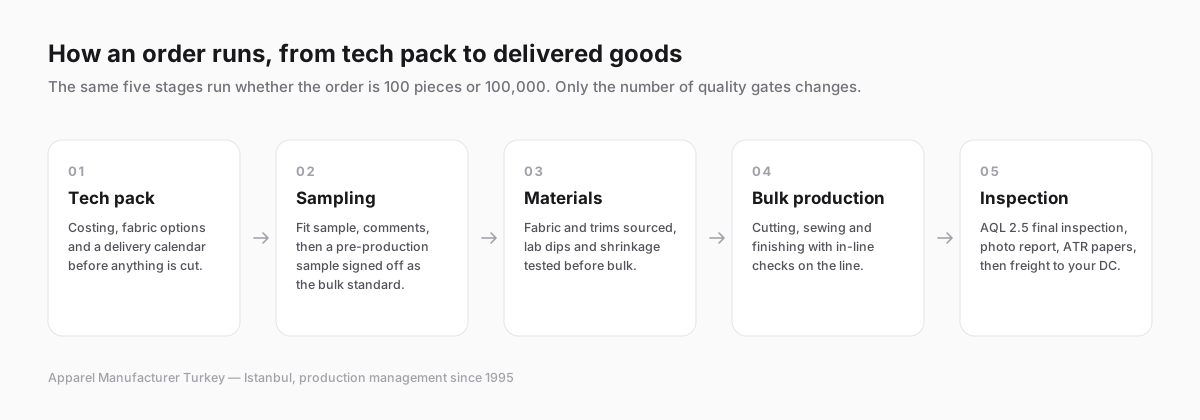
The Full Chain Under One Flag
What sets Turkey apart from most sourcing countries is completeness. The country grows cotton, spins yarn, knits and weaves fabric, dyes and finishes it, and cuts and sews garments, all within its own borders. Turkey is among the world's leading apparel exporters, with apparel exports in the tens of billions of dollars annually and textiles adding billions more; exact figures move year to year, so check current trade statistics if you need precise numbers.
In practice this means a knit fabric can be spun, knitted, dyed and sewn into garments within a few hundred kilometres, sometimes within a single industrial zone. For brands, the payoff is speed and traceability: shorter fabric lead times than importing from Asia, and a supply chain you can physically visit end to end in a week.
The sector is organised into distinct company types, and understanding who does what is the key to reading any Turkish supplier list: spinners make yarn, weavers and knitters make greige or yarn-dyed fabric, dye houses and finishing plants give fabric its colour and hand, converters trade and develop fabric ranges, and garment factories cut and sew. Many companies do exactly one of these things very well.
Who Does What: From Spinner to Sewing Line
At the top of the chain sit spinners, producing cotton, polyester, viscose and blended yarns in ring-spun, open-end and compact qualities. Their customers are weaving and knitting mills, which turn yarn into fabric: circular knitters producing jersey, rib, interlock and fleece, and weavers producing everything from poplin and twill to jacquard and towelling.
Fabric then usually passes through a dye house or integrated finishing plant for bleaching, dyeing, printing and finishing treatments such as brushing, sanforising or peaching. This stage determines colour accuracy, shrinkage and hand feel, and it is where many quality problems in finished garments actually originate, long before a sewing machine is involved.
Finally, garment factories cut, sew, finish and pack. Some are large industrial plants working for major European retailers; many more are mid-sized factories and workshops of 30 to 300 machines that handle branded and private label production. Alongside these sit supporting trades: printers, embroiderers, laundries for denim washing, trim suppliers, pattern rooms and testing laboratories.
Regional Clusters: Where Each Speciality Lives
Istanbul is the garment hub and commercial centre: the largest concentration of sewing factories, sampling rooms, showrooms and export offices, strongest in fashion-led product across knits, wovens and outerwear. Bursa, historically a silk city, is today the heartland of knitted fabrics and also a centre for towelling and automotive textiles; much of the jersey used in Turkish-made garments is knitted there.
Denizli built its reputation on cotton weaving and is one of the world's best-known centres for home textiles, towels and bathrobes, with a strong base in woven cotton apparel fabrics as well. The Corlu and Cerkezkoy zone in Thrace, west of Istanbul, hosts a dense concentration of dye houses, printing and finishing plants serving mills and garment makers across the Marmara region.
Gaziantep in the southeast is a powerhouse for nonwovens, carpets and increasingly denim and workwear production, while Kahramanmaras is one of the country's main yarn spinning centres, feeding mills nationwide. Other notable clusters include Izmir for organic cotton and casualwear and Adana for cotton and spinning. The practical point: your fabric and your sewing may naturally come from different cities, and that is normal.
Vertically Integrated Mills vs Specialised Suppliers
A minority of Turkish companies are vertically integrated, running spinning, knitting or weaving, dyeing and garment production under one roof. These groups typically serve large retail programmes: their strength is control and accountability across the whole chain, their limitation is that they usually want big, stable volumes and offer less flexibility in fabric choice, since they prefer to sell their own fabric.
The majority of the industry is specialised, and for small and mid-sized brands this is usually the better fit. A specialised chain lets you pick the best knitter for your jersey, the best dye house for your colour standard and a sewing factory sized to your order, rather than accepting one company's average across all stages. The cost is coordination: someone has to manage handoffs, timing and responsibility between independent companies.
That coordination role is precisely what a full-package garment manufacturer or a production partner performs. When a Turkish factory quotes you a finished garment price, it is quietly orchestrating spinners, mills and dye houses behind the scenes; when something goes wrong at fabric stage, the value of a partner who knows which link failed, and has leverage over it, becomes very concrete.
How a Brand Navigates from Fabric to Finished Garment
Few brands should try to assemble a Turkish supply chain supplier by supplier. Dealing directly with spinners and dye houses requires volumes and technical staff that most brands do not have, and mills mostly sell in quantities far above a 100-piece garment order. The realistic entry points are three: a full-package garment manufacturer, a fabric converter plus a CMT factory, or a sourcing partner who manages the chain for you.
Full-package is the default: you approve fabric quality and lab dips, and the manufacturer buys fabric on its own account. Working through a converter suits brands with strong opinions about fabric who still want someone else to hold mill relationships. Whichever route you take, insist on knowing where your fabric is actually knitted or woven and dyed; traceability is achievable in Turkey and increasingly required by EU regulation and buyer due diligence anyway.
We manage apparel production through a vetted network of Turkish manufacturers, which in practice means we sit at the garment end of the chain and reach back into it: sourcing OEKO-TEX certified fabrics from mills we know, placing dyeing with houses that hold our clients' colour standards, and producing in BSCI or Sedex audited factories. MOQs start at 100 pieces per style, sampling takes one to two weeks, and EU deliveries travel by road in three to seven days, duty-free with an ATR certificate.
Turkish Textile Regions and Their Specialities
| Istanbul and Marmara | Garment manufacturing, sampling, fashion product, export offices |
|---|---|
| Bursa | Knitted fabrics, towelling, technical and automotive textiles |
| Denizli | Cotton weaving, home textiles, towels, bathrobes |
| Corlu / Cerkezkoy | Dyeing, printing and finishing plants |
| Gaziantep | Nonwovens, carpets, denim and workwear |
| Kahramanmaras | Yarn spinning |
| Izmir and Adana | Organic cotton, casualwear, cotton and spinning |
Planning a production run?
Send your tech pack or reference photos — clear quote with MOQ, sampling cost and lead time within one business day.
How production works
Send your enquiry
Share tech packs, sketches or reference garments together with target quantities and delivery dates.
Technical review
We assess fabrics, construction and printing requirements and match your project to the right production line.
Quotation
You receive a clear offer covering unit price, sampling cost, MOQ and production timeline.
Sampling
Pre-production samples are made for fit, fabric and print approval before any bulk fabric is cut.
Approval
You confirm the approved sample, quantities per size and colourway, labelling and packaging.
Bulk production
Cutting, sewing, printing, embroidery and finishing run under a production plan you can follow.
Quality control
Inline checks during production plus AQL final inspection before cartons are sealed.
Shipping
Road freight to Europe in 3-7 days, air or sea worldwide, with export documentation handled for you.
Frequently asked questions
Related pages
More in Manufacturing
Want one partner instead of five suppliers?
Tell us what you want to make and we will assemble the chain: the right mill, dye house and factory from our vetted network, managed as a single project with one point of contact. Email info@apparelmanufacturerturkey.com.