The Turkish Garment Industry: A Buyer's Reference Guide
How Turkey became one of the world's leading garment producers, where the industry stands today, and what its strengths, pressures and direction of travel mean for brands deciding where to manufacture.
- Global position
- Top-tier apparel exporter
- EU access
- Duty-free via Customs Union
- Supply chain
- Fibre to garment, domestic
- EU transit
- 3-7 days by road
Reviewed and updated 2026-08-09 by the Apparel Manufacturer Turkey production team in Istanbul, managing apparel production since 1995.
Quick answer
The Turkish garment industry is a top-tier global apparel exporter and one of the largest suppliers of clothing to the European Union, built on a complete domestic textile chain, skilled workers and duty-free EU access under the Customs Union. Its strengths are speed, quality and flexibility; its pressures are labour costs above Asian levels, currency volatility and peak-season capacity.
From Anatolian Workshops to Global Supplier: A Short History
Textiles are old business in Anatolia: Bursa was a silk city on the trade routes centuries before industrial manufacturing existed, and cotton has long been grown on the Aegean and Cukurova plains. The modern industry, however, took shape from the 1950s onwards, as state-planned spinning and weaving investments built a fabric base, and family workshops in Istanbul began sewing for the domestic market.
The turning point came in the 1980s, when Turkey liberalised its economy and turned decisively toward exports. Garment manufacturing, labour-intensive and quick to scale, led that export drive. European retailers discovered a supplier that was close, quality-capable and hungry, and Istanbul's garment districts grew from workshops into an export industry within a decade.
The 1996 Customs Union with the European Union locked in the relationship, removing duties on Turkish garments entering the EU. Through the 2000s the industry moved upmarket as China took the volume business: Turkish factories specialised in fashion product, speed and smaller runs. In the 2010s and 2020s, fast fashion's need for near-shore replenishment, and later the supply chain shocks of the pandemic era, renewed Turkey's strategic importance to European buyers.
The Industry's Scale and Position Today
Turkey today ranks among the world's leading apparel exporters and is one of the largest clothing suppliers to the European Union, alongside China and Bangladesh. Apparel exports run in the tens of billions of dollars annually, with textiles adding billions more, and the combined sector is one of Turkey's most important sources of export earnings and manufacturing employment, providing work for well over a million people across formal and informal segments. These are indicative orders of magnitude; anyone modelling a sourcing decision should verify current-year figures from trade statistics.
Structurally, the industry is broad rather than concentrated: a small number of large integrated groups serve major retail programmes, while thousands of small and mid-sized factories and workshops handle branded, private label and fashion production. This long tail is a strength for buyers who need flexibility and a challenge for those who need audited, transparent capacity, which is why partner selection matters more in Turkey than in more consolidated supplier countries.
The customer base is dominated by Europe: German, British, Spanish, Dutch and French buyers take the largest share, with the major European fast fashion groups among the biggest single customers. Sales to the Middle East, North America and Central Asia add further volume, and Turkish brands themselves have become significant regional players, giving the industry a domestic design culture that pure export platforms lack.
A Regional Map of Turkish Garment Production
Istanbul and the surrounding Marmara region form the industry's core: the densest concentration of garment factories, sampling rooms and export houses, strongest in fashion-led product across knitwear, wovens, outerwear and tailoring. Thrace, just west of the city, adds the Corlu and Cerkezkoy dyeing and finishing cluster that colours much of the country's fabric.
Bursa supplies the knitted fabrics on which much of the garment industry runs, alongside towelling and technical textiles. Denizli is the cotton weaving and home textile capital, also producing woven garments; Izmir and the Aegean coast are associated with organic cotton and casualwear; and Adana anchors cotton growing and spinning in the south.
The southeast has become the industry's growth frontier. Gaziantep is a major centre for nonwovens, denim and workwear, and cities such as Malatya, Kahramanmaras, a principal yarn spinning hub, and Sanliurfa host newer garment investment attracted by lower costs and government incentives. For buyers, the map matters practically: fabric, dyeing and sewing for one order often happen in different provinces, coordinated from Istanbul.
What Turkey Does Well: The Structural Strengths
Speed is the headline strength. Proximity means road freight reaches most European markets in three to seven days, against weeks by sea from Asia, and the complete domestic textile chain means fabric lead times are short too. A brand can go from approved sample to garments on EU shelves in a fraction of the time an Asian programme requires, which transforms how much inventory risk it must carry.
The fabric base is the second pillar: few garment-exporting countries knit, weave, dye and finish at Turkey's breadth and quality, particularly in cotton jerseys, denim and towelling. Add the Customs Union, which gives duty-free EU access with an ATR movement certificate and alignment with EU technical standards, and Turkey's landed-cost position against duty-paying competitors is stronger than factory prices alone suggest.
Finally, the workforce. Decades of producing for demanding European brands have built deep pattern-making, sewing and finishing skill, and a commercial culture used to European communication styles, sizing and quality expectations. Workable minimums, often a few hundred pieces per style, and genuine small-run flexibility complete the picture; these are capabilities that pure volume platforms struggle to replicate.
The Honest Challenges: Costs, Currency and Capacity
Turkey is not a low-cost country. Minimum wages have risen substantially in recent years, and labour costs sit well above Bangladesh, Pakistan or Vietnam. For basic, price-driven volume product, Asia usually wins on unit price, and Turkish factories themselves concede this. Turkey's economics work where speed, quality, smaller runs and duty-free EU access are worth paying for, not where the cheapest possible t-shirt is the goal.
Currency volatility is a persistent feature of the operating environment. Sharp moves in the lira periodically cut dollar-term costs and then inflation claws them back, which makes long-term price agreements harder and explains why most export business is quoted in euros or dollars. Buyers should expect quotes to have shorter validity than in more stable markets and build that into planning.
Capacity tightens in peak season. When European buyers place autumn-winter and spring-summer programmes simultaneously, good factories fill up, and brands that arrive late queue or pay for it. The industry has also faced real shocks, from the 2023 earthquakes in the southeast to global demand swings, and informality in parts of the workshop tier remains a compliance risk that serious buyers manage through audited suppliers and inspection rather than assumption.
Sustainability: Real Progress, Ongoing Work
European buyer pressure and EU regulation have made sustainability a board-level issue for Turkish manufacturers, and the response has been substantial. OEKO-TEX certified fabrics are widely available, GOTS-certified organic cotton production, much of it around the Aegean, is well established, and recycled fibre use is growing, helped by Turkey's large domestic recycling capacity. BSCI and Sedex social audits are standard among export-oriented factories.
Turkey also has structural sustainability advantages that predate the agenda: proximity to Europe means dramatically lower transport emissions than Asian sourcing, and the integrated domestic chain shortens fabric logistics too. Water treatment and cleaner dyeing investment in the main finishing clusters has advanced, driven by both regulation and customer requirements, though performance still varies between the leaders and the rest.
The work is not finished. The informal workshop segment remains harder to audit, chemical and water management is uneven outside the top tier, and forthcoming EU rules on due diligence, ecodesign and traceability will raise the bar again. The practical takeaway for buyers: excellent, certified, transparent supply chains are available in Turkey, but they are chosen, not automatic; certification status should be checked supplier by supplier, and current documentation requested rather than assumed.
What It All Means for Buyers
The Turkish garment industry fits a specific and growing profile of buyer: brands and retailers for whom speed to market, dependable quality, moderate minimums and duty-free EU access outweigh the last increment of unit price. That includes European fashion brands running near-shore replenishment, premium and mid-market labels producing a few hundred to a few thousand pieces per style, and Gulf-market brands drawing on Turkey's strength in modest wear and occasionwear.
It fits less well for buyers whose only variable is price on high-volume basics, who will usually land cheaper from Asia even after duty and freight, or for those unwilling to invest in supplier selection: the breadth of the industry means quality ranges widely, and outcomes depend heavily on choosing and managing the right factory. A hybrid strategy, volume basics from Asia and fashion, replenishment and speed-critical product from Turkey, is common among larger buyers precisely because it plays to each region's strengths.
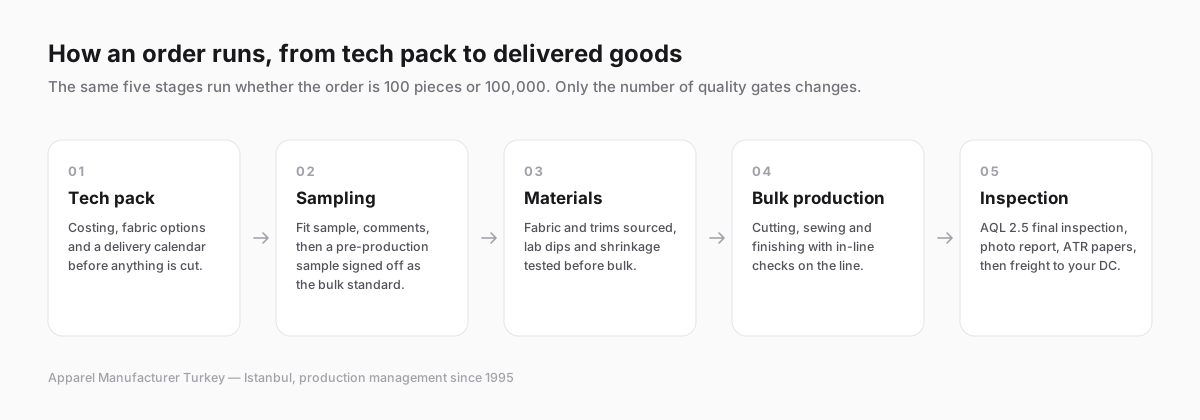
Whichever category you fall into, the mechanics of buying well in Turkey are consistent: vet factories in person or through a trusted partner, insist on audit reports and fabric certifications, sample before committing, book peak-season capacity early, and treat currency-driven price validity seriously. Done that way, Turkey offers one of the most responsive and complete garment sourcing platforms available anywhere.
Outlook: Where the Industry Is Heading
The forces reshaping global sourcing mostly favour Turkey's model. Near-shoring and risk diversification push European buyers toward closer suppliers; fast, small-batch retail models need exactly the speed and flexibility Turkish factories sell; and tightening EU sustainability regulation rewards suppliers inside Europe's regulatory orbit with short logistics and improving certification coverage. Investment in the lower-cost southeast is expanding capacity, and automation and digital product development are gradually lifting productivity.
The industry's own strategy is to keep moving up the value chain: more design contribution, more branded and collection business, more technical and sustainable product, rather than competing head-on with Asian labour costs. Success is not guaranteed, and cost pressure, macroeconomic swings and competition from other near-shore suppliers such as Egypt and North Africa are real. But Turkey's combination of a complete textile base, skilled labour and EU market access is structurally hard to replicate, and it underpins a reasonable expectation that the country remains a top-tier apparel supplier through the coming decade.
If you are researching Turkey as a production base and want to see how these industry dynamics translate into an actual order, our team in Istanbul is happy to share practical guidance from inside the market. A short conversation about your product and volumes will tell you quickly whether Turkey is the right fit; reach us at info@apparelmanufacturerturkey.com.
Turkish Garment Industry at a Glance
| Global position | Among the world's leading apparel exporters; major EU supplier |
|---|---|
| Export scale | Apparel exports in the tens of billions of dollars annually (indicative) |
| Core hub | Istanbul and the Marmara region |
| Fabric strongholds | Bursa knits, Denizli cotton, Corlu/Cerkezkoy finishing |
| Key advantage | Speed: 3-7 day road freight to the EU, duty-free with ATR |
| Main pressures | Labour costs vs Asia, currency volatility, peak-season capacity |
| Sustainability | OEKO-TEX and GOTS fabrics, BSCI/Sedex audits widespread in export tier |
Planning a production run?
Send your tech pack or reference photos — clear quote with MOQ, sampling cost and lead time within one business day.
Frequently asked questions
Related pages
Researching Turkey as a production base?
We are happy to answer questions about how the industry works in practice, with no obligation. If you would like a practical view on whether your product fits Turkish production, write to info@apparelmanufacturerturkey.com.