Washed T-Shirt Manufacturer
Washed tees are sewn first and dyed or washed as finished garments, which is what creates the faded seams, soft hand and lived-in colour the look depends on. We manage garment-dye and wash programmes through vetted Turkish factories and dyehouses, from 100 pieces per style.
- Processes
- Garment dye, enzyme, pigment washes
- MOQ
- 100 pcs / style
- Sampling
- 1-2 weeks + wash trials
- Bulk production
- 5-8 weeks incl. wash
Reviewed and updated 2026-08-02 by the Apparel Manufacturer Turkey production team in Istanbul, managing apparel production since 1995.
Quick answer
Washed t-shirts are sewn first and then garment dyed or washed in Turkey, using enzyme and pigment processes on 200-280 GSM PFD cotton jersey to create faded seams and a lived-in hand. Apparel Manufacturer Turkey runs wash trials during 1-2 week sampling; MOQ is 100 pieces per style, with bulk taking 5-8 weeks including washing.
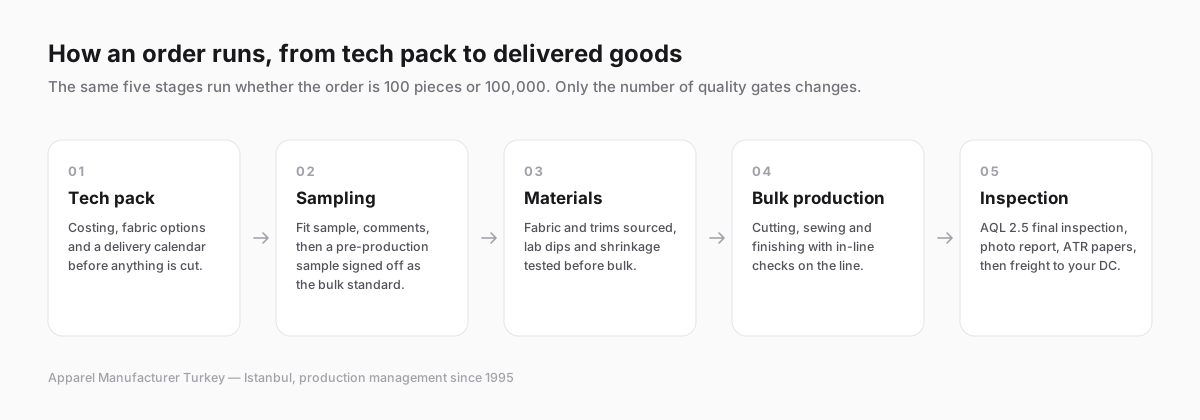
How a washed tee is actually made
A washed tee reverses the normal sequence. Instead of cutting coloured fabric, the garment is sewn from prepared-for-dye (PFD) fabric in greige or optic white, then dyed and washed as a complete garment in rotary machines. Because dye reaches seams, collars and stitching all at once, you get the tonal seam contrast, subtle mottling and relaxed hand that piece-dyed tees cannot imitate.
The base fabric has to be engineered for this: 100 percent cotton, sewn with cotton or dye-compatible thread if you want tonal seams, or polyester thread if you want contrast stitching that resists the dye. Trims, labels and tapes are all chosen for how they behave in the dye bath. This is why a washed programme is specified differently from day one, not converted at the end.
Pigment vs reactive dye: the defining choice
Reactive dye bonds chemically with the cotton fibre. It gives deep, saturated, wash-fast colour with good consistency, and a cleaner, more uniform surface. Choose reactive when you want rich colour with a garment-dyed hand but predictable shade matching across reorders.
Pigment dye does not bond with the fibre; it sits on the surface fixed by a binder. That surface position is the point: pigment-dyed tees fade at seams, edges and high-abrasion points from the first wash, developing the vintage character that defines the washed-tee category. The trade-offs are lower rub-fastness, more piece-to-piece variation and wider shade tolerances, all of which we manage with agreed shade bands rather than pretending they do not exist.
- Reactive: deep bonded colour, high fastness, consistent shades, subtle wash character
- Pigment: surface colour, strong seam fading, true vintage look, wider tolerances
- Both can be combined with enzyme washes for extra softness and surface cleanup
Shrinkage control in garment-dyed programmes
Garment dyeing shrinks cotton, typically 5-10 percent depending on fabric and process, and the shrinkage is part of the finish, it is what relaxes the fabric. The professional answer is not to avoid it but to cut for it: patterns are graded up by tested shrinkage factors so the after-wash garment lands on your spec. We run wash trials on the actual production fabric during sampling, measure length and width shrinkage separately (they differ), and bake those factors into the cutting patterns.
This is also why the pre-production sample for a washed programme goes through the full dye and wash process, not just a fit check on raw fabric. You approve the finished, shrunk, softened garment, the thing your customer will receive, and bulk is cut to reproduce it.
Weights, minimums and honest timelines
Washed tees work across weights, but the look lands best on 200-280 GSM bodies; heavier fabric shows richer pigment fading at seams and survives aggressive washes better. MOQ is 100 pieces per style, which you may split across colourways; note that in garment dyeing a colourway is a dye batch, so consolidated colour plans price better than many small shades.
Cost drivers are the dye route (pigment processes with multiple wash cycles cost more than a single reactive dye), the wash recipe complexity, and higher reject allowances than piece-dyed programmes, garment dye is harder on seams and shading, and we inspect accordingly. On timing, be realistic: sampling 1-2 weeks plus wash trials, bulk 4-6 weeks of cut-and-sew plus 1-2 weeks in the dyehouse, so plan 5-8 weeks for bulk overall, then 3-7 days road freight to the EU.
Washed t-shirt programme summary
| Base fabric | PFD cotton jersey, 200-280 GSM recommended |
|---|---|
| Dye routes | Reactive or pigment garment dye |
| Wash options | Enzyme, softener, tinting, light stone |
| Shrinkage | Measured in trials, compensated in patterns |
| Thread | Cotton for tonal seams, polyester for contrast |
| MOQ | 100 pcs per style / dye batch |
| Bulk lead time | 5-8 weeks including dye and wash |
Planning a production run?
Send your tech pack or reference photos — clear quote with MOQ, sampling cost and lead time within one business day.
How production works
Send your enquiry
Share tech packs, sketches or reference garments together with target quantities and delivery dates.
Technical review
We assess fabrics, construction and printing requirements and match your project to the right production line.
Quotation
You receive a clear offer covering unit price, sampling cost, MOQ and production timeline.
Sampling
Pre-production samples are made for fit, fabric and print approval before any bulk fabric is cut.
Approval
You confirm the approved sample, quantities per size and colourway, labelling and packaging.
Bulk production
Cutting, sewing, printing, embroidery and finishing run under a production plan you can follow.
Quality control
Inline checks during production plus AQL final inspection before cartons are sealed.
Shipping
Road freight to Europe in 3-7 days, air or sea worldwide, with export documentation handled for you.
Frequently asked questions
Related pages
Develop your wash
Send reference photos or garments to info@apparelmanufacturerturkey.com and we will propose a dye route, wash recipe and sampling plan with lab dips.